What are the two major control systems of the body?
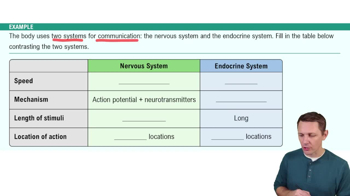
The endocrine system and the nervous system coordinate and integrate body cell activities.
How do endocrine and nervous systems differ in response speed and duration?
The nervous system initiates rapid, short-duration responses via action potentials, while the endocrine system initiates slower, long-duration responses via hormones.
What are hormones and how do they travel to target cells?
Hormones are chemical messengers secreted by endocrine glands that travel through the blood to reach target cells.
What distinguishes endocrine glands from exocrine glands?
Endocrine glands are ductless and secrete hormones directly into extracellular fluid; exocrine glands have ducts and secrete nonhormonal substances.
Name three types of chemical messengers and their range of action.
Hormones act over long distances via blood; autocrines affect the same cell that secretes them; paracrines affect neighboring cells locally.
What determines a hormone's mode of action?
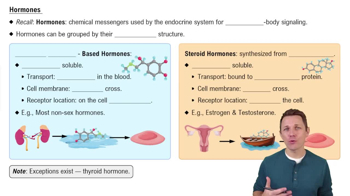
A hormone's chemical structure determines its solubility, transport in blood, receptor type, and degradation rate.
What are the two main classes of hormones based on chemical structure?
Amino acid–based hormones (water soluble) and steroid hormones (lipid soluble).
How do water-soluble hormones act on target cells?
They bind to plasma membrane receptors and use second messenger systems like cyclic AMP to alter cell activity.
How do lipid-soluble hormones act on target cells?
They diffuse through the plasma membrane, bind intracellular receptors, and directly activate gene transcription.
Describe the cyclic AMP (cAMP) second messenger mechanism.
Hormone binds receptor → activates G protein → activates adenylate cyclase → converts ATP to cAMP → cAMP activates protein kinases → cellular response.
What is the role of phospholipase C in hormone signaling?
Activated by G protein, it splits PIP2 into DAG and IP3; DAG activates protein kinases, IP3 releases Ca2+ as a second messenger.
What are the three types of stimuli that trigger hormone release?
Humoral stimuli (blood ion/nutrient levels), neural stimuli (nerve fibers), and hormonal stimuli (hormones stimulating other glands).
How does the nervous system modulate hormone release?
It can override endocrine controls by modifying stimulation or inhibition of glands, especially during stress.
What factors influence target cell activation by hormones?
Blood hormone levels, number of receptors on target cells, and receptor-hormone binding affinity.
What is up-regulation and down-regulation of hormone receptors?
Up-regulation is increasing receptor numbers in response to low hormone levels; down-regulation is decreasing receptors due to high hormone levels.
What is the half-life of a hormone?
The time required for the blood concentration of a hormone to decrease by half.
Compare lipid-soluble and water-soluble hormones in terms of transport and receptor location.
Lipid-soluble hormones bind plasma proteins and have intracellular receptors; water-soluble hormones circulate freely and bind plasma membrane receptors.
Define permissiveness, synergism, and antagonism in hormone interactions.
Permissiveness: one hormone needs another to act; synergism: combined hormones amplify effects; antagonism: one hormone opposes another.
How does the hypothalamus control the pituitary gland?
It releases hormones that regulate anterior pituitary secretion and produces neurohormones stored in the posterior pituitary.
What hormones are stored and released by the posterior pituitary?
Oxytocin and antidiuretic hormone (ADH), both produced by hypothalamic neurons.
What are the main functions of oxytocin?
Stimulates uterine contractions during childbirth and triggers milk ejection during breastfeeding.
What triggers ADH release and what are its effects?
High blood osmolarity triggers ADH release; it promotes water reabsorption in kidneys and causes vasoconstriction.
What are the six hormones secreted by the anterior pituitary?
 뒤로
뒤로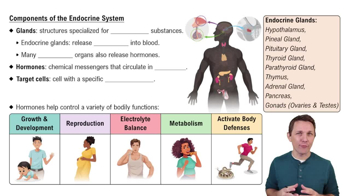
 7:06
7:06