Skip to main content
Anatomy & Physiology
나의 코스
배우기
시험 준비
AI 튜터
학습 가이드
교과서적 해결책
플래시카드
탐험해 보세요
앱을 사용해 보세요
나의 코스
배우기
시험 준비
AI 튜터
학습 가이드
교과서적 해결책
플래시카드
탐험해 보세요
앱을 사용해 보세요
뒤로
Endocrine System - Anatomy & Physiology
카드를 뒤집기 위해 탭할 수 있습니다.
Endocrine glands
카드를 뒤집기 위해 탭할 수 있습니다.
👆
Endocrine glands
Glands of internal secretion that release hormones into the blood or interstitial spaces without ducts.
진행 상황 추적
컨트롤 버튼이 '내비게이션' 모드로 변경되었습니다.
1/30
추천 영상
7:06
Components of the Endocrine System
13359
views
407
rank
6:20
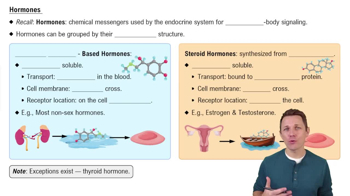
Hormones
10202
views
250
rank
3:33
Introduction to the Endocrine System Example 1
14560
views
416
rank
1
comments
이 집합의 용어 (30)
하이드의 정의
Endocrine glands
Glands of internal secretion that release hormones into the blood or interstitial spaces without ducts.
Hormone
A chemical messenger released into the blood to be transported throughout the body.
Difference between endocrine and exocrine glands
Endocrine glands secrete hormones into blood; exocrine glands secrete products into ducts.
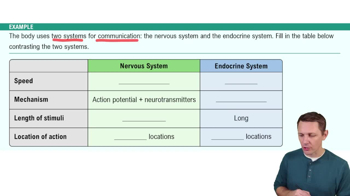
Nervous vs Endocrine system effects
Nervous system effects are rapid and brief; endocrine system effects are widespread and prolonged.
Four classes of hormones
Steroids, amines, peptides/proteins, and eicosanoids.
Permissive hormone effect
One hormone's effect requires prior or simultaneous exposure to another hormone.
Synergistic hormone effect
Two or more hormones complement each other and are needed for full effect.
Antagonistic hormone effect
One hormone's effect is opposed by another hormone.
Hypothalamus role in endocrine system
The true master gland integrating nervous and endocrine systems, controlling pituitary gland.
Anterior pituitary gland function
Secretes hormones regulating growth, reproduction, and metabolism.
Human Growth Hormone (HGH) effects
Stimulates body growth, protein synthesis, lipolysis, and decreases glucose use.
Thyroid-Stimulating Hormone (TSH)
Stimulates thyroid gland to secrete T3 and T4 hormones.
Follicle-Stimulating Hormone (FSH)
Stimulates ovarian follicle development and estrogen secretion in females; sperm production in males.
Luteinizing Hormone (LH)
Triggers ovulation and progesterone production in females; testosterone secretion in males.
Prolactin (PRL)
Initiates and maintains milk production in mammary glands.
Oxytocin functions
Stimulates uterine contractions during delivery and milk ejection after birth.
Antidiuretic Hormone (ADH)
Reduces urine output by promoting water reabsorption in kidneys and raises blood pressure.
Thyroid hormones actions
Regulate basal metabolic rate, oxygen use, protein synthesis, and growth.
Parathyroid Hormone (PTH)
Increases blood calcium by stimulating osteoclasts and enhancing calcium absorption.
Adrenal cortex zones and secretions
Zona glomerulosa: mineralocorticoids; zona fasciculata: glucocorticoids; zona reticularis: gonadocorticoids.
Aldosterone function
Stimulates sodium retention and potassium excretion to regulate water and electrolyte balance.
Glucocorticoids effects
Regulate metabolism, increase stress resistance, and have anti-inflammatory properties.
Adrenal medulla hormones
Secretes epinephrine and norepinephrine to increase heart rate, blood pressure, and blood flow.
Pancreatic islets hormone functions
Alpha cells secrete glucagon (raises blood sugar); beta cells secrete insulin (lowers blood sugar).
Diabetes mellitus types
Type I: insulin deficiency; Type II: insulin resistance, often in overweight adults.
Ovaries hormone functions
Produce estrogens and progesterone for female sexual characteristics and reproduction.
Testes hormone functions
Produce testosterone for sperm production and male sexual characteristics.
Pineal gland hormone
Melatonin, which regulates circadian rhythms and may influence seasonal affective disorder.
Thymus gland hormones
Thymosin and related hormones promote T cell maturation and immune function.
General Adaptation Syndrome (GAS)
Body's stress response with stages: alarm, resistance, and exhaustion.
 뒤로뒤로
뒤로뒤로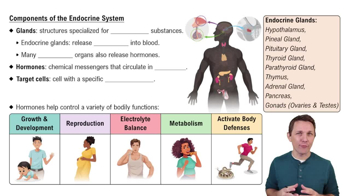
 7:06
7:06