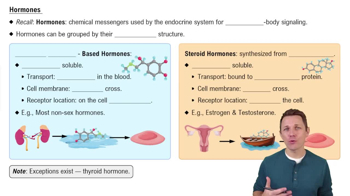
How does endocrine signaling maintain homeostasis?
Endocrine signaling maintains homeostasis using feedback mechanisms that regulate hormone levels and target cell responses.
What are features common to all endocrine organs/tissues?
Common features include hormone secretion into the bloodstream, lack of ducts, and regulation of distant target cells.
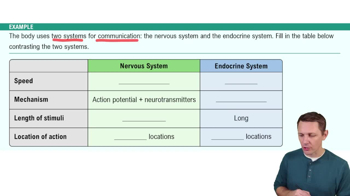
Compare endocrine signaling with nervous system signaling.
Endocrine signaling is slower, uses hormones in blood, and has longer-lasting effects; nervous system signaling is fast, uses electrical impulses, and has short-term effects.
What is the interaction between the endocrine system and the sympathetic autonomic nervous system (SANS)?
They overlap in stress responses; SANS triggers rapid responses while endocrine hormones sustain longer-term effects.
What determines hormone specificity on target cells?
Specificity is determined by the presence of specific receptors on target cells that bind particular hormones.
What should be known about hormone-secreting organs discussed in class?
Know the hormones they secrete, cell types involved, target tissues, and hormone actions.
What is the role of the hypothalamus in endocrine control?
The hypothalamus controls the pituitary gland and downstream endocrine organs, regulating hormone secretion.
What are the three types of stimuli regulating hormone secretion by endocrine cells?
Humoral stimuli, neural stimuli, and hormonal stimuli.
How is the response regulated by target cells?
Target cells regulate response by receptor availability, hormone degradation, and feedback mechanisms.
What is an example of antagonism between hormones?
 뒤로
뒤로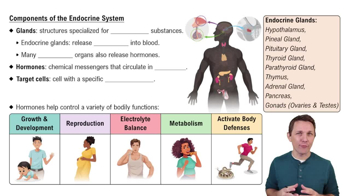
 7:06
7:06