What are the general functions of the endocrine system?
The endocrine system regulates body functions through hormones, controlling metabolism, growth, reproduction, and homeostasis.
What is a hormone?
A hormone is a chemical messenger secreted by endocrine glands that travels through the bloodstream to target cells to regulate physiological processes.
What defines a target cell in the endocrine system?
A target cell has specific receptors for a hormone; when the hormone binds, it triggers a cellular response.
How do hormones control the correct cells?
Hormones control correct cells by binding only to cells with specific receptors for that hormone.
What is receptor distribution and its significance?
Receptor distribution means not all cells have the same hormone receptors, allowing hormones to affect only specific cells.
What is up-regulation of hormone receptors?
Up-regulation is the increase in receptor number on a cell, making it more sensitive to a hormone.
What is down-regulation of hormone receptors?
Down-regulation is the decrease in receptor number on a cell, reducing its sensitivity to a hormone.
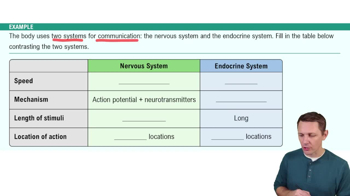
Compare the nervous and endocrine systems in chemical messengers and target delivery.
Nervous system uses neurotransmitters released at synapses; endocrine system uses hormones released into blood to reach distant targets.
Compare the time required for nervous vs. endocrine system effects.
Nervous system effects are rapid and short-lived; endocrine system effects are slower to start but longer lasting.
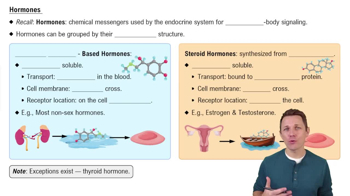
What are the two main chemical classes of hormones?
Amino acid-based hormones (hydrophilic except thyroid hormone) and steroid hormones (hydrophobic, derived from cholesterol).
Where are receptors for hydrophilic vs. hydrophobic hormones located?
Hydrophilic hormone receptors are on the cell membrane; hydrophobic hormone receptors are inside the cell, often in the nucleus.
Why can't most amino acid-based hormones enter target cells?
Because they are hydrophilic and cannot cross the lipid plasma membrane, they bind to surface receptors.
What is signal transduction in hormone action?
Signal transduction is the process by which a hormone binding to a receptor triggers a cascade of intracellular events leading to a response.
Describe kinase receptors and their role.
Kinase receptors are membrane proteins that phosphorylate enzymes when a hormone binds, activating intracellular signaling pathways.
What is the second messenger mechanism in hormone action?
Hormone binding activates a membrane receptor that produces a second messenger (e.g., cAMP) inside the cell to amplify the signal.
In the cAMP second messenger system, what enzyme produces cAMP?
Adenylyl cyclase is the membrane-bound enzyme that converts ATP to cAMP.
What is the function of protein kinases in hormone signaling?
Protein kinases phosphorylate proteins to alter their activity, mediating the cellular response to hormones.
How are hydrophobic hormones able to affect target cells?
They diffuse through the plasma membrane, bind intracellular receptors, and directly activate gene transcription.
Where does signal amplification occur in hormone action?
Amplification occurs at the target cell, where one hormone molecule can trigger the production of many second messengers.
What is negative feedback in hormone secretion control?
Negative feedback reduces hormone secretion when blood hormone levels are high to maintain homeostasis.
Give an example of neural control of hormone secretion.
Neural control involves nerve signals stimulating hormone release, such as the milk let-down reflex triggered by oxytocin.
What is the body's main biological clock and its role in hormone rhythms?
The suprachiasmatic nucleus in the hypothalamus controls circadian rhythms, regulating 24-hour hormone release cycles.
Define permissiveness in hormone interactions.
Permissiveness occurs when one hormone enhances the effect of another hormone.
Define antagonism in hormone interactions.
Antagonism occurs when one hormone opposes or inhibits the action of another hormone.
How are hydrophobic hormones transported in the blood?
They bind to transport proteins, which carry them through the bloodstream.
What is hyposecretion and hypersecretion of hormones?
Hyposecretion is insufficient hormone secretion; hypersecretion is excessive hormone secretion.
What is the difference between primary and secondary hormone disorders?
Primary disorders originate in the endocrine gland; secondary disorders result from problems outside the gland, such as pituitary dysfunction.
How does receptor number affect hormone function?
Changes in receptor number alter cell sensitivity, affecting the magnitude of the hormone's effect.
 뒤로
뒤로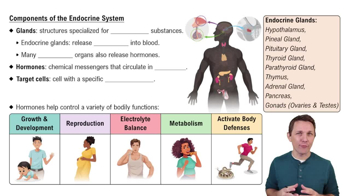
 7:06
7:06