Cells are the smallest living units in the human body (eukaryotic cells) and the building blocks of all organisms.
What is the function of the plasma membrane?
The plasma membrane forms the outer boundary of a cell, allowing selective transport of substances and separating intracellular and extracellular fluids.
What are the major components of the plasma membrane?
Phospholipids and cholesterol are major components; phospholipids form a bilayer with hydrophilic heads and hydrophobic tails.
What role does cholesterol play in the plasma membrane?
Cholesterol stiffens the plasma membrane, making it less fluid and less permeable.
What are integral and peripheral proteins in the plasma membrane?
Integral proteins are embedded in the membrane; transmembrane proteins span the membrane. Peripheral proteins are bound to the membrane surface.
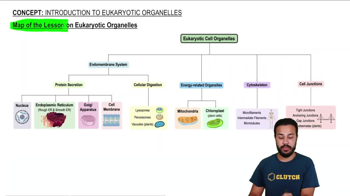
What are the three major parts of the cytoplasm?
Cytosol (intracellular fluid), organelles (internal structures with specific functions), and inclusions (insoluble materials like glycogen granules).
What distinguishes nonmembranous from membranous organelles?
Nonmembranous organelles lack membranes and contact cytosol directly; membranous organelles are enclosed by phospholipid membranes.
Name three types of cytoskeletal fibers.
Microfilaments, intermediate filaments, and microtubules.
What are the functions of microfilaments?
Provide mechanical strength, attach plasma membrane to cytoplasm, and determine cytosol consistency.
What is the role of intermediate filaments?
Strengthen the cell, maintain cell shape, and stabilize organelle positions.
Describe microtubules and their functions.
Largest cytoskeletal fibers; hollow tubes of tubulin that maintain cell shape, anchor organelles, assist in movement, and form spindle apparatus.
What is the centrosome and its function?
A cytoplasmic region near the nucleus that organizes microtubules; contains centrioles that form the spindle apparatus during cell division.
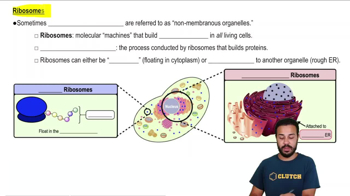
What are ribosomes and their function?
Organelles composed of rRNA and proteins that synthesize proteins; can be free in cytoplasm or fixed on rough ER.
What are the two types of endoplasmic reticulum (ER)?
Smooth ER (SER) lacks ribosomes and synthesizes lipids; Rough ER (RER) has ribosomes and synthesizes and modifies proteins.
What are the main functions of the Golgi apparatus?
Modifies and packages secretions, further modifies proteins, and packages digestive enzymes into lysosomes.
What are lysosomes and their functions?
Vesicles with digestive enzymes that hydrolyze polymers, recycle organelles, destroy bacteria, and perform autolysis.
What is the function of mitochondria?
Produce energy in the form of ATP; number varies by cell type according to energy demand.
What are the main functions of the nucleus?
Stores genetic information (DNA), controls protein synthesis, and determines cell structure and function.
What is the nuclear envelope and nuclear pores?
Double membrane surrounding the nucleus; nuclear pores allow regulated exchange of RNA and proteins between nucleus and cytoplasm.
What is the nucleolus and its role?
Nuclear organelle that synthesizes rRNA and assembles ribosomal subunits.
What is the Central Dogma of Molecular Biology?
DNA is transcribed into mRNA, which is then translated into a protein.
What is transcription?
Synthesis of RNA from a DNA template, occurring in the nucleus.
What is translation?
Synthesis of a polypeptide from an mRNA template at the ribosome.
What is diffusion?
Passive movement of substances from higher to lower concentration down their concentration gradient.
What is osmosis?
Net diffusion of water across a selectively permeable membrane toward higher solute concentration.
 뒤로
뒤로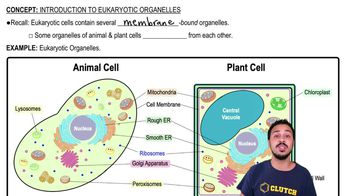
 03:45
03:45