What are the three main functions of the nervous system?
Sensory input, integration, and motor output.
What are the two principal parts of the nervous system?
Central nervous system (CNS) and Peripheral nervous system (PNS).
What structures make up the CNS?
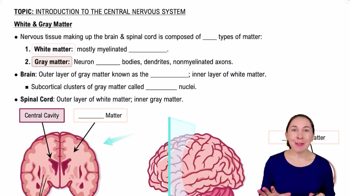
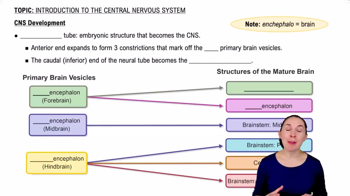
The brain and spinal cord located in the dorsal body cavity.
What is the main role of the PNS?
Consists mainly of nerves extending from the brain and spinal cord, connecting the CNS to limbs and organs.
What are the two functional divisions of the PNS?
Sensory (afferent) division and Motor (efferent) division.
What does the sensory (afferent) division do?
Conveys impulses from sensory receptors to the CNS.
What are the two subdivisions of the motor (efferent) division?
Somatic nervous system (voluntary control of skeletal muscles) and autonomic nervous system (involuntary control of smooth muscle, cardiac muscle, and glands).
What are the two functional subdivisions of the autonomic nervous system (ANS)?
Sympathetic division (mobilizes body systems during activity) and parasympathetic division (conserves energy during rest).
What is a neuron?
A large, highly specialized cell that conducts electrical impulses; the structural unit of the nervous system.
What are the special characteristics of neurons?
Extreme longevity, amitotic (cannot divide), and high metabolic rate requiring continuous oxygen and glucose.
What is contained in the neuron cell body (soma)?
Spherical nucleus with nucleolus, cytoplasm, free ribosomes, Golgi apparatus, and rough ER (Nissl bodies).
What are dendrites?
Short, tapering, branched processes that receive signals and convey them toward the cell body.
What is the axon hillock?
Cone-shaped area where the axon originates from the cell body.
What is the function of the axon?
Conducts nerve impulses away from the cell body to axon terminals.
What are axon terminals?
Knob-like distal endings of axons that release neurotransmitters.
What is the difference between tracts and nerves?
Tracts are bundles of axons in the CNS; nerves are bundles of axons in the PNS.
What is an action potential?
A brief reversal of membrane potential that transmits electrical signals over long distances without decay.
What happens during the resting state of an action potential?
All voltage-gated Na+ and K+ channels are closed; only leakage channels are open.
What ion movement causes depolarization during an action potential?
Voltage-gated Na+ channels open, allowing Na+ to enter the cell.
What occurs at the threshold during an action potential?
Positive feedback opens all voltage-gated Na+ channels, causing a large spike in membrane potential.
What happens during repolarization?
Voltage-gated Na+ channels inactivate and K+ channels open, allowing K+ to exit the cell.
What is hyperpolarization?
A phase where the membrane potential becomes more negative than the resting potential due to K+ channels remaining open.
 뒤로
뒤로
 0:50
0:50