 뒤로
뒤로Histology: Tissue Types in Anatomy & Physiology
 03:32
03:32
이 집합의 용어 (20)
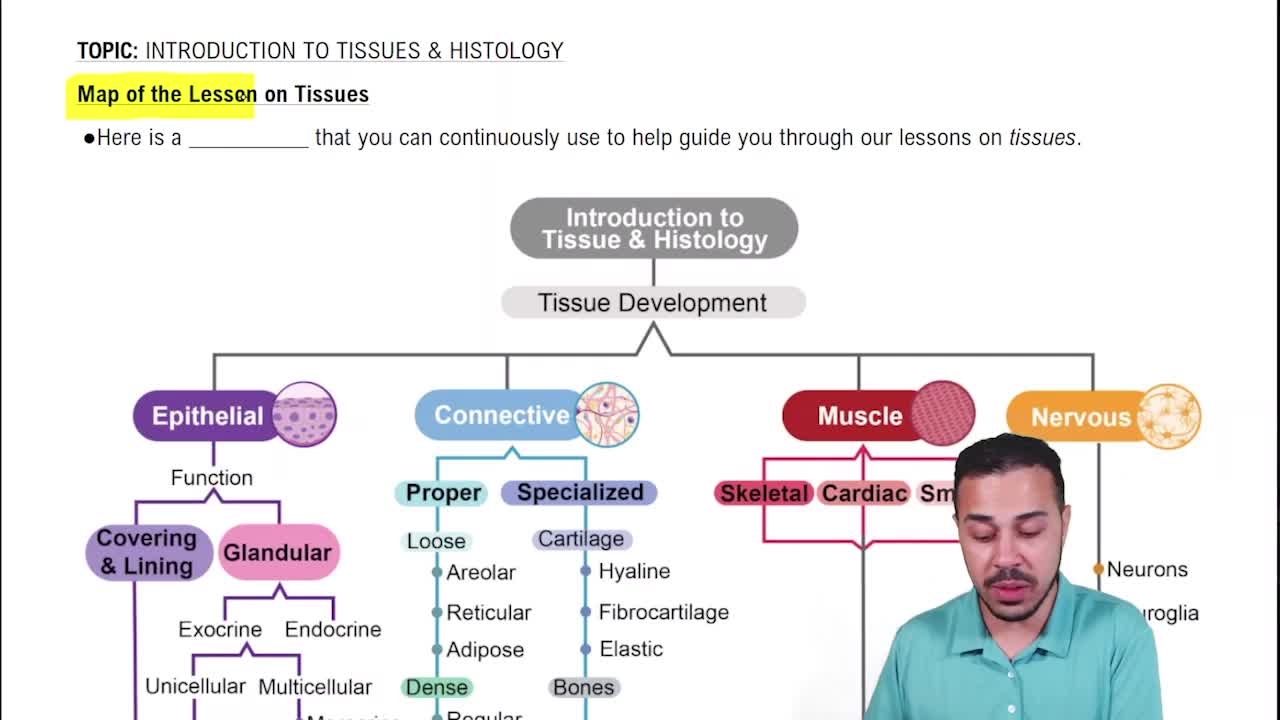
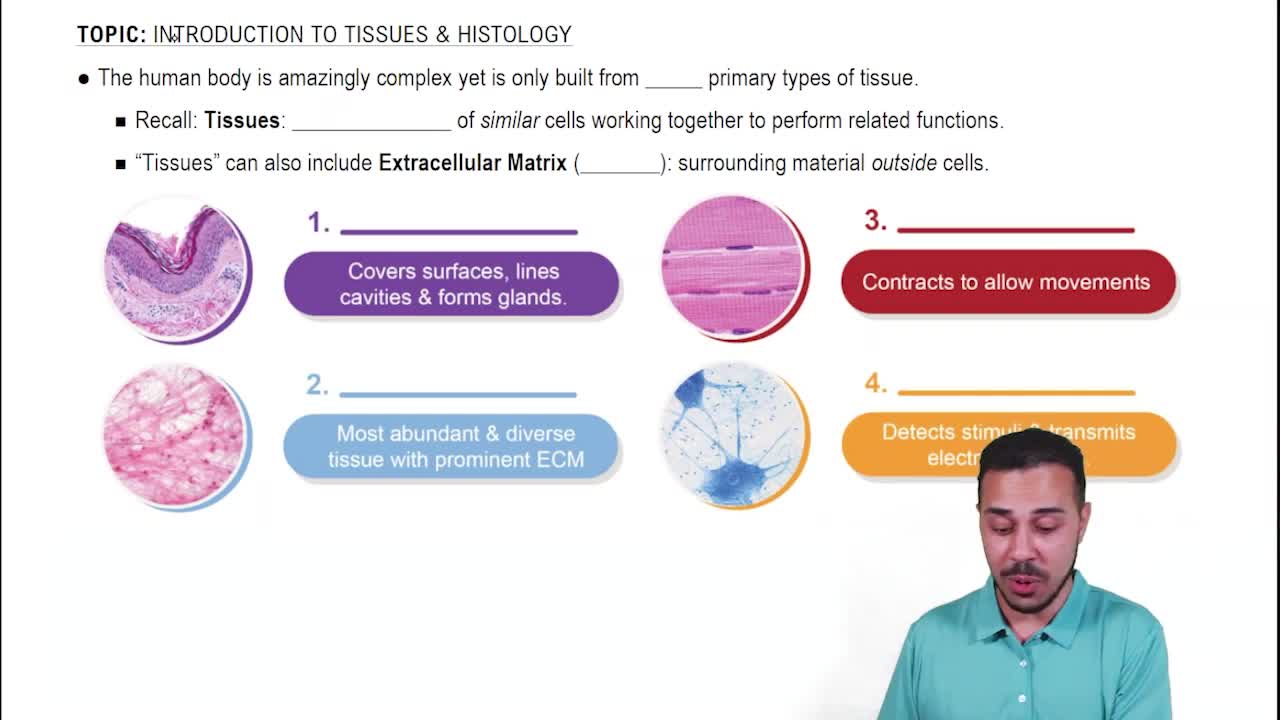
Epithelial tissue, connective tissue, muscle tissue, and nervous tissue.
To cover body surfaces, line cavities, and form glands for protection, absorption, secretion, and filtration.
Closely packed cells, polarity (apical and basal surfaces), avascularity, and high regeneration capacity.
It has abundant extracellular matrix and connects, supports, or binds other tissues.
Cells, fibers (collagen, elastic, reticular), and ground substance (fluid or solid matrix).
Skeletal muscle, cardiac muscle, and smooth muscle.
Voluntary, striated muscle attached to bones for movement.
Involuntary, striated muscle found only in the heart with intercalated discs for synchronized contraction.
In walls of hollow organs; it is involuntary and controls slow, sustained contractions.
To transmit electrical signals for communication and control within the body.
Neurons (signal transmitters) and neuroglia (support cells).
Provides structural support and mediates biochemical interactions between cells.
By diffusion from underlying connective tissue.
Adipose tissue.
Simplified squamous epithelial tissue.
To form a supportive network in soft organs like lymph nodes and the spleen.
Its striated appearance due to organized sarcomeres.
Via electrical impulses along axons and chemical signals at synapses.
Cuboidal and columnar epithelial tissues.
To provide elasticity and allow tissues to stretch and recoil.