What are the main components of the lymphatic system?
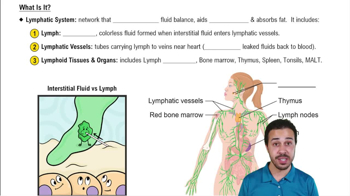
The lymphatic system consists of lymph, lymphatic vessels, lymphoid tissues, lymphoid organs, and lymphoid cells.
What is lymph and where is it found?
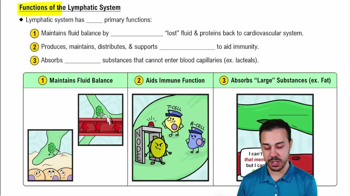
Lymph is a fluid similar to plasma but without plasma proteins, found in lymphatic vessels, drained from interstitial spaces.
What are lacteals and their function?
Lacteals are special lymphatic vessels in the small intestine that absorb dietary lipids and transport them to the bloodstream.
Where are lymphocytes produced and activated?
Lymphocytes are produced in primary lymphoid organs (red bone marrow and thymus) and activated in secondary lymphoid organs (tonsils, MALT, lymph nodes, spleen).
Describe the flow of lymph through a lymph node.
Lymph enters through afferent lymphatic vessels, flows into the sub-capsular sinus, moves through cortical and medullary sinuses, and exits via efferent lymphatic vessels at the hilum.
What is the function of lymph nodes?
Lymph nodes purify lymph by removing 99% of antigens, stimulate immune cells, and monitor peripheral infections to protect vital organs.
What are the primary functions of the spleen?
The spleen removes abnormal blood cells by phagocytosis, stores recycled iron, and initiates immune responses by B and T cells to blood-borne antigens.
Differentiate between innate and adaptive immunity.
Innate immunity is nonspecific and always active against any pathogen. Adaptive immunity is specific, develops after exposure, and depends on lymphocyte activity.
List the main components of innate (nonspecific) defenses.
Innate defenses include physical barriers, phagocytes, immune surveillance by NK cells, interferons, complement system, inflammation, and fever.
What role do natural killer (NK) cells play in immune surveillance?
NK cells identify and destroy abnormal cells by releasing perforins that form pores in target cell membranes, causing lysis.
How do interferons protect against viral infections?
Interferons are proteins released by infected cells that stimulate neighboring cells to produce antiviral proteins, blocking viral replication.
Describe the complement system and its activation pathways.
The complement system is a group of plasma proteins that assist antibodies in destroying pathogens. Activation occurs via classical, alternative, and lectin pathways.
What are the effects of complement activation?
Complement activation leads to pore formation (cell lysis), enhanced phagocytosis (opsonization), histamine release (inflammation), and activation of adaptive defenses.
What are the cardinal signs of inflammation?
The cardinal signs of inflammation are redness, swelling, heat, and pain.
What are the main functions of inflammation?
Inflammation temporarily repairs injury, prevents pathogen entry, slows pathogen spread, and mobilizes defenses to facilitate tissue repair.
Define fever and its role in immunity.
Fever is an elevated body temperature that increases metabolic rate, accelerates immune defenses, and inhibits some viruses and bacteria.
What are the four properties of adaptive immunity?
Adaptive immunity has specificity, versatility, memory, and tolerance to self-antigens.
What are the primary types of T cells and their functions?
T cells include cytotoxic (CD8) cells that destroy infected cells, helper (CD4) cells that stimulate immune responses, regulatory cells that moderate immunity, and memory cells.
How do cytotoxic T cells destroy target cells?
Cytotoxic T cells release perforins to lyse membranes, secrete cytokines to induce apoptosis, or release lymphotoxins to disrupt cell metabolism.
Describe the process of B cell activation and antibody production.
B cells bind antigens, process and present them on class II MHC proteins, receive helper T cell cytokine signals, then differentiate into plasma cells that secrete antibodies and memory B cells.
What are the five major classes of antibodies and their roles?
IgG (most abundant, crosses placenta), IgE (allergic responses), IgD (B cell receptor), IgM (first antibody produced), and IgA (found in secretions, protects mucosa).
Explain the difference between primary and secondary antibody responses.
Primary response is slower, with initial IgM production followed by IgG. Secondary response is faster, stronger, and mainly IgG due to memory B cells.
What is immunocompetence?
Immunocompetence is the ability of lymphocytes to produce an immune response after exposure to an antigen.
How does the immune system develop before and after birth?
Fetus produces immune cells by 3-4 months; maternal IgG crosses placenta for passive immunity; after birth, IgA in breast milk provides passive immunity while infant develops active immunity.
 뒤로
뒤로
 3:32
3:32