 뒤로
뒤로Metabolism and Energy Balance in Anatomy & Physiology
 02:17
02:17
이 집합의 용어 (34)
Fats are digested into fatty acids and monoglycerides, carbohydrates into monosaccharides, and proteins into amino acids before absorption.
Carbohydrates and proteins are absorbed by intestinal cells via active transport and facilitated diffusion using specific transport proteins.
Fats are absorbed by intestinal cells as micelles, then reassembled into triglycerides and packaged into chylomicrons for transport.
The lacteal, a lymphatic vessel in the intestinal villus, specifically absorbs digested fats as chylomicrons.
Carbohydrates and proteins are used for energy or synthesis; fats are stored as energy reserves or used for energy.
Fats are primarily used by the body to store excess calories as triglycerides in adipose tissue.
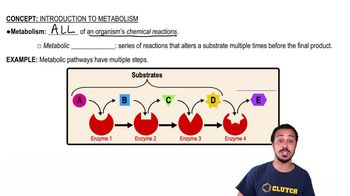
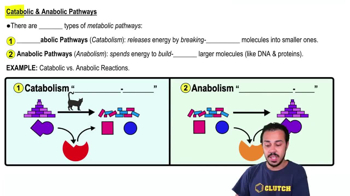
Anabolic reactions build complex molecules from simpler ones; catabolic reactions break down molecules to release energy.
Anabolic: protein synthesis, glycogen formation. Catabolic: glycolysis, lipolysis.
Glucose, fatty acids, and amino acids are used; they enter aerobic respiration via glycolysis, beta-oxidation, and deamination respectively.
The mitochondrion is responsible for most ATP production through aerobic respiration.
Glycolysis occurs in the cytoplasm, TCA cycle and ETC occur in the mitochondria.
Input: glucose; Output: 2 pyruvate, 2 ATP, 2 NADH.
Input: acetyl-CoA; Output: CO2, NADH, FADH2, 2 ATP (GTP equivalent).
Input: NADH, FADH2; Output: water, ~28-34 ATP via oxidative phosphorylation.
ATP synthase uses the proton gradient across the inner mitochondrial membrane to drive phosphorylation of ADP to ATP.
Each NADH produces about 3 ATP, each FADH2 produces about 2 ATP in the ETC.
Beta-oxidation breaks down fatty acids into acetyl-CoA units, yielding more ATP because fats have more carbon-hydrogen bonds.
Vitamins A, D, E, and K are fat-soluble and stored in body fat.
Vitamins B-complex and C are water-soluble and not stored extensively in the body.
Vitamins act as coenzymes or antioxidants essential for metabolism and cellular function.
Minerals support enzyme function, nerve transmission, muscle contraction, and structural roles like bone formation.
Lipoproteins are complexes that transport lipids in the blood, consisting of lipids and proteins.
HDL transports cholesterol from tissues to liver; LDL delivers cholesterol from liver to tissues.
Cholesterol in HDL is taken to the liver for excretion; cholesterol in LDL is used by tissues or can deposit in arteries.
Lipoprotein lipase breaks down triglycerides in lipoproteins, releasing fatty acids for tissue energy use.
The hypothalamus contains hunger and satiety centers regulating food intake.
High blood glucose and amino acids suppress hunger; low levels stimulate hunger centers.
Insulin, leptin, CCK, and PPY suppress hunger; ghrelin and neuropeptide Y stimulate hunger; glucagon supports glucose regulation.
Metabolic rate is the rate at which the body uses energy to maintain life processes.
Direct calorimetry measures heat production; indirect calorimetry measures oxygen consumption.
BMR is the energy expenditure at rest, fasting, and thermoneutral conditions.
Age decreases BMR; thyroid hormones increase BMR; muscle mass and body temperature also influence BMR.
TMR includes BMR plus energy used for physical activity and digestion; BMR is the baseline energy use.
Absorptive state: nutrients absorbed, insulin dominant. Postabsorptive state: fasting, glucagon dominant, energy from stores.