Skip to main content
Anatomy & Physiology
나의 코스
배우기
시험 준비
AI 튜터
학습 가이드
교과서적 해결책
플래시카드
탐험해 보세요
앱을 사용해 보세요
나의 코스
배우기
시험 준비
AI 튜터
학습 가이드
교과서적 해결책
플래시카드
탐험해 보세요
앱을 사용해 보세요
뒤로
Muscular System Anatomy & Physiology
카드를 뒤집기 위해 탭할 수 있습니다.
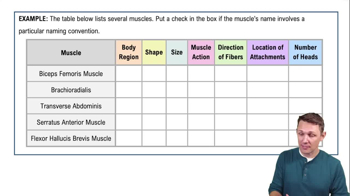
Criteria for naming muscles
카드를 뒤집기 위해 탭할 수 있습니다.
👆
Criteria for naming muscles
Shape
,
function
,
attachment
,
region
,
alignment
,
number of origins
, and
size
.
진행 상황 추적
컨트롤 버튼이 '내비게이션' 모드로 변경되었습니다.
1/21
추천 영상
4:43
Muscle Naming
8637
views
160
rank
4:32
Muscle Naming Example 1
6331
views
126
rank
2
comments
이 집합의 용어 (21)
하이드의 정의
Criteria for naming muscles
Shape
,
function
,
attachment
,
region
,
alignment
,
number of origins
, and
size
.
Seven fascicle arrangements
Muscle fascicles can be arranged as
circular
,
convergent
,
parallel
,
unipennate
,
bipennate
,
multipennate
, and
fusiform
.
Prime mover (agonist)
The muscle that provides most of the energy needed for a specific movement.
Antagonist muscle
The muscle that resists the movement driven by the prime mover.
Synergist muscle
Muscle that offers additional force to assist the prime mover during a movement.
Fixator muscle
Muscle that stabilizes the origin of the prime mover to prevent undesirable movements.
Muscle shape: Circular example
Orbicularis oris muscle, which encircles the mouth.
Muscle shape: Convergent example
Pectoralis major, with fascicles converging toward a single tendon.
Muscle shape: Parallel example
Sartorius muscle, with fascicles running parallel to the long axis.
Muscle shape: Fusiform example
Biceps brachii, spindle-shaped with a thick belly.
Muscle shape: Unipennate example
Extensor digitorum longus, with fascicles on one side of the tendon.
Muscle shape: Bipennate example
Rectus femoris, with fascicles on both sides of a central tendon.
Muscle shape: Multipennate example
Deltoid muscle, with fascicles attaching obliquely from many directions.
Major muscles of the face
Includes
frontalis
,
orbicularis oculi
,
zygomaticus
,
masseter
, and
orbicularis oris
.
Muscles of the anterior arm
Includes
biceps brachii
,
brachialis
, and
brachioradialis
.
Muscles of the posterior arm
Includes
triceps brachii
with long, lateral, and medial heads.
Muscles of the anterior thigh
Includes
quadriceps femoris
group: vastus lateralis, vastus medialis, vastus intermedius, and rectus femoris.
Muscles of the posterior thigh (hamstrings)
Includes
biceps femoris
,
semitendinosus
, and
semimembranosus
.
Muscles of the anterior leg
Includes
tibialis anterior
,
extensor digitorum longus
, and
fibularis tertius
.
Muscles of the posterior leg
Includes
gastrocnemius
,
soleus
, and
plantaris
.
Muscles of the abdominal wall
Includes
rectus abdominis
,
external oblique
,
internal oblique
, and
transversus abdominis
.
 뒤로뒤로
뒤로뒤로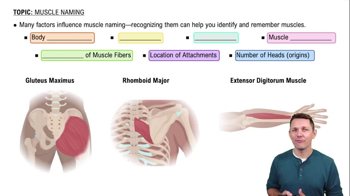
 4:43
4:43