Skip to main content
Anatomy & Physiology
나의 코스
배우기
시험 준비
AI 튜터
학습 가이드
교과서적 해결책
플래시카드
탐험해 보세요
앱을 사용해 보세요
나의 코스
배우기
시험 준비
AI 튜터
학습 가이드
교과서적 해결책
플래시카드
탐험해 보세요
앱을 사용해 보세요
뒤로
Muscular System - Anatomy & Physiology Exam III Study Guide
카드를 뒤집기 위해 탭할 수 있습니다.
Four characteristics of muscle tissue
카드를 뒤집기 위해 탭할 수 있습니다.
👆
Four characteristics of muscle tissue
Excitability
,
contractility
,
extensibility
, and
elasticity
진행 상황 추적
컨트롤 버튼이 '내비게이션' 모드로 변경되었습니다.
1/29
추천 영상
5:47
B. Excitation-Contraction Coupling
10201
views
235
rank
2
comments
7:39
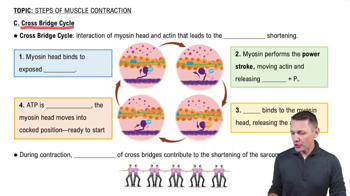
C. Cross Bridge Cycle
9599
views
198
rank
2
comments
3:26
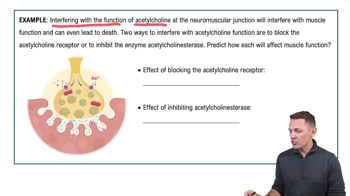
Steps of Muscle Contraction Example 3
8818
views
172
rank
이 집합의 용어 (29)
하이드의 정의
Four characteristics of muscle tissue
Excitability
,
contractility
,
extensibility
, and
elasticity
Functions of muscles
Movement, posture maintenance, joint stabilization, and heat generation
Connective tissue sheaths in muscle anatomy
Epimysium
surrounds the whole muscle,
perimysium
surrounds fascicles,
endomysium
surrounds individual muscle fibers
Difference between tendons and aponeurosis
Tendons are cord-like structures connecting muscle to bone; aponeurosis is a broad, flat sheet of connective tissue
Sarcolemma and sarcoplasm
Sarcolemma is the muscle fiber plasma membrane; sarcoplasm is the cytoplasm inside the muscle fiber
Role of sarcoplasmic reticulum in muscle contraction
Stores and releases calcium ions needed to trigger contraction
Function of T-tubules
Transmit action potentials deep into the muscle fiber to trigger calcium release
Myofilaments in muscle fibers
Actin
(thin filaments) and
myosin
(thick filaments) responsible for contraction
Sarcomere structure components
Z discs mark sarcomere boundaries, M line is center of thick filaments, I band contains thin filaments only, A band contains thick filaments
Role of troponin and tropomyosin during contraction
Troponin binds calcium to move tropomyosin off actin binding sites, allowing myosin to bind
Triad in muscle fibers
Two terminal cisterns of sarcoplasmic reticulum and one T-tubule between them
Sliding filament model of contraction
Actin filaments slide over myosin filaments, shortening the sarcomere and contracting the muscle
Neuromuscular junction components
Axon terminals release acetylcholine into synaptic cleft, which binds receptors on junctional folds of sarcolemma
Events at neuromuscular junction during contraction
Acetylcholine release, binding to receptors, depolarization of sarcolemma, triggering muscle excitation
Excitation-contraction coupling
Process linking muscle fiber excitation to calcium release and contraction initiation
Cross bridge cycle
Myosin heads attach to actin, pivot, detach, and re-cock to pull thin filaments
Myasthenia gravis
Autoimmune disease causing weakness by blocking acetylcholine receptors at neuromuscular junction
Difference between depolarization and repolarization
Depolarization is membrane potential becoming more positive; repolarization is returning to resting negative potential
Refractory period in muscle fibers
Time during which muscle fiber cannot be re-excited after an action potential
Isotonic vs isometric contraction
Isotonic changes muscle length with movement; isometric generates force without changing length
Motor unit
One motor neuron and all the muscle fibers it innervates
Muscle twitch phases
Latent period, period of contraction, and period of relaxation
Temporal summation and tetanus
Multiple stimuli increase contraction strength; incomplete tetanus has partial relaxation, complete tetanus has none
Muscle response to stimulus strength
Recruitment activates more motor units to increase contraction force
Muscle tone
Continuous, passive partial contraction of muscles for posture and readiness
ATP functions in muscle contraction
Provides energy for cross bridge cycling, calcium pumping, and direct phosphorylation
Energy pathways for ATP production in muscle
Direct phosphorylation, anaerobic glycolysis, and aerobic respiration
Muscle groups roles: prime mover, antagonist, synergist
Prime mover causes main action, antagonist opposes it, synergist assists the prime mover
How muscles are named
Based on location, shape, number of origins, fascicle direction, attachments, or action
 뒤로뒤로
뒤로뒤로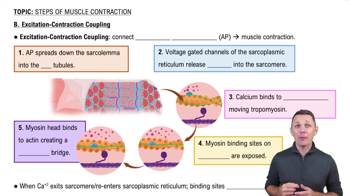
 5:47
5:47