 뒤로
뒤로Muscular System - Anatomy & Physiology
 6:31
6:31
이 집합의 용어 (25)
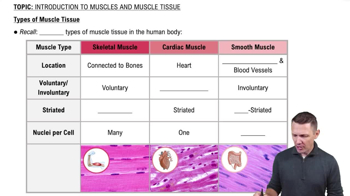
Skeletal muscle, cardiac muscle, and smooth muscle.
myo- and mys- refer to muscle; sarco- refers to flesh.
Large, cigar-shaped, multinucleate, striated, voluntary muscle fibers attached to bones by tendons.
Endomysium encloses single fibers, perimysium wraps fascicles, epimysium covers entire muscle, and fascia lies outside epimysium.
Tendons are cordlike collagen structures attaching muscle to bone; aponeuroses are sheetlike connective tissues attaching muscles indirectly.
Spindle-shaped, uninucleate, no striations, involuntary, found in walls of hollow organs, slow and sustained contractions.
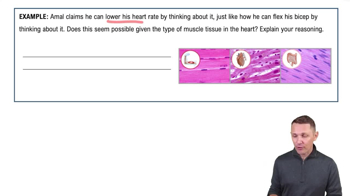
Striated, involuntary, uninucleate, branching cells connected by intercalated discs, contracts at pacemaker-set rate.
Maintain posture, stabilize joints, and generate heat.
The specialized plasma membrane of a skeletal muscle fiber.
Alternating light (I) bands and dark (A) bands formed by arrangement of thin and thick myofilaments.
The contractile unit of a muscle fiber, composed of organized thick (myosin) and thin (actin) filaments.
Myosin heads form cross bridges by attaching to actin filaments and pivot to slide filaments during contraction.
Stores and releases calcium ions, which trigger muscle contraction.
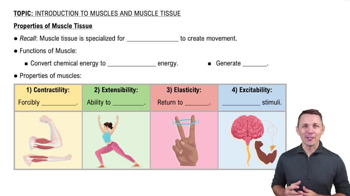
Irritability is the ability to respond to stimuli; contractility is the ability to shorten forcibly.
One motor neuron and all the skeletal muscle fibers it stimulates.
Acetylcholine (ACh) released at the neuromuscular junction.
Sodium ions enter the cell, making the interior more positive and generating an action potential.
Acetylcholinesterase (AChE) breaks down ACh into acetic acid and choline.
Calcium binds to thin filaments exposing myosin-binding sites; myosin heads attach and pivot, sliding thin filaments toward sarcomere center.
By direct phosphorylation of ADP by creatine phosphate, aerobic respiration, and anaerobic glycolysis.
Ion imbalances, oxygen deficit, lactic acid buildup, and decreased ATP supply during prolonged strenuous activity.
Isotonic: muscle shortens and movement occurs; Isometric: muscle tension increases but length stays the same.
Continuous partial contraction of muscles due to systematic stimulation of different motor units, keeping muscles firm and ready.
Increases muscle strength, flexibility, endurance, metabolism efficiency, and resistance to fatigue.
Increases muscle size and strength by enlarging individual muscle fibers.