 뒤로
뒤로Nervous System and Nervous Tissue - Anatomy & Physiology
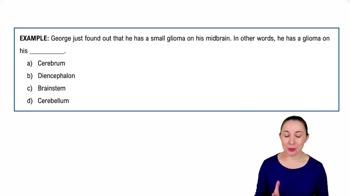
 0:50
0:50
이 집합의 용어 (27)
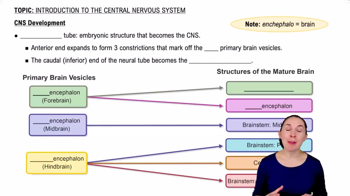
The nervous system includes the brain, spinal cord, and nerves.
Sensory detects stimuli, motor initiates responses, and integrative processes information.
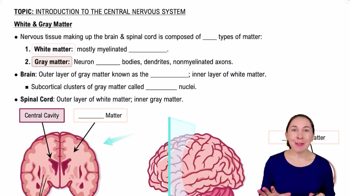
Central nervous system (CNS) includes brain and spinal cord; Peripheral nervous system (PNS) includes all nerves outside CNS.
Somatic nervous system controls voluntary movements; Autonomic nervous system controls involuntary functions.
Sympathetic division prepares for 'fight or flight'; Parasympathetic division promotes 'rest and digest'.
Neurons transmit nerve impulses; Neuroglial cells support and protect neurons.
Six types: Astrocytes, oligodendrocytes, microglia, ependymal cells (CNS); Schwann cells, satellite cells (PNS).
Dendrites receive signals; Axons transmit impulses away from the cell body.
Myelin insulates axons and increases the speed of action potential propagation.
Neurons can be multipolar, bipolar, or unipolar based on the number of processes.
Neurons are classified as sensory (afferent), motor (efferent), or interneurons.
Leak channels, ligand-gated channels, mechanically gated channels, and voltage-gated channels.
Polarized at rest, depolarized when membrane potential becomes less negative, repolarized returning to rest, hyperpolarized when more negative than rest.
Action potentials are all-or-none signals; graded potentials vary in magnitude and decay with distance.
Approximately \(-70\,mV\).
Usually around \(-55\,mV\), the level needed to trigger an action potential.
Sodium (Na+) and potassium (K+) ions are key; Na+ is higher outside, K+ higher inside at rest.
Na+ moves into the neuron during depolarization; K+ moves out during repolarization.
Time during which a neuron cannot fire another action potential or requires a stronger stimulus.
Absolute: no new action potential possible; Relative: action potential possible with stronger stimulus.
Saltatory conduction occurs in myelinated axons jumping between nodes; continuous conduction occurs in unmyelinated axons.
Larger diameter axons conduct impulses faster due to less resistance.
A junction where a neuron communicates with another cell (neuron, muscle, or gland).
Chemical synapses use neurotransmitters; electrical synapses use gap junctions for direct ion flow.
Action potential triggers neurotransmitter release, which crosses the synaptic cleft and binds receptors on the postsynaptic cell.
A chemical messenger released by neurons to transmit signals across a synapse.
Neurotransmitters are broken down by enzymes, reabsorbed by the presynaptic neuron, or diffuse away.