Skip to main content
Anatomy & Physiology
나의 코스
배우기
시험 준비
AI 튜터
학습 가이드
교과서적 해결책
플래시카드
탐험해 보세요
앱을 사용해 보세요
나의 코스
배우기
시험 준비
AI 튜터
학습 가이드
교과서적 해결책
플래시카드
탐험해 보세요
앱을 사용해 보세요
뒤로
Organization of the Abdominopelvic Cavity
카드를 뒤집기 위해 탭할 수 있습니다.
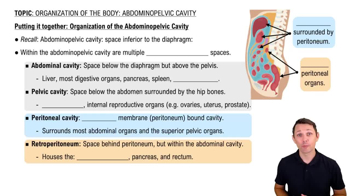
What is the abdominopelvic cavity?
카드를 뒤집기 위해 탭할 수 있습니다.
👆
What is the abdominopelvic cavity?
The space inferior to the diaphragm that contains multiple organ spaces.
진행 상황 추적
컨트롤 버튼이 '내비게이션' 모드로 변경되었습니다.
1/20
추천 영상
2:13
Organization of the Body: Abdominopelvic Cavity Example 1
4870
views
90
rank
5:46
Organization of the Abdominopelvic Cavity
6401
views
105
rank
이 집합의 용어 (20)
하이드의 정의
What is the abdominopelvic cavity?
The space inferior to the diaphragm that contains multiple organ spaces.
What organs are found in the abdominal cavity?
Liver, most digestive organs, pancreas, spleen, and kidneys.
What defines the pelvic cavity?
Space below the abdomen surrounded by the hip bones, containing the bladder and internal reproductive organs.
What is the peritoneal cavity?
A cavity bound by the peritoneum membrane that surrounds most abdominal organs and superior pelvic organs.
What is the retroperitoneum?
Space behind the peritoneum but within the abdominal cavity housing the kidneys, pancreas, and rectum.
Which cavity surrounds the bladder?
The pelvic cavity.
Which cavity surrounds the stomach?
The abdominal cavity and peritoneal cavity.
Are the lungs within the abdominopelvic cavity?
No, the lungs are not surrounded by the abdominopelvic cavity.
Which cavity surrounds the large intestine?
The abdominal cavity and peritoneal cavity.
Are the kidneys within the peritoneal cavity?
No, kidneys are retroperitoneal, located behind the peritoneum.
What serous membrane must be cut to operate on the stomach?
The peritoneum must be cut to access the stomach.
Do you have to cut through the peritoneum to operate on the kidneys via the posterior lumbar region?
No, because the kidneys are posterior to the peritoneum.
How can infection from a burst appendix spread rapidly?
The peritoneum spans the entire ventral cavity, allowing infection to travel to virtually all organs.
What role does the peritoneal cavity's serous fluid play in infection spread?
It allows infection to quickly spread throughout the abdominopelvic cavity.
What organs are located in the retroperitoneum?
Kidneys, pancreas, and rectum.
What organs are surrounded by the peritoneum?
Most abdominal organs and superior pelvic organs.
What is the anatomical location of the abdominal cavity?
Space below the diaphragm but above the pelvis.
What is the anatomical location of the pelvic cavity?
Space below the abdomen surrounded by the hip bones.
Why is the peritoneum important in abdominal surgeries?
It is a serous membrane that must be cut to access many abdominal organs.
What is the significance of the retroperitoneal space?
It contains important organs not enclosed by the peritoneum, affecting surgical approaches.
 뒤로뒤로
뒤로뒤로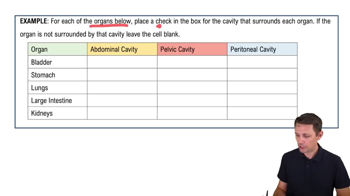
 2:13
2:13