 뒤로
뒤로Peripheral Nervous System - Anatomy & Physiology
 1:06
1:06
이 집합의 용어 (14)
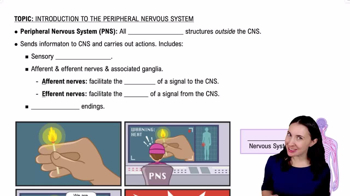
The PNS consists of all nerves outside the brain and spinal cord, connecting the CNS to limbs and organs.
The sensory (afferent) division and the motor (efferent) division.
The somatic nervous system (voluntary control) and the autonomic nervous system (involuntary control).
Sympathetic division controls fight-or-flight; parasympathetic division controls rest-and-digest.
A nerve is a bundle of axons in the PNS. Sensory nerves carry impulses to CNS, motor nerves carry impulses from CNS, and mixed nerves carry both.
Cranial nerves originate from the brain; spinal nerves originate from the spinal cord.
Endoneurium surrounds individual axons, perineurium surrounds fascicles, and epineurium surrounds the entire nerve.
Nerve roots connect spinal nerves to the spinal cord. The dorsal root contains sensory neurons; the ventral root contains motor neurons.
A plexus is a network of intersecting spinal nerves. The cervical plexus includes the phrenic nerve; the lumbar plexus includes the femoral nerve; the sacral plexus includes the sciatic nerve.
A dermatome is an area of skin innervated by sensory fibers from a single spinal nerve. It helps diagnose nerve damage or spinal cord injury.
Exteroreceptors detect stimuli from outside the body; interoreceptors detect internal stimuli from organs.
Mechanoreceptors: touch/pressure; thermoreceptors: temperature; nociceptors: pain; photoreceptors: light; chemoreceptors: chemicals.
A reflex is a rapid, involuntary response to a stimulus to protect the body.
Impulse travels from receptor to sensory neuron, then to integration center in CNS, then to motor neuron, and finally to effector muscle or gland.