Skip to main content
Anatomy & Physiology
나의 코스
배우기
시험 준비
AI 튜터
학습 가이드
교과서적 해결책
플래시카드
탐험해 보세요
앱을 사용해 보세요
나의 코스
배우기
시험 준비
AI 튜터
학습 가이드
교과서적 해결책
플래시카드
탐험해 보세요
앱을 사용해 보세요
뒤로
Urinary System - Anatomy & Physiology Exam 4 Study Guide
카드를 뒤집기 위해 탭할 수 있습니다.
Functions of the urinary system in maintaining blood pH
카드를 뒤집기 위해 탭할 수 있습니다.
👆
Functions of the urinary system in maintaining blood pH
The urinary system regulates blood pH by excreting hydrogen ions and reabsorbing bicarbonate, maintaining acid-base balance.
진행 상황 추적
컨트롤 버튼이 '내비게이션' 모드로 변경되었습니다.
1/30
추천 영상
0:54
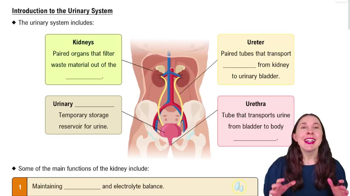
Introduction to the Urinary System Example 1
6177
views
170
rank
2:57
The Urinary System
8200
views
242
rank
2
comments
이 집합의 용어 (30)
하이드의 정의
Functions of the urinary system in maintaining blood pH
The urinary system regulates blood pH by excreting hydrogen ions and reabsorbing bicarbonate, maintaining acid-base balance.
Role of the urinary system in water balance
It controls water balance by adjusting urine volume and concentration through reabsorption and secretion in the nephron.
How the urinary system maintains electrolyte concentrations
It regulates electrolytes by selective reabsorption and secretion of ions like sodium, potassium, and calcium in the nephron.
Nutrient conservation by the urinary system
The kidneys reabsorb essential nutrients such as glucose and amino acids to prevent their loss in urine.
Three major waste products excreted by the urinary system
Urea, creatinine, and uric acid are the primary waste products eliminated in urine.
Role of the urinary system in amino acid catabolism
It removes nitrogenous wastes from amino acid breakdown, mainly as urea, to prevent toxic buildup.
Filtration barriers within the renal corpuscle
Filtration occurs through fenestrated endothelium, basement membrane, and podocyte filtration slits, allowing selective passage of plasma.
Effect of afferent vs efferent arteriole diameters on filtration
A wider afferent arteriole and narrower efferent arteriole increase glomerular pressure, promoting filtration.
Net filtration pressure (NFP) calculation
NFP = (Glomerular hydrostatic pressure) - (Capsular hydrostatic pressure + Blood colloid osmotic pressure).
Glomerular filtration rate (GFR) significance
GFR measures the volume of filtrate formed per minute, indicating kidney filtration efficiency.
Autoregulation of glomerular filtration
Kidneys adjust afferent arteriole diameter to maintain stable GFR despite blood pressure changes.
Hormonal regulation of glomerular filtration
Renin-angiotensin-aldosterone system increases blood pressure and sodium reabsorption; natriuretic peptides promote sodium and water excretion.
Autonomic regulation of glomerular filtration
Sympathetic stimulation constricts afferent arterioles, reducing GFR during stress or low blood volume.
Characteristics of diffusion in kidney function
Diffusion moves solutes down concentration gradients, important in solute exchange in peritubular capillaries.
Role of osmosis in kidney function
Osmosis drives water movement across membranes, crucial for water reabsorption in nephron segments.
Carrier-mediated transport in the nephron
Uses specific transport proteins for reabsorption of glucose, amino acids, and ions; can be saturated.
Active transport in kidney function
Energy-dependent movement of ions like sodium against gradients, essential for reabsorption and secretion.
Renal threshold concept
The plasma concentration at which a substance begins to appear in urine due to saturation of reabsorption.
Transport maximum (Tm)
Maximum rate at which a substance can be reabsorbed or secreted by carrier proteins in the nephron.
Milliosmoles (mOsm) in renal function
Unit measuring solute concentration; kidneys regulate urine osmolarity to maintain body fluid balance.
Specialized functions of nephron regions
Proximal tubule reabsorbs most solutes; loop of Henle creates osmotic gradient; distal tubule and collecting duct fine-tune reabsorption.
Histology of nephron related to function
Different epithelial types reflect function: proximal tubule has microvilli for absorption; distal tubule has fewer microvilli.
Counter-current multiplication process
Loop of Henle creates a concentration gradient in medulla by active transport and fluid flow in opposite directions.
Difference between filtration, secretion, and reabsorption
Filtration is plasma filtering into nephron; secretion adds substances to filtrate; reabsorption returns substances to blood.
Hormonal control of water and solute reabsorption in distal tubule and collecting duct
Antidiuretic hormone increases water reabsorption; aldosterone increases sodium reabsorption.
Pathway of urine from collecting ducts to excretion
Urine flows from collecting ducts → papillary ducts → minor calyces → major calyces → renal pelvis → ureter → bladder → urethra.
Histology of excretory organs and function
Transitional epithelium lines ureters and bladder, allowing stretch; smooth muscle layers enable peristalsis.
Involuntary control in micturition reflex
Stretch receptors trigger parasympathetic contraction of bladder detrusor muscle and relaxation of internal sphincter.
Voluntary control in micturition
Somatic nervous system controls external urethral sphincter, allowing conscious urine release.
Major age-related changes affecting urinary excretion
Reduced nephron number, decreased GFR, and weakened bladder muscles lead to impaired urine control.
 뒤로뒤로
뒤로뒤로
 0:54
0:54