Ch. 12 The Central Nervous System
Amerman - Human Anatomy & Physiology 2nd Edition
Amerman2nd EditionHuman Anatomy & PhysiologyISBN: 9780136873822당신이 사용하는 게 아니라요?교과서 변경
12장, 문제 22

The part of the brain responsible for the production of language is known as:
a. Wernicke's area
b. The prefrontal cortex
c. The auditory association area
d. Broca's area

검증된 단계별 안내
1
Step 1: Begin by identifying the key function described in the question: the production of language. This refers to the brain's ability to generate and articulate speech.
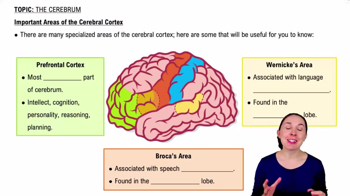
Step 2: Recall the specific regions of the brain associated with language. Two primary areas are involved: Broca's area and Wernicke's area. Broca's area is responsible for language production, while Wernicke's area is involved in language comprehension.
Step 3: Eliminate options that do not directly relate to language production. For example, the prefrontal cortex is primarily involved in decision-making and executive functions, and the auditory association area processes sound but does not produce language.
Step 4: Focus on Broca's area, which is located in the frontal lobe, typically in the left hemisphere. It plays a critical role in speech production and articulation.
Step 5: Conclude that the correct answer is Broca's area, as it is the part of the brain responsible for the production of language.

비슷한 문제에 대한 검증된 영상 답변:

이 영상 해법은 위 문제에 도움이 된다고 튜터들이 추천한 것입니다.

주요 개념

질문에 올바르게 답하기 위해 반드시 이해해야 하는 핵심 개념들은 다음과 같습니다.

Broca's Area

Broca's area is a region in the frontal lobe of the brain, typically located in the left hemisphere, that is crucial for language production. It is responsible for the formation of words and sentences, enabling individuals to express themselves verbally. Damage to this area can result in Broca's aphasia, characterized by difficulty in speech production while comprehension remains relatively intact.
추천 영상:
3:15
Important Areas of the Cerebral Cortex

Wernicke's Area

Wernicke's area is located in the temporal lobe, also primarily in the left hemisphere, and is essential for language comprehension. It allows individuals to understand spoken and written language. Damage to this area can lead to Wernicke's aphasia, where a person may produce fluent but nonsensical speech and struggle to comprehend language.
추천 영상:
3:15
Important Areas of the Cerebral Cortex

Language Processing in the Brain

Language processing in the brain involves a network of areas, including Broca's and Wernicke's areas, that work together to facilitate communication. This network is responsible for various aspects of language, such as syntax, semantics, and phonetics. Understanding how these areas interact is vital for grasping how language is produced and understood in the human brain.
추천 영상:
가이드 코스
04:19
1) RNA Processing
관련 실천
교과서 질문

The two components of the CNS that are responsible for maintenance of homeostasis are the ________ and the ________. 

898
views
1
rank

교과서 질문

Which of the following statements is false? 

a. The suprachiasmatic nucleus is often called the body's 'master clock.' 

b. Melatonin and the ventrolateral preoptic nucleus increase the activity of the reticular formation. 

c. A decrease in the activity of the reticular formation disconnects the thalamus from the cerebral cortex and decreases the level of consciousness. 

d. Orexins are neurotransmitters that stimulate the reticular formation.

811
views
1
rank
교과서 질문

Declarative memories are formed by the process of ________ that takes place in the ________, and are stored in the ________. 

1176
views
교과서 질문

Which of the following is not a component of emotion?

a. Visceral motor responses mediated by the hypothalamus

b. Somatic motor responses mediated by the limbic system and the hypothalamus

c. Somatic motor responses mediated by the upper motor neurons of the corticospinal tracts

d. Subjective feelings mediated by the amygdala and the cerebral cortex

811
views
교과서 질문

Match the term on the left with its correct description from the column on the right.     


____ REM sleep     

____ Stage I sleep     

____ Delta waves     

____ Beta waves     

____ Theta waves     

____ Stage IV sleep


a. The EEG pattern seen in the deepest stage of sleep

b. The deepest stage of sleep

c. The EEG pattern seen in an alert, awake adult

d. Drowsiness or the lightest stage of sleep

e. The EEG pattern seen in lighter stages of sleep

f. The stage of sleep during which most dreaming takes place

811
views
1
rank