Predict what would happen if the mucous membranes of the body stopped secreting mucus or if they secreted excess mucus.
Ch. 4 Histology
4장, 문제 1
Explain how connective tissues differ from epithelial tissues in structure and function.
검증된 단계별 안내1
Connective tissues are characterized by having a large amount of extracellular matrix, which is composed of protein fibers (like collagen and elastin) and ground substance, whereas epithelial tissues are tightly packed cells with minimal extracellular matrix.
Epithelial tissues form continuous sheets that cover surfaces, line cavities, and form glands, while connective tissues provide support, protection, and binding of other tissues and organs.
Epithelial tissues are avascular (lack blood vessels) and rely on diffusion from underlying connective tissues for nutrients, whereas connective tissues are typically vascularized (except for cartilage).
The cells in connective tissues are more scattered and include specialized types such as fibroblasts, adipocytes, and macrophages, while epithelial tissues consist of uniform cell types like squamous, cuboidal, or columnar cells arranged in layers.
Epithelial tissues primarily function in protection, absorption, secretion, and filtration, while connective tissues function in structural support, energy storage, immune defense, and repair of tissues.

비슷한 문제에 대한 검증된 영상 답변:
이 영상 해법은 위 문제에 도움이 된다고 튜터들이 추천한 것입니다.
도움이 되었나요?
주요 개념
질문에 올바르게 답하기 위해 반드시 이해해야 하는 핵심 개념들은 다음과 같습니다.
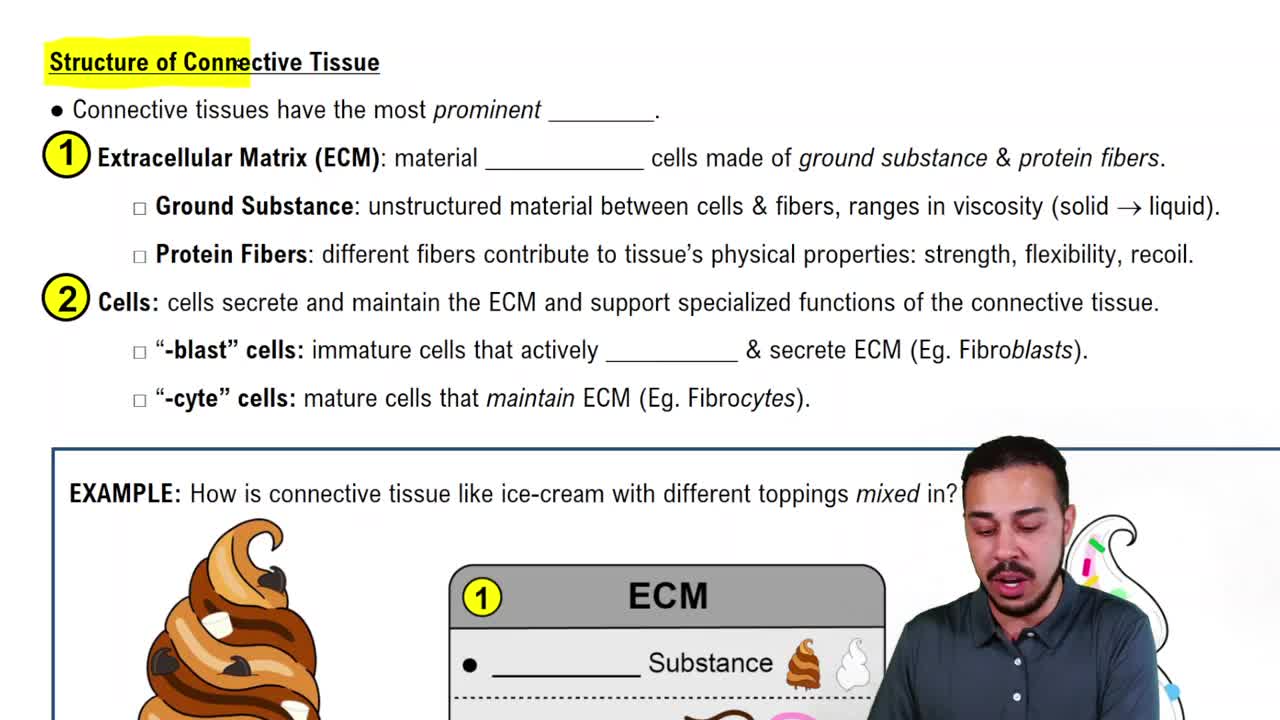
Connective Tissue Structure
Connective tissues are characterized by a diverse composition that includes cells, fibers, and a matrix. The matrix can be liquid, gel-like, or solid, providing structural support and facilitating the transport of nutrients and waste. Unlike epithelial tissues, which are tightly packed, connective tissues have more space between cells, allowing for flexibility and strength.
추천 영상:
가이드 코스
Structure of Connective Tissue
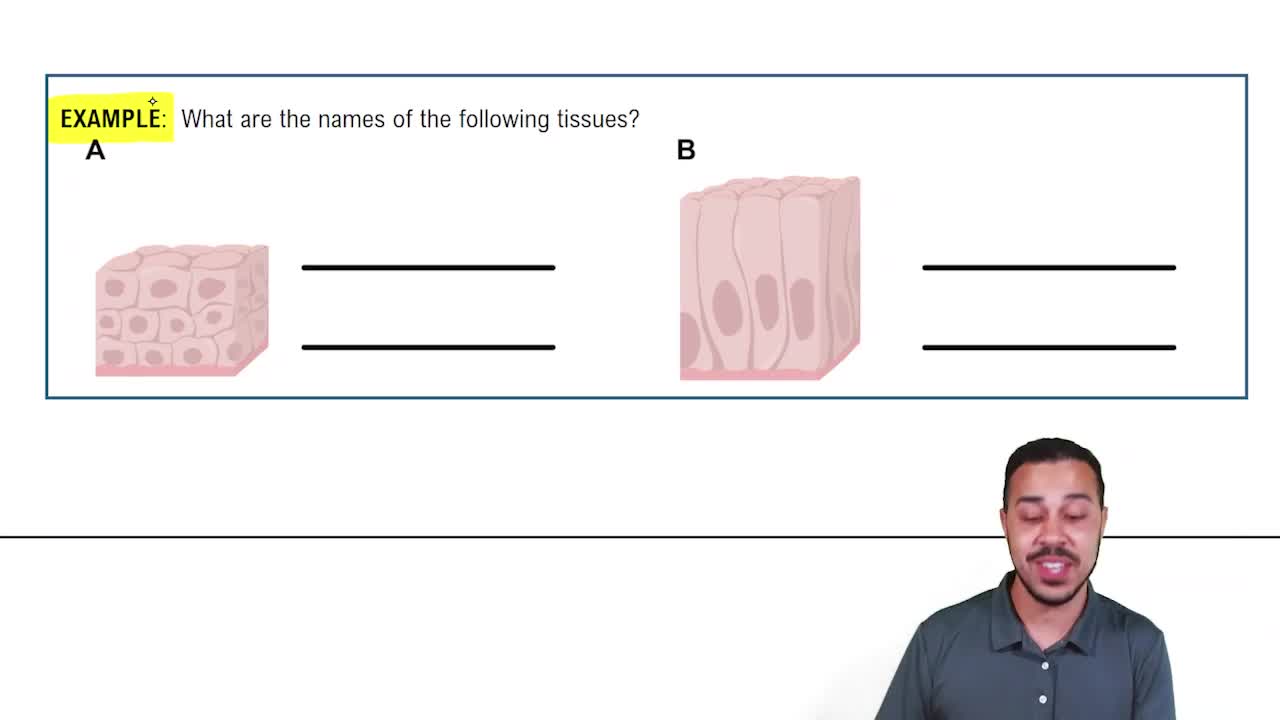
Epithelial Tissue Structure
Epithelial tissues consist of closely packed cells with minimal extracellular matrix, forming continuous sheets that cover surfaces and line cavities. They are anchored to underlying connective tissues by a basement membrane. This structure allows epithelial tissues to serve as protective barriers and facilitate absorption, secretion, and sensation.
추천 영상:
가이드 코스
Structural Naming of Epithelial Tissue Example 1
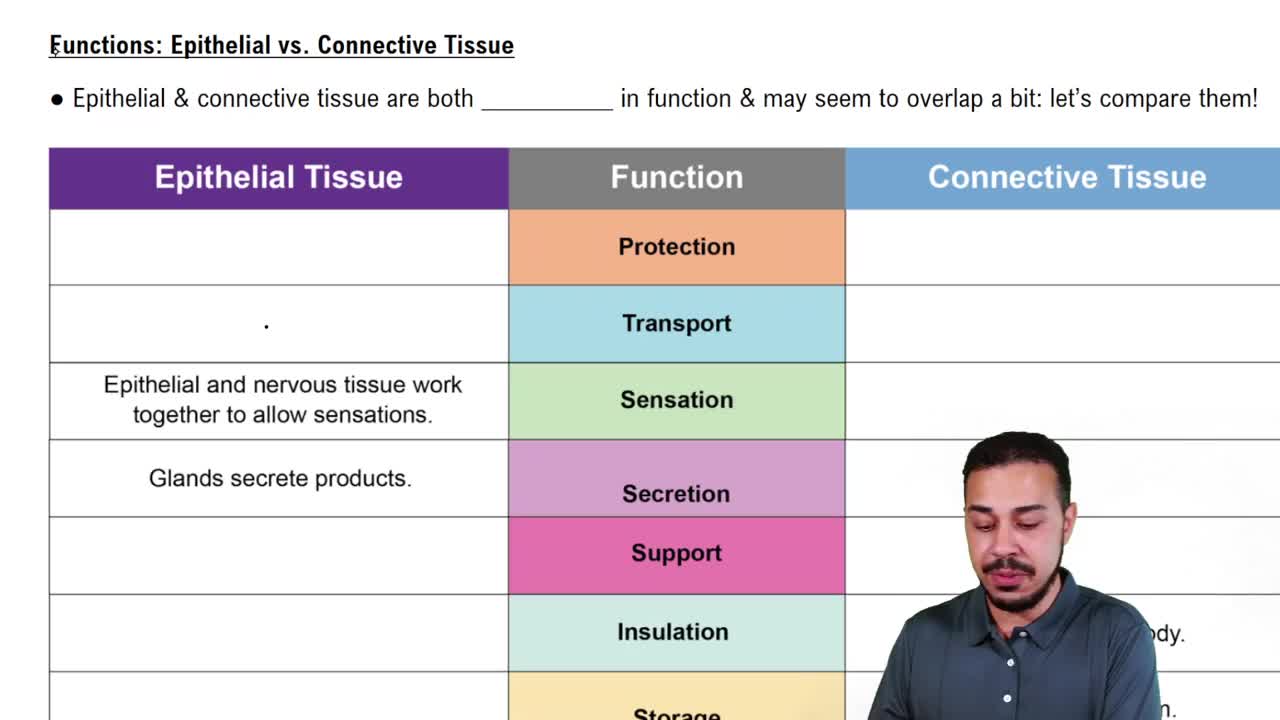
Function of Connective vs. Epithelial Tissues
The primary function of connective tissues is to support, bind, and protect other tissues and organs, as well as to store energy and transport substances. In contrast, epithelial tissues primarily function in protection, absorption, secretion, and sensation. This functional distinction is closely tied to their structural differences, with connective tissues providing support and epithelial tissues forming protective layers.
추천 영상:
가이드 코스
Functions: Epithelial vs. Connective Tissue
관련 실천
교과서 질문
905
views
교과서 질문
State whether each of the following describes epithelial, connective, muscle, or nervous tissue.
a. ____ECM is often the primary element.
b. ____Consists of excitable cells that are specialized for contraction.
c. ____Sheets of tightly packed cells with little ECM.
d. ____Makes up the majority of the brain and spinal cord.
e. ____Cells may be smooth or striated.
f. ____Binds, connects, supports, and transports substances throughout the body.
706
views
교과서 질문
Why do you think the rate of cell division is different for different tissues? Where in the body would you expect to find cells that have a rapid rate of division? Where might you find cells that have a slow rate of division? Explain.
798
views