Ch. 6 Bones and Bone Tissue
Amerman - Human Anatomy & Physiology 2nd Edition
Amerman2nd EditionHuman Anatomy & PhysiologyISBN: 9780136873822당신이 사용하는 게 아니라요?교과서 변경
6장, 문제 7

Which bones form via intramembranous ossification?


a. Irregular bones
b. Certain flat bones
c. Long bones
d. Short bones
e. More than one of the above

검증된 단계별 안내
1
Understand the process of intramembranous ossification: This is a type of bone formation where bone develops directly from mesenchymal tissue without a cartilage precursor. It is primarily responsible for forming certain types of bones in the body.
Recall the types of bones in the human body: Bones are classified into four main categories based on their shapes—flat bones, long bones, short bones, and irregular bones.
Identify the bones formed by intramembranous ossification: This process is most commonly associated with the formation of flat bones, such as those in the skull (e.g., frontal, parietal, and occipital bones), as well as parts of the clavicle.
Eliminate incorrect options: Long bones (e.g., femur, humerus) and short bones (e.g., carpals, tarsals) are formed via endochondral ossification, not intramembranous ossification. Irregular bones (e.g., vertebrae) are also primarily formed through endochondral ossification.
Conclude that the correct answer is 'b. Certain flat bones,' as these are the bones formed via intramembranous ossification.

비슷한 문제에 대한 검증된 영상 답변:

이 영상 해법은 위 문제에 도움이 된다고 튜터들이 추천한 것입니다.
도움이 되었나요?

주요 개념

질문에 올바르게 답하기 위해 반드시 이해해야 하는 핵심 개념들은 다음과 같습니다.

Intramembranous Ossification

Intramembranous ossification is a process of bone formation that occurs directly from mesenchymal tissue, without a cartilage intermediate. This type of ossification primarily forms flat bones, such as the skull and clavicles, through the direct transformation of connective tissue into bone.
추천 영상:
02:23
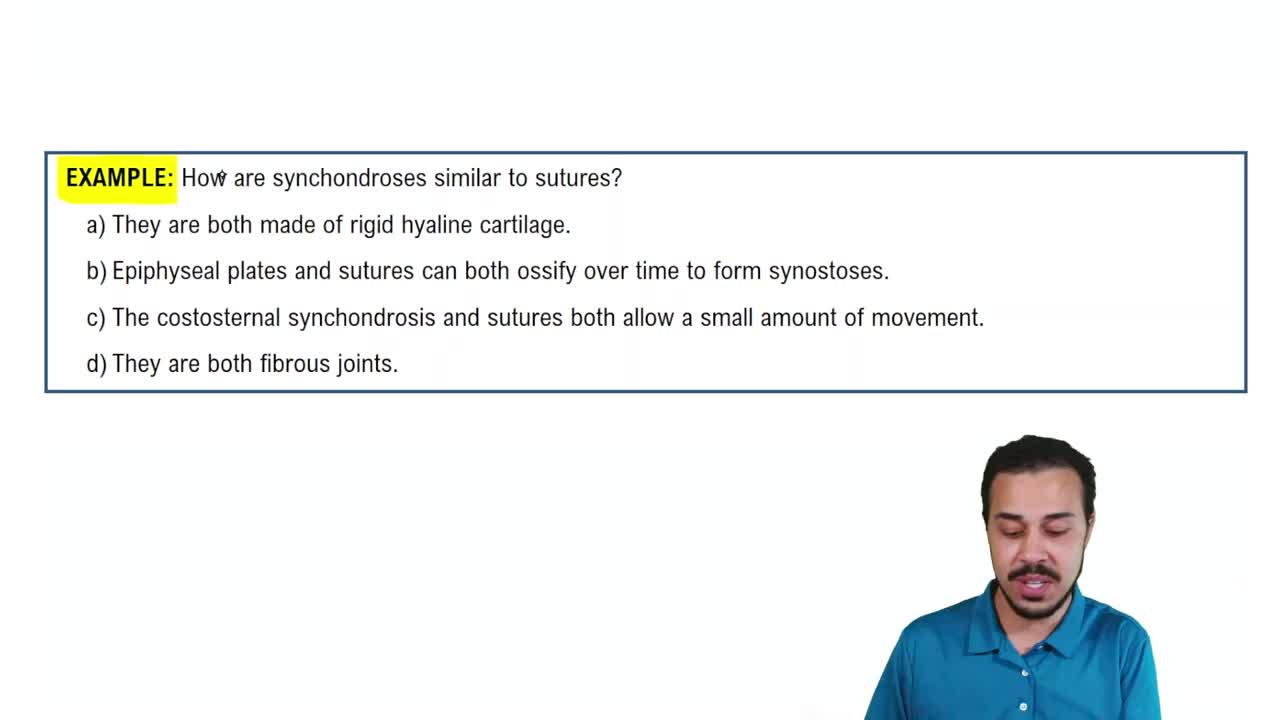
Structural Class: Cartilaginous Joints Example 1

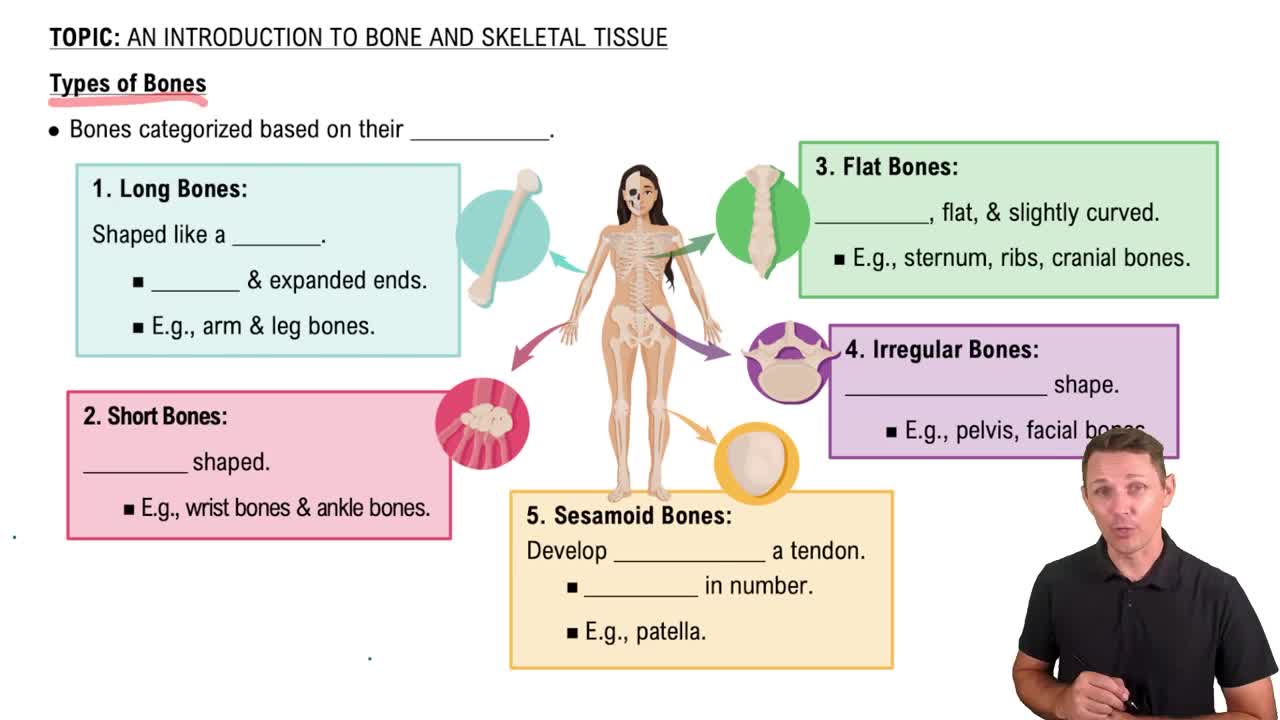
Types of Bones

Bones are classified into several categories based on their shapes and functions: flat bones (like the skull), long bones (like the femur), short bones (like the carpals), and irregular bones (like the vertebrae). Understanding these classifications helps in identifying which bones are formed through different ossification processes.
추천 영상:
가이드 코스
4:14
Types of Bones

Ossification Processes

There are two primary types of ossification: intramembranous and endochondral. While intramembranous ossification directly converts mesenchyme to bone, endochondral ossification involves the formation of a cartilage model that is later replaced by bone, typically seen in long bones. Recognizing these processes is essential for understanding bone development.
추천 영상:
04:19
1) RNA Processing
관련 실천
교과서 질문

The part of the epiphysis that does not ossify during a person's lifetime is the:

a. Articular surface

b. Secondary ossification center

c. Diaphyseal notch

d. Nutrient foramen

823
views
2
rank

교과서 질문

What is the difference between a primary and secondary ossification center in a long bone?

1487
views
1
rank
교과서 질문

The subunit of compact bone is the _____ . It consists of rings of bone matrix called ______that surround a structure called the______ that contains blood vessels and nerves. Other structures called _______also contain blood vessels and nerves. Osteocytes are housed in_____and communicate via_______.

779
views
교과서 질문

The branching pieces of bone in spongy bone are called:


a. Lamellae

b. Lacunae

c. Osteoclasts

d. Trabeculae

992
views
교과서 질문

Mark the following statements about bone tissue as true or false. If a statement is false, correct it to make a true statement.


f. Osteocytes are mature and less active osteoblasts that have become surrounded by bone ECM.

706
views
교과서 질문

Of the following statements, identify those that are properties of intramembranous ossification, endochondral ossification, or both.

a. The bone is formed via a hyaline cartilage model.

b. Bone tissue forms from ossification centers.

c. Bone forms from within a mesenchyme membrane.

d. The early spongy bone is formed, after which the early compact bone develops.

e. The original primary bone is replaced with secondary bone.

f. A bone collar forms, followed by the early spongy bone.

791
views