Ch. 11 Introduction to the Nervous System and Nervous Tissue
Amerman- Human Anatomy & Physiology 3e
Amerman3rd EditionHuman Anatomy & PhysiologyISBN: 9780138247201, 9780138247928, 9780138201814당신이 사용하는 게 아니라요?교과서 변경
11장, 문제 L3.4

Albert, the patient in question 3, takes the drug lithium, which reduces the permeability of the neuronal axolemma to Na+ (that is, it allows fewer Na+ to enter the axon). Predict the effect this would normally have on his neuronal action potentials. Do you think this drug would be beneficial or harmful, considering his condition?

검증된 단계별 안내
1
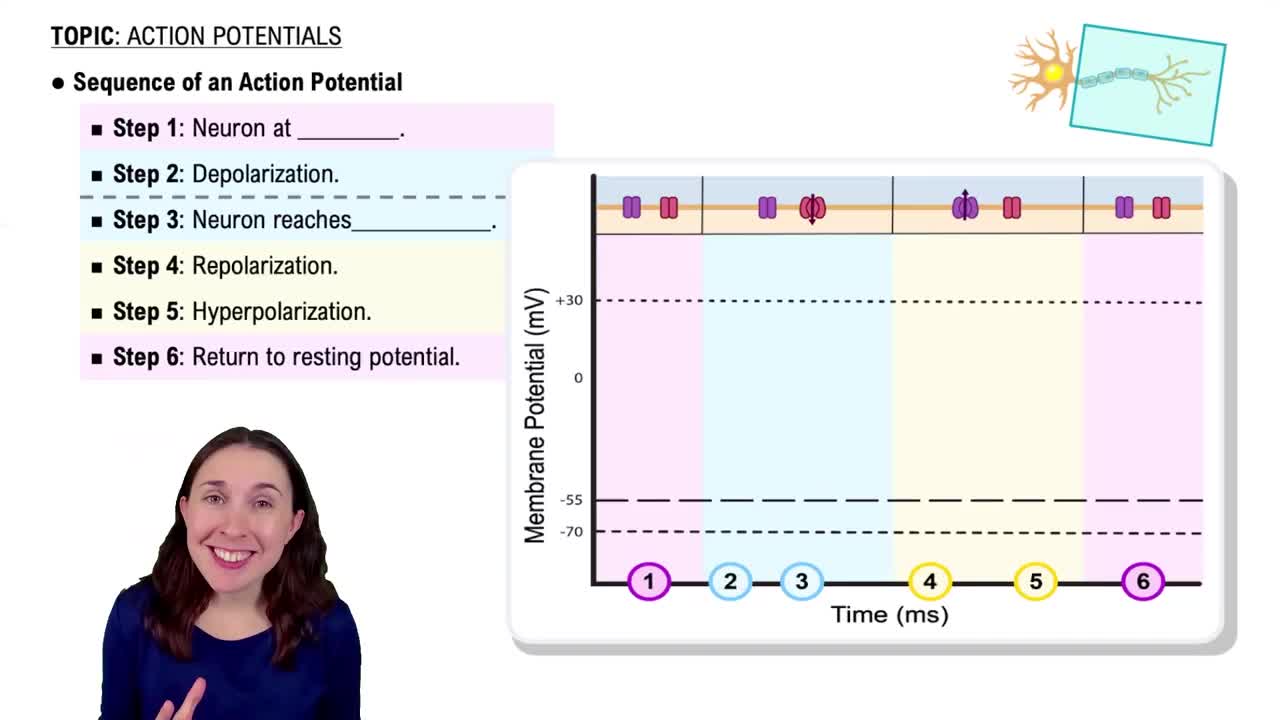
Understand the role of Na+ in neuronal action potentials: Sodium ions (Na+) play a critical role in generating action potentials. During the depolarization phase, voltage-gated Na+ channels open, allowing Na+ to enter the neuron, which causes the membrane potential to become more positive.
Analyze the effect of reduced Na+ permeability: If the drug lithium reduces the permeability of the neuronal axolemma to Na+, fewer Na+ ions will enter the neuron during depolarization. This would likely slow down or reduce the magnitude of the depolarization phase of the action potential.
Consider the impact on action potential generation: With reduced Na+ entry, the threshold for generating an action potential may not be reached as easily, or the action potential may be weaker. This could lead to decreased neuronal excitability and slower signal transmission.
Evaluate the potential benefits or harms: Determine whether reduced neuronal excitability is beneficial or harmful based on the patient's condition. For example, if the patient has a condition like bipolar disorder, where excessive neuronal activity may contribute to symptoms, reducing excitability could be therapeutic. However, if the patient requires normal neuronal signaling for other functions, this could be harmful.
Conclude based on the patient's specific condition: Assess the overall effect of the drug by weighing its benefits (e.g., stabilizing mood in bipolar disorder) against potential side effects (e.g., impaired neuronal communication in other systems). This requires understanding the patient's medical history and condition in detail.

비슷한 문제에 대한 검증된 영상 답변:

이 영상 해법은 위 문제에 도움이 된다고 튜터들이 추천한 것입니다.

주요 개념

질문에 올바르게 답하기 위해 반드시 이해해야 하는 핵심 개념들은 다음과 같습니다.

Neuronal Action Potentials

Neuronal action potentials are rapid changes in the electrical membrane potential of a neuron that occur when it is stimulated. This process involves the influx of sodium ions (Na<sup>+</sup>) through voltage-gated channels, leading to depolarization. The action potential is crucial for the transmission of signals along the axon and communication between neurons.
추천 영상:
03:53
Action Potential

Sodium Ion Permeability

Sodium ion permeability refers to the ability of the neuronal membrane to allow Na<sup>+</sup> ions to pass through. When permeability is high, Na<sup>+</sup> enters the neuron rapidly, contributing to depolarization and the generation of action potentials. Conversely, reduced permeability, as seen with lithium, limits Na<sup>+</sup> entry, potentially impairing neuronal excitability and signaling.
추천 영상:
01:55
Ions - Sodium and Potassium Example 3

Lithium's Mechanism of Action

Lithium is a mood-stabilizing medication commonly used to treat bipolar disorder. It affects neuronal excitability by altering ion transport mechanisms, particularly reducing Na<sup>+</sup> permeability. While this can stabilize mood by dampening excessive neuronal firing, it may also hinder normal action potential generation, which could be detrimental depending on the patient's specific neurological condition.
추천 영상:
03:53
Action Potential