
Ch. 12 The Central Nervous System
Amerman- Human Anatomy & Physiology 3e
Amerman3rd EditionHuman Anatomy & PhysiologyISBN: 9780138247201, 9780138247928, 9780138201814당신이 사용하는 게 아니라요?교과서 변경
12장, 문제 L2.1

Huntington's disease is characterized by a loss of normal inhibition mediated by the basal nuclei. Predict the symptoms you are likely to see with this disease.

검증된 단계별 안내
1
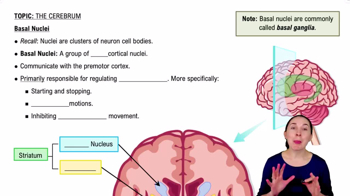
Understand the role of the basal nuclei: The basal nuclei are clusters of neurons in the brain that play a critical role in regulating motor control, coordination, and inhibition of unnecessary movements. They help ensure smooth and purposeful movements by suppressing involuntary or excessive motor activity.
Recognize the impact of Huntington's disease: Huntington's disease is a genetic disorder that leads to the degeneration of neurons in the basal nuclei, particularly in the striatum. This degeneration disrupts the normal inhibitory function of the basal nuclei, leading to a loss of control over motor activity.
Predict motor symptoms: Without proper inhibition from the basal nuclei, patients are likely to experience involuntary movements known as chorea. These movements are jerky, uncoordinated, and can affect various parts of the body, including the limbs, face, and trunk.
Consider cognitive and behavioral symptoms: In addition to motor dysfunction, the degeneration of neurons in Huntington's disease can affect cognitive processes and emotional regulation. Symptoms may include difficulty with decision-making, memory loss, mood swings, and depression.
Summarize the progression of symptoms: Huntington's disease is progressive, meaning symptoms worsen over time. Early stages may involve subtle motor or cognitive changes, while later stages can lead to severe motor impairment, difficulty swallowing, and significant cognitive decline.

비슷한 문제에 대한 검증된 영상 답변:

이 영상 해법은 위 문제에 도움이 된다고 튜터들이 추천한 것입니다.
도움이 되었나요?

주요 개념

질문에 올바르게 답하기 위해 반드시 이해해야 하는 핵심 개념들은 다음과 같습니다.

Basal Nuclei Function

The basal nuclei, or basal ganglia, are a group of nuclei in the brain that play a crucial role in coordinating movement and regulating voluntary motor control. They help inhibit unwanted movements and facilitate desired actions. Dysfunction in these structures can lead to motor symptoms such as tremors, rigidity, and involuntary movements, which are characteristic of disorders like Huntington's disease.
추천 영상:
3:26
Basal Nuclei

Huntington's Disease Pathophysiology

Huntington's disease is a genetic neurodegenerative disorder caused by the mutation of the HTT gene, leading to the progressive degeneration of neurons, particularly in the basal ganglia. This degeneration results in a loss of inhibitory control over motor functions, leading to symptoms such as chorea (involuntary jerking movements), cognitive decline, and psychiatric issues. Understanding this pathophysiology is essential for predicting the symptoms associated with the disease.
추천 영상:
가이드 코스
3:19
Immune Tolerance

Motor Symptoms of Huntington's Disease

The motor symptoms of Huntington's disease primarily include chorea, which is characterized by irregular, unpredictable movements, and dystonia, which involves sustained muscle contractions. As the disease progresses, patients may also experience bradykinesia (slowness of movement) and rigidity. These symptoms arise from the imbalance between excitatory and inhibitory signals in the brain, particularly due to the loss of function in the basal nuclei.
추천 영상:
4:31
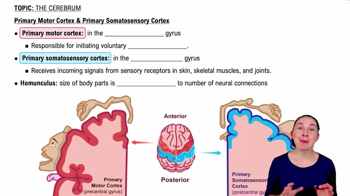
Primary Motor Cortex & Primary Somatosensory Cortex