Ch. 13 The Peripheral Nervous System
Amerman- Human Anatomy & Physiology 3e
Amerman3rd EditionHuman Anatomy & PhysiologyISBN: 9780138247201, 9780138247928, 9780138201814당신이 사용하는 게 아니라요?교과서 변경
13장, 문제 L2.1

Devise a series of physical examination tests that assess the function of each of the cranial nerves.

검증된 단계별 안내
1
Begin by assessing Cranial Nerve I (Olfactory Nerve): Ask the patient to close their eyes and identify familiar scents, such as coffee or vanilla, presented one nostril at a time. This tests the sense of smell.
Evaluate Cranial Nerve II (Optic Nerve): Use a visual acuity chart (e.g., Snellen chart) to assess vision clarity. Additionally, perform a visual field test by asking the patient to identify objects or movements in their peripheral vision.
Test Cranial Nerves III (Oculomotor), IV (Trochlear), and VI (Abducens): Observe eye movements by asking the patient to follow a pen or finger in an 'H' pattern. Check for pupil constriction and accommodation by shining a light into the eyes and observing the pupillary response.
Assess Cranial Nerve V (Trigeminal Nerve): Test sensory function by lightly touching the patient's face in the forehead, cheek, and jaw areas with a cotton ball or blunt object. Test motor function by asking the patient to clench their jaw and palpate the masseter muscles.
Evaluate Cranial Nerve VII (Facial Nerve): Ask the patient to perform facial movements such as smiling, frowning, raising eyebrows, and closing their eyes tightly. Check for symmetry and strength in these movements.

비슷한 문제에 대한 검증된 영상 답변:

이 영상 해법은 위 문제에 도움이 된다고 튜터들이 추천한 것입니다.
도움이 되었나요?

주요 개념

질문에 올바르게 답하기 위해 반드시 이해해야 하는 핵심 개념들은 다음과 같습니다.

Cranial Nerves

Cranial nerves are twelve pairs of nerves that emerge directly from the brain, primarily responsible for sensory and motor functions of the head and neck. Each nerve has specific functions, such as vision, smell, taste, and facial movement. Understanding these nerves is crucial for devising appropriate physical examination tests to assess their function.
추천 영상:
가이드 코스
8:20
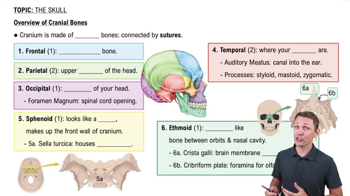
Overview of Cranial Bones

Neurological Examination

A neurological examination is a systematic assessment of the nervous system, focusing on cranial nerves, motor function, sensory function, and reflexes. It helps identify neurological deficits and is essential for evaluating cranial nerve function. The examination includes tests like visual acuity, facial sensation, and muscle strength, tailored to each cranial nerve.
추천 영상:
4:35
Transport Maximum (TM) & Renal Threshold

Assessment Techniques

Assessment techniques refer to the specific methods used to evaluate the function of cranial nerves during a physical examination. These techniques can include visual tests, auditory assessments, and motor function evaluations. Each technique is designed to elicit responses that indicate the integrity and functionality of the respective cranial nerve.
추천 영상:
3:02
Internal Regulation - The Myogenic Mechanism
관련 실천
교과서 질문

Match each type of neuroglial cell with its correct function.

____ Schwann cells    

____ Ependymal cells     

____ Microglial cells    

____ Oligodendrocytes     

____ Satellite cells    

____ Astrocytes

a. Phagocytic cells of the CNS

b. Surround the cell bodies of neurons in the PNS

c. Create the myelin sheath in the PNS

d. Anchor neurons and blood vessels, maintain extracellular environment around neurons, assist in repair of damaged brain tissue

e. Create the myelin sheath in the CNS

f. Ciliated cells in the CNS that produce and circulate the fluid around the brain and spinal cord

1187
views
1
rank
교과서 질문

Predict what might happen if nociceptors were rapidly adapting instead of slowly adapting receptors. Would this change be beneficial or potentially harmful?

860
views
교과서 질문

A spinal nerve divides into a(n)_____ that serves the anterior side of the body and the limbs and a(n)_____that serves the posterior side of the body.

673
views
교과서 질문

Mark the following statements as true or false. If a statement is false, correct it to make a true statement.

e. There are 31 pairs of spinal nerves and 12 pairs of cranial nerves.

797
views
교과서 질문

Mark the following statements as true or false. If a statement is false, correct it to make a true statement.

d. The term nerve is the equivalent of the term neuron.

779
views
교과서 질문

Explain why you lose both motor and sensory function of a part of your body when a spinal nerve is numbed with anesthetic agents.

635
views