Ch. 13 The Peripheral Nervous System
Amerman- Human Anatomy & Physiology 3e
Amerman3rd EditionHuman Anatomy & PhysiologyISBN: 9780138247201, 9780138247928, 9780138201814당신이 사용하는 게 아니라요?교과서 변경
13장, 문제 15

______detect the degree to which a muscle is stretched, whereas______detect the force of a muscle contraction.

검증된 단계별 안내
1
Step 1: Understand the two types of sensory receptors involved in muscle function. Muscle spindles are specialized sensory receptors that detect the degree of stretch in a muscle, while Golgi tendon organs are sensory receptors that detect the force or tension generated during muscle contraction.
Step 2: Recall the anatomical location of these receptors. Muscle spindles are located within the muscle fibers themselves, specifically in the intrafusal fibers, whereas Golgi tendon organs are located at the junction between the muscle and its tendon.
Step 3: Consider the physiological role of each receptor. Muscle spindles provide feedback to the central nervous system about muscle length and changes in length, helping to regulate muscle tone and prevent overstretching. Golgi tendon organs monitor tension to prevent excessive force that could damage the muscle or tendon.
Step 4: Match the descriptions in the problem to the correct receptor. The phrase 'detect the degree to which a muscle is stretched' corresponds to muscle spindles, and the phrase 'detect the force of a muscle contraction' corresponds to Golgi tendon organs.
Step 5: Conclude that the correct answer involves identifying muscle spindles as the receptors for stretch and Golgi tendon organs as the receptors for force detection.

비슷한 문제에 대한 검증된 영상 답변:

이 영상 해법은 위 문제에 도움이 된다고 튜터들이 추천한 것입니다.
도움이 되었나요?

주요 개념

질문에 올바르게 답하기 위해 반드시 이해해야 하는 핵심 개념들은 다음과 같습니다.

Muscle Spindles

Muscle spindles are sensory receptors located within the belly of muscles. They detect changes in muscle length and the rate of that change, providing the central nervous system with information about muscle stretch. This feedback is crucial for maintaining posture and coordinating movement.
추천 영상:
04:02
Centrosomes & Mitotic Spindles

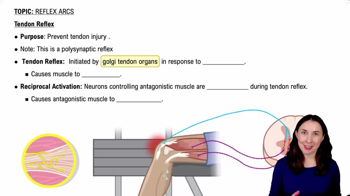
Golgi Tendon Organs

Golgi tendon organs are proprioceptive sensory receptors located at the junction of muscles and tendons. They monitor the tension or force generated by muscle contractions, helping to prevent muscle damage from excessive force. This feedback allows for the regulation of muscle activity and contributes to overall motor control.
추천 영상:
3:01
Tendon Reflex

Proprioception

Proprioception is the body's ability to sense its position and movement in space. It involves the integration of sensory information from muscle spindles, Golgi tendon organs, and other receptors to provide awareness of body posture and movement. This sense is essential for coordination, balance, and executing complex motor tasks.
추천 영상:
3:34
Somatosensory System
관련 실천
교과서 질문

The lower motor neurons that innervate contractile skeletal muscle fibers are called:

a. α-motor neurons

b. β-motor neurons

c. upper motor neurons

d. γ-motor neurons

809
views
교과서 질문

Mark the following statements as true or false. If a statement is false, correct it to make a true statement.

a. The simple stretch reflex is a monosynaptic reflex with only a single synapse in the spinal cord between the sensory and motor neurons.

834
views
교과서 질문

Which of the following is the correct order of events of a reflex arc?


a. Stimulus detection and delivery → motor response → integration in the CNS

b. Motor response → stimulus detection and delivery → integration in the CNS

c. Stimulus detection and delivery → integration in the CNS → delivery of motor response

d. Integration in the CNS → motor response → stimulus detection and delivery

1113
views
1
rank
교과서 질문

The cell bodies of upper motor neurons reside in the ________ and function to ________, whereas the cell bodies of lower motor neurons reside in the ________ and function to ________.

921
views
교과서 질문

Which of the following statements is false?

a. The spinothalamic tracts are part of the anterolateral system.

b. Pain, temperature, and crude touch stimuli are carried by the anterolateral system.

c. Descending pathways from the brain and spinal cord can make the spinal cord less receptive to pain stimuli.

d. The thalamus serves as the 'gateway' for entry of all special sensory stimuli into the cerebral cortex, with the exception of audition (hearing).

552
views
교과서 질문

Label the following components of the corticospinal tracts with numbers 1 through 6, with 1 being the origin of the tracts and 6 their destination.     

_____ Medullary pyramids where most fibers decussate.     

_____ Anterior horn of the spinal gray matter.     

_____ Midbrain and pons.      

_____ Upper motor neurons in the primary motor and premotor cortices.     

_____ Corona radiata and internal capsule.        

_____ Lateral funiculus of the spinal cord.

589
views