Ch. 13 The Peripheral Nervous System
Amerman- Human Anatomy & Physiology 3e
Amerman3rd EditionHuman Anatomy & PhysiologyISBN: 9780138247201, 9780138247928, 9780138201814당신이 사용하는 게 아니라요?교과서 변경
13장, 문제 10

Tactile nerve endings, tactile corpuscles, bulbous corpuscles, and lamellated corpuscles are all types of:
a. Nociceptors
b. Mechanoreceptors
c. Photoreceptors
d. Chemoreceptors

검증된 단계별 안내
1
Step 1: Begin by understanding the definitions of the receptor types listed in the answer choices. Nociceptors detect pain, mechanoreceptors detect mechanical stimuli like pressure or vibration, photoreceptors detect light, and chemoreceptors detect chemical changes.
Step 2: Review the function of tactile nerve endings, tactile corpuscles, bulbous corpuscles, and lamellated corpuscles. These structures are specialized sensory receptors found in the skin and other tissues that respond to mechanical stimuli such as touch, pressure, and vibration.
Step 3: Match the function of these sensory structures to the receptor type that corresponds to mechanical stimuli. Recall that mechanoreceptors are responsible for detecting mechanical changes in the environment.
Step 4: Eliminate the incorrect options based on the definitions and functions. For example, tactile nerve endings and corpuscles do not detect pain (nociceptors), light (photoreceptors), or chemical changes (chemoreceptors).
Step 5: Conclude that tactile nerve endings, tactile corpuscles, bulbous corpuscles, and lamellated corpuscles are all types of mechanoreceptors, as they respond to mechanical stimuli like touch, pressure, and vibration.

비슷한 문제에 대한 검증된 영상 답변:

이 영상 해법은 위 문제에 도움이 된다고 튜터들이 추천한 것입니다.
도움이 되었나요?

주요 개념

질문에 올바르게 답하기 위해 반드시 이해해야 하는 핵심 개념들은 다음과 같습니다.

Mechanoreceptors

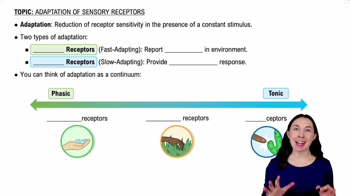
Mechanoreceptors are specialized sensory receptors that respond to mechanical pressure or distortion. They play a crucial role in the sensation of touch, vibration, and proprioception. The types mentioned in the question, such as tactile corpuscles and bulbous corpuscles, are all mechanoreceptors that detect different forms of mechanical stimuli.
추천 영상:
4:49
Adaptation

Tactile Nerve Endings

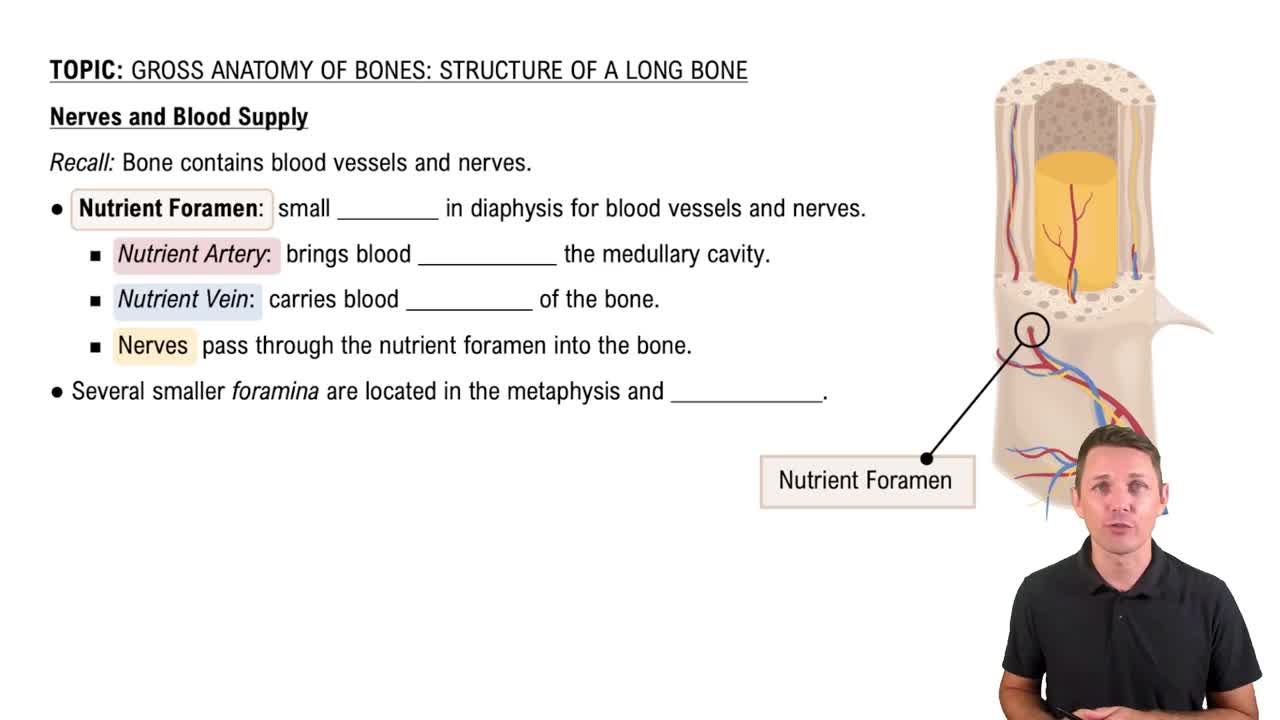
Tactile nerve endings, also known as free nerve endings, are sensory receptors located in the skin that respond to light touch. They are responsible for detecting fine tactile sensations and are distributed throughout the skin, providing essential information about the external environment.
추천 영상:
2:25
Nerves and Blood Supply

Corpuscles

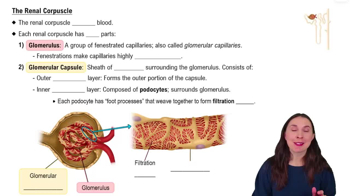
Corpuscles, such as tactile corpuscles (Meissner's corpuscles) and lamellated corpuscles (Pacinian corpuscles), are encapsulated mechanoreceptors that enhance sensitivity to specific types of mechanical stimuli. Tactile corpuscles are sensitive to light touch and vibration, while lamellated corpuscles respond to deep pressure and high-frequency vibrations, illustrating the diversity of mechanoreceptive functions.
추천 영상:
4:52
The Renal Corpuscle
관련 실천
교과서 질문

Why is visceral pain often perceived as cutaneous pain?

810
views
교과서 질문

Mark the following statements about the spinal cord as true or false. If a statement is false, correct it to make a true statement.

The corticospinal tracts are the main sensory tracts in the spinal cord.

549
views
교과서 질문

A receptor potential:

a. Always leads to an action potential

b. Never leads to an action potential

c. Causes hyperpolarization of the neuron

d. Leads to an action potential if the stimulus is strong enough

1056
views
교과서 질문

Place the following sequence of events for the detection of somatic sensation in the proper order. Place a 1 by the first event, a 2 by the second event, and so on.     

a. ______The central process transmits the action potential to a second-order sensory neuron in the CNS.     

b. ______The action potential is transferred to the central process in the posterior root ganglion.     

c. ______The stimulus triggers an action potential.     

d. ______The signal is transferred to other CNS sensory neurons for eventual perception and interpretation.     

e. ______The action potential is propagated along the peripheral process of the neuron.

734
views
교과서 질문

How do upper and lower motor neurons differ?

830
views
교과서 질문

Match the following nerves with the structures they innervate.     


____Phrenic nerve     

____Median nerve     

____Femoral nerve     

____Tibial nerve     

____Radial nerve     

____Intercostal nerves     

____Common fibular nerve     

____Musculocutaneous nerve


a. Motor to the triceps brachii muscle and muscles in the forearm that extend the hand; sensory from the posterior hand

b. Motor to the muscles in the anterior arm that flex the forearm; sensory from skin over the lateral forearm

c. Motor to the muscles in the anterior and lateral leg that evert and dorsiflex the foot; sensory from the skin of the anteroinferior leg

d. Motor to the diaphragm muscle

e. Motor to the muscles in the anterior thigh extend the knee; sensory from the skin over the anterior thigh and leg

f. Motor to the hamstring muscles that extend the thigh and flex the leg, muscles of the leg that plantarflex the foot, and muscles of the foot; sensory from the skin over the posterior and lateral leg and foot

g. Motor to the muscles between the ribs and the abdominal muscles; sensory from the skin over the abdomen

h. Motor to the muscles in the forearm that flex the hand, certain intrinsic hand muscles; sensory from the skin of the anterior hand

704
views