Ch. 14 The Autonomic Nervous System and Homeostasis
Amerman- Human Anatomy & Physiology 3e
Amerman3rd EditionHuman Anatomy & PhysiologyISBN: 9780138247201, 9780138247928, 9780138201814당신이 사용하는 게 아니라요?교과서 변경
14장, 문제 L3.1

The poison curare (kyoo-RAH-ray) blocks the binding of acetylcholine to its receptors at the neuromuscular junction. What effects would you predict from such a poison? Can you think of any useful applications for it? Why might an overdose of it be lethal?

검증된 단계별 안내
1
Understand the role of acetylcholine (ACh) at the neuromuscular junction: Acetylcholine is a neurotransmitter that binds to receptors on the muscle cell membrane (sarcolemma) to initiate muscle contraction. Blocking this binding prevents the muscle from receiving the signal to contract.
Predict the effects of curare: Since curare blocks ACh from binding to its receptors, it would lead to muscle paralysis. This is because the muscle fibers cannot depolarize and initiate contraction without the ACh-receptor interaction.
Consider potential applications: Curare or similar compounds can be used in controlled medical settings as muscle relaxants during surgeries to prevent involuntary muscle movements. This is particularly useful in procedures requiring complete muscle relaxation.
Explain why an overdose could be lethal: An overdose of curare could paralyze critical muscles, such as the diaphragm and intercostal muscles, which are essential for breathing. Without the ability to contract these muscles, respiratory failure would occur, leading to death if not treated promptly.
Discuss possible treatments for overdose: In cases of curare poisoning, treatments may include mechanical ventilation to support breathing and the administration of acetylcholinesterase inhibitors, which increase the concentration of acetylcholine in the synaptic cleft to compete with curare for receptor binding.

비슷한 문제에 대한 검증된 영상 답변:

이 영상 해법은 위 문제에 도움이 된다고 튜터들이 추천한 것입니다.

주요 개념

질문에 올바르게 답하기 위해 반드시 이해해야 하는 핵심 개념들은 다음과 같습니다.

Neuromuscular Junction

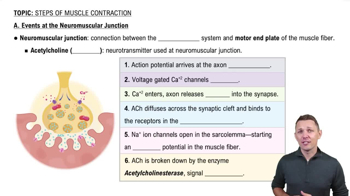
The neuromuscular junction is the synapse or connection point between a motor neuron and a muscle fiber. It is where the transmission of signals occurs, allowing muscles to contract. Acetylcholine, a neurotransmitter, is released from the motor neuron and binds to receptors on the muscle fiber, triggering muscle contraction. Understanding this process is crucial for predicting the effects of curare.
추천 영상:
5:56
A. Events at the Neuromuscular Junction

Acetylcholine Receptors

Acetylcholine receptors are specialized proteins located on the surface of muscle cells that bind acetylcholine. When acetylcholine binds to these receptors, it initiates a series of events leading to muscle contraction. Curare's action of blocking these receptors prevents muscle contraction, leading to paralysis. This concept is essential for understanding the physiological effects of curare.
추천 영상:
2:47
Sensory Receptors

Toxicology and Lethality

Toxicology is the study of the adverse effects of substances on living organisms. An overdose of curare can be lethal because it causes paralysis of the respiratory muscles, leading to respiratory failure. Without the ability to breathe, the body cannot obtain oxygen, resulting in death. This highlights the importance of dosage and the potential dangers of neurotoxic substances.
추천 영상:
7:55
Structure of the Sympathetic Nervous System