
Ch. 14 The Autonomic Nervous System and Homeostasis
Amerman- Human Anatomy & Physiology 3e
Amerman3rd EditionHuman Anatomy & PhysiologyISBN: 9780138247201, 9780138247928, 9780138201814당신이 사용하는 게 아니라요?교과서 변경
14장, 문제 1

Which of the following best describes the basic function of the autonomic nervous system?
a. Controls the somatic nervous system
b. Controls automatic functions to maintain homeostasis
c. Detects somatic sensory information
d. All of the above

검증된 단계별 안내
1
Step 1: Begin by understanding the autonomic nervous system (ANS). The ANS is a division of the peripheral nervous system responsible for regulating involuntary physiological processes, such as heart rate, blood pressure, digestion, and respiratory rate.
Step 2: Recall the concept of homeostasis. Homeostasis refers to the body's ability to maintain a stable internal environment despite external changes. The ANS plays a critical role in maintaining homeostasis by controlling automatic functions.
Step 3: Analyze the options provided in the question. Option (a) suggests the ANS controls the somatic nervous system, which is incorrect because the somatic nervous system is responsible for voluntary movements and is separate from the ANS. Option (c) suggests the ANS detects somatic sensory information, which is also incorrect because sensory information is processed by sensory neurons, not the ANS.
Step 4: Evaluate option (b). This option states that the ANS controls automatic functions to maintain homeostasis, which aligns with the primary role of the ANS. It regulates involuntary processes to ensure the body remains in balance.
Step 5: Consider option (d), which states 'All of the above.' Since options (a) and (c) are incorrect, option (d) cannot be correct. Therefore, the best description of the basic function of the ANS is option (b).

비슷한 문제에 대한 검증된 영상 답변:

이 영상 해법은 위 문제에 도움이 된다고 튜터들이 추천한 것입니다.
도움이 되었나요?

주요 개념

질문에 올바르게 답하기 위해 반드시 이해해야 하는 핵심 개념들은 다음과 같습니다.

Autonomic Nervous System (ANS)

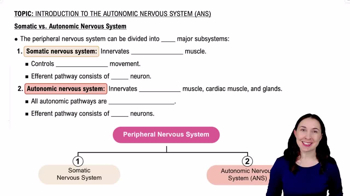
The autonomic nervous system is a component of the peripheral nervous system that regulates involuntary physiological functions, including heart rate, blood pressure, respiration, and digestion. It operates automatically, without conscious control, and is divided into the sympathetic and parasympathetic systems, which work together to maintain homeostasis.
추천 영상:
1:50
Somatic vs. Autonomic Nervous System

Homeostasis

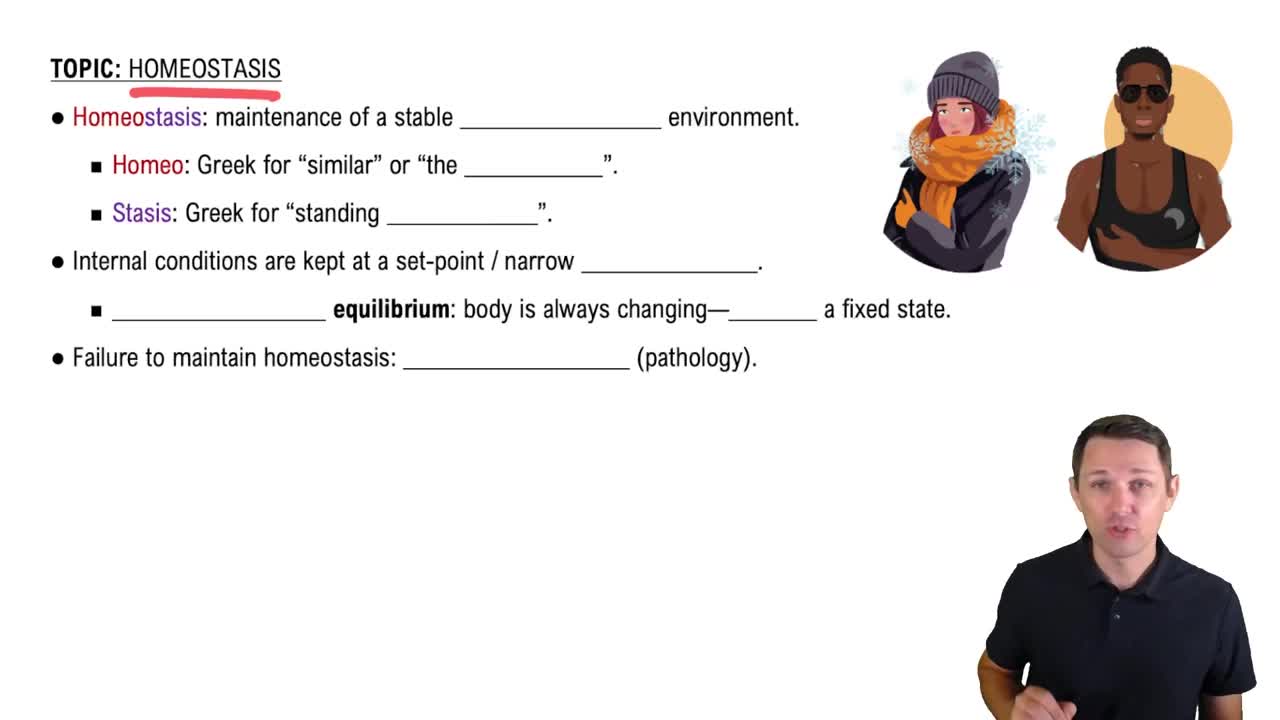
Homeostasis refers to the body's ability to maintain a stable internal environment despite external changes. This involves various physiological processes that regulate temperature, pH, hydration, and other vital conditions, ensuring that the body functions optimally. The autonomic nervous system plays a crucial role in achieving and maintaining homeostasis.
추천 영상:
01:59
Introduction to Homeostasis

Somatic Nervous System

The somatic nervous system is responsible for voluntary movements and the transmission of sensory information to the central nervous system. It controls skeletal muscles and mediates conscious sensations, such as touch and pain. In contrast to the autonomic nervous system, the somatic system requires conscious thought and is not involved in automatic bodily functions.
추천 영상:
1:50
Somatic vs. Autonomic Nervous System