Ch. 15 The Special Senses
Amerman- Human Anatomy & Physiology 3e
Amerman3rd EditionHuman Anatomy & PhysiologyISBN: 9780138247201, 9780138247928, 9780138201814당신이 사용하는 게 아니라요?교과서 변경
15장, 문제 21

Stimuli from the inner ear regarding head movement and position are sent to all of the following except the:
a. Vestibular nuclei
b. Oculomotor nucleus
c. Parietal lobe
d. Cerebellum.
e. Trigeminal nucleus

검증된 단계별 안내
1
Step 1: Understand the role of the inner ear in detecting head movement and position. The vestibular system, located in the inner ear, is responsible for sensing balance and spatial orientation. It sends signals to various parts of the brain to coordinate movement and maintain equilibrium.
Step 2: Identify the structures involved in processing vestibular information. The vestibular nuclei in the brainstem receive input from the inner ear and relay signals to other areas, including the oculomotor nuclei (for eye movement coordination) and the cerebellum (for balance and motor control).
Step 3: Recognize the role of the parietal lobe in sensory integration. While the parietal lobe processes sensory information, it is not directly involved in receiving vestibular input from the inner ear. This makes it a potential answer to the question.
Step 4: Examine the trigeminal nucleus. The trigeminal nucleus is primarily involved in processing sensory information from the face, such as touch and pain, and does not play a role in vestibular processing.
Step 5: Based on the analysis, determine which structure does not receive vestibular input. Compare the roles of the listed options and identify the one that is unrelated to head movement and position stimuli from the inner ear.

비슷한 문제에 대한 검증된 영상 답변:

이 영상 해법은 위 문제에 도움이 된다고 튜터들이 추천한 것입니다.
도움이 되었나요?

주요 개념

질문에 올바르게 답하기 위해 반드시 이해해야 하는 핵심 개념들은 다음과 같습니다.

Vestibular System

The vestibular system is a sensory system located in the inner ear that helps maintain balance and spatial orientation. It detects head movements and position relative to gravity, sending signals to various brain regions to coordinate balance and eye movements.
추천 영상:
가이드 코스
4:25
Complement System

Neural Pathways

Neural pathways are the routes through which signals travel in the nervous system. In the context of the vestibular system, these pathways connect the inner ear to various brain structures, including the vestibular nuclei, cerebellum, and oculomotor nucleus, facilitating the processing of balance and spatial information.
추천 영상:
가이드 코스
4:40
Alternative Pathway

Brain Regions Involved in Balance

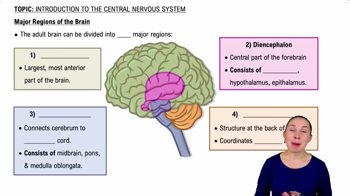
Several brain regions are involved in processing balance and spatial orientation, including the vestibular nuclei, cerebellum, and oculomotor nucleus. Each of these areas plays a distinct role in integrating sensory information and coordinating motor responses, while the parietal lobe is more involved in sensory perception and spatial awareness rather than direct balance control.
추천 영상:
3:10
Major Regions of the Brain