Ch. 17 The Cardiovascular System I: The Heart
Amerman- Human Anatomy & Physiology 3e
Amerman3rd EditionHuman Anatomy & PhysiologyISBN: 9780138247201, 9780138247928, 9780138201814당신이 사용하는 게 아니라요?교과서 변경
17장, 문제 8b

Mark the following statements as true or false. If a statement is false, correct it to make a true statement.
Pacemaker cells lack a distinct plateau phase.

검증된 단계별 안내
1
Step 1: Understand the role of pacemaker cells in the heart. Pacemaker cells are specialized cardiac cells responsible for generating and regulating the heart's rhythmic contractions. They are found in the sinoatrial (SA) node and atrioventricular (AV) node.
Step 2: Review the action potential phases of pacemaker cells. Unlike contractile cardiac cells, pacemaker cells have a unique action potential that includes three phases: Phase 4 (spontaneous depolarization), Phase 0 (rapid depolarization), and Phase 3 (repolarization).
Step 3: Recall that pacemaker cells do not have a distinct plateau phase. The plateau phase (Phase 2) is characteristic of contractile cardiac cells, where calcium influx balances potassium efflux, maintaining a prolonged depolarization. Pacemaker cells lack this phase because their action potential is designed for rhythmic firing rather than sustained contraction.
Step 4: Evaluate the statement provided. The statement 'Pacemaker cells lack a distinct plateau phase' is true based on the physiology of pacemaker cells.
Step 5: If the statement were false, the correction would involve clarifying that pacemaker cells do not exhibit a plateau phase due to their unique action potential designed for automaticity rather than contraction.

비슷한 문제에 대한 검증된 영상 답변:

이 영상 해법은 위 문제에 도움이 된다고 튜터들이 추천한 것입니다.
도움이 되었나요?

주요 개념

질문에 올바르게 답하기 위해 반드시 이해해야 하는 핵심 개념들은 다음과 같습니다.

Pacemaker Cells

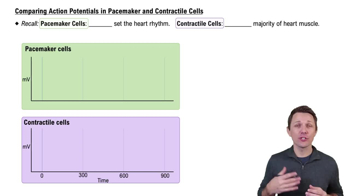
Pacemaker cells are specialized cardiac cells responsible for initiating and regulating the heartbeat. They generate electrical impulses that trigger heart contractions, primarily located in the sinoatrial (SA) node. Unlike other cardiac cells, pacemaker cells have an unstable resting membrane potential, allowing them to spontaneously depolarize and set the rhythm of the heart.
추천 영상:
가이드 코스
6:36
Comparing Action Potentials in Pacemaker and Contractile Cells

Plateau Phase

The plateau phase is a characteristic part of the action potential in cardiac muscle cells, particularly in ventricular myocytes. It is marked by a prolonged depolarization due to the influx of calcium ions, which helps prevent tetany and allows the heart to fill with blood before contracting again. Pacemaker cells do not exhibit this plateau phase, as their action potentials are shorter and primarily driven by different ionic currents.
추천 영상:
03:21
Phases of Mitosis

Action Potential

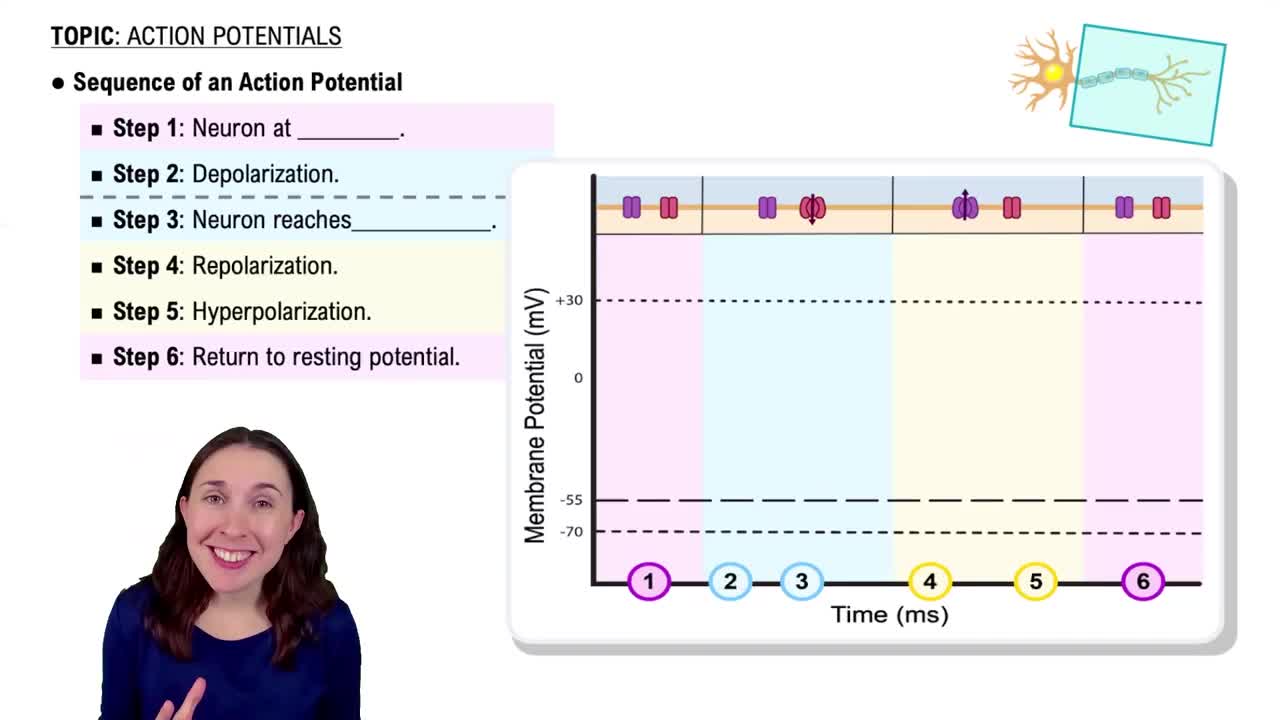
An action potential is a rapid change in membrane potential that occurs in excitable cells, such as neurons and muscle cells, including those in the heart. In cardiac cells, the action potential consists of several phases, including depolarization, plateau, and repolarization. Understanding the differences in action potentials between pacemaker cells and other cardiac cells is crucial for comprehending their distinct roles in heart function.
추천 영상:
03:53
Action Potential