Predict which would be more damaging to long-term survival: a blood clot lodged in the right coronary artery or one in the left coronary artery. Explain.
Ch. 18 The Cardiovascular System II: The Blood Vessels
Amerman3rd EditionHuman Anatomy & PhysiologyISBN: 9780138247201, 9780138247928, 9780138201814당신이 사용하는 게 아니라요?교과서 변경
18장, 문제 L2.2
Explain why a person who is 7 feet tall is likely to have higher blood pressure than a person whose height is 4 feet.
검증된 단계별 안내1
Understand the relationship between height and blood pressure: Blood pressure is influenced by the distance blood must travel from the heart to the extremities. Taller individuals have longer blood vessels, which can increase resistance to blood flow.
Consider the role of gravity: In taller individuals, the heart must work harder to pump blood against gravity to reach the upper extremities (e.g., the brain) and to return blood from the lower extremities (e.g., the legs). This increased workload can contribute to higher blood pressure.
Analyze the concept of vascular resistance: Longer blood vessels in taller individuals result in greater total peripheral resistance. According to the formula for blood flow, \( Q = \frac{\Delta P}{R} \), where \( Q \) is blood flow, \( \Delta P \) is the pressure difference, and \( R \) is resistance, higher resistance requires higher pressure to maintain adequate blood flow.
Examine the role of hydrostatic pressure: Hydrostatic pressure increases with height due to the column of blood in the vessels. Taller individuals experience greater hydrostatic pressure in their lower extremities, which can contribute to overall higher blood pressure.
Consider the physiological adaptations: While taller individuals may have higher blood pressure due to these factors, their cardiovascular system may adapt over time to compensate for the increased demands, such as stronger heart muscles or more efficient blood vessel regulation.

비슷한 문제에 대한 검증된 영상 답변:
이 영상 해법은 위 문제에 도움이 된다고 튜터들이 추천한 것입니다.
주요 개념
질문에 올바르게 답하기 위해 반드시 이해해야 하는 핵심 개념들은 다음과 같습니다.
Height and Blood Pressure Relationship
Research indicates that taller individuals often experience higher blood pressure due to the increased volume of blood required to supply their larger body mass. This relationship is influenced by the need for the heart to exert more force to circulate blood throughout a greater distance, leading to elevated pressure levels.
추천 영상:
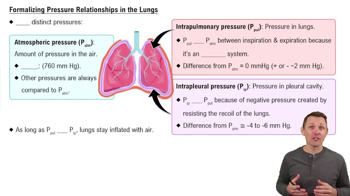
Formalizing Pressure Relationships in the Lungs
Body Mass Index (BMI)
BMI is a measure that relates body weight to height, providing insight into body composition. A higher BMI, often associated with taller individuals, can contribute to increased blood pressure as excess weight can strain the cardiovascular system, leading to hypertension over time.
추천 영상:
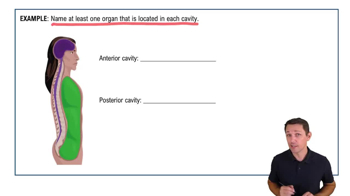
Organization of the Body: Body Cavities Example 1
Cardiovascular System Dynamics
The cardiovascular system's dynamics involve the heart's ability to pump blood and the resistance encountered in blood vessels. Taller individuals may have larger blood vessels and increased vascular resistance, which can elevate blood pressure as the heart works harder to maintain adequate blood flow throughout the body.
추천 영상:
가이드 코스
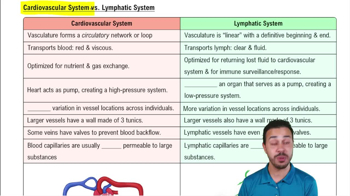
Cardiovascular System vs. Lymphatic System
관련 실천
교과서 질문
886
views
1
rank
교과서 질문
A birth defect called transposition of great vessels results in the pulmonary trunk emanating from the left ventricle and the aorta stemming from the right ventricle.
Predict the potential effects of this birth defect.
749
views
교과서 질문
Collagen vascular diseases weaken the collagen in the tunica externa of blood vessels. Predict the effects of such a disease.
933
views
교과서 질문
Explain why a severed artery spurts blood, whereas a severed vein merely leaks blood.
929
views
교과서 질문
The carotid sinus contains:
a. Baroreceptors
b. Chemoreceptors
c. Metabolic controls
d. Smooth muscle cells
1054
views
교과서 질문
Predict the effects of each of the following on systemic arterial blood pressure:
Caffeine consumption, which increases heart rate and causes vasoconstriction
667
views