Ch. 18 The Cardiovascular System II: The Blood Vessels
Amerman- Human Anatomy & Physiology 3e
Amerman3rd EditionHuman Anatomy & PhysiologyISBN: 9780138247201, 9780138247928, 9780138201814당신이 사용하는 게 아니라요?교과서 변경
18장, 문제 1d

Mark the following statements as true or false. If a statement is false, correct it to make a true statement.
Muscular arteries control blood flow at the tissue level.

검증된 단계별 안내
1
Step 1: Understand the role of muscular arteries in the circulatory system. Muscular arteries are medium-sized arteries that distribute blood to specific organs and tissues. They are characterized by a thick tunica media containing smooth muscle cells.
Step 2: Recall the primary function of muscular arteries. Their main role is to regulate blood flow and pressure by vasoconstriction (narrowing of the vessel) or vasodilation (widening of the vessel). However, they do not directly control blood flow at the tissue level.
Step 3: Identify the vessels responsible for controlling blood flow at the tissue level. Blood flow at the tissue level is primarily regulated by arterioles, which are smaller branches of arteries. Arterioles adjust blood flow to tissues by altering their diameter in response to local signals such as oxygen demand or metabolic activity.
Step 4: Evaluate the statement provided in the problem. The statement 'Muscular arteries control blood flow at the tissue level' is false because muscular arteries distribute blood to organs, while arterioles are responsible for fine-tuning blood flow at the tissue level.
Step 5: Correct the false statement to make it true. The corrected statement would be: 'Arterioles control blood flow at the tissue level.'

비슷한 문제에 대한 검증된 영상 답변:

이 영상 해법은 위 문제에 도움이 된다고 튜터들이 추천한 것입니다.
도움이 되었나요?

주요 개념

질문에 올바르게 답하기 위해 반드시 이해해야 하는 핵심 개념들은 다음과 같습니다.

Muscular Arteries

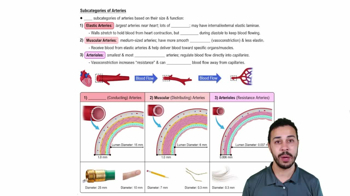
Muscular arteries, also known as distributing arteries, are medium-sized blood vessels that primarily regulate blood flow to specific organs and tissues. They have a thicker muscular layer compared to elastic arteries, allowing them to constrict and dilate effectively, thus controlling blood distribution based on the body's needs.
추천 영상:
가이드 코스
14:43
Subcategories of Arteries

Blood Flow Regulation

Blood flow regulation refers to the mechanisms by which the body adjusts the distribution and volume of blood to various tissues. This process is crucial for maintaining homeostasis and is influenced by factors such as vascular resistance, blood pressure, and the metabolic demands of tissues.
추천 영상:
가이드 코스
6:40
Relationship Between Blood Flow, Pressure, & Resistance

Tissue Perfusion

Tissue perfusion is the process of delivering blood to capillary beds in tissues, ensuring that they receive adequate oxygen and nutrients. Effective perfusion is vital for cellular function and is influenced by the diameter of blood vessels, particularly the role of muscular arteries in adjusting blood flow to meet the metabolic needs of different tissues.
추천 영상:
가이드 코스
4:55
Lymphoid Tissue