Ch. 18 The Cardiovascular System II: The Blood Vessels
Amerman- Human Anatomy & Physiology 3e
Amerman3rd EditionHuman Anatomy & PhysiologyISBN: 9780138247201, 9780138247928, 9780138201814당신이 사용하는 게 아니라요?교과서 변경
18장, 문제 17

Match the following arteries with the correct description. 
__Radial artery      
__Celiac trunk      
__Basilar artery       
__Superior mesenteric artery      
__Dorsalis pedis artery      
__Femoral artery      
__Internal iliac artery      
__Renal artery      
__Internal carotid artery      
__Subclavian artery
a. Supplies the small intestine and most of the large intestine 
b. Supplies the pelvis 
c. Supplies the upper limb 
d. Located in the lateral forearm 
e. Provides the blood supply to the lower limb 
f. Supplies the brain via the anterior and middle cerebral arteries 
g. Large single branch off the aorta that supplies the liver, stomach, duodenum, and spleen 
h. Supplies the foot and ankle 
i. Supplies the kidney 
j. Forms from the fusion of the two vertebral arteries 

검증된 단계별 안내
1
Step 1: Begin by identifying the anatomical location and function of each artery listed in the problem. For example, the radial artery is located in the lateral forearm, and the renal artery supplies the kidneys.
Step 2: Match each artery to its corresponding description based on its anatomical role. For instance, the radial artery matches with 'd. Located in the lateral forearm,' and the renal artery matches with 'i. Supplies the kidney.'
Step 3: Use your knowledge of systemic circulation to match arteries that supply specific organs or regions. For example, the celiac trunk supplies the liver, stomach, duodenum, and spleen, which corresponds to 'g. Large single branch off the aorta that supplies the liver, stomach, duodenum, and spleen.'
Step 4: Consider arteries that supply broader regions, such as the femoral artery, which provides blood to the lower limb, matching it with 'e. Provides the blood supply to the lower limb.' Similarly, the subclavian artery supplies the upper limb, matching it with 'c. Supplies the upper limb.'
Step 5: For arteries involved in specialized functions, such as the basilar artery formed by the fusion of vertebral arteries, match it with 'j. Forms from the fusion of the two vertebral arteries.' Continue this process for all remaining arteries and descriptions.

비슷한 문제에 대한 검증된 영상 답변:

이 영상 해법은 위 문제에 도움이 된다고 튜터들이 추천한 것입니다.

주요 개념

질문에 올바르게 답하기 위해 반드시 이해해야 하는 핵심 개념들은 다음과 같습니다.

Arterial Supply

Arterial supply refers to the network of arteries that deliver oxygenated blood to various organs and tissues in the body. Each artery has a specific region or organ it supplies, which is crucial for maintaining the function and health of that area. Understanding the arterial supply is essential for identifying the role of each artery in the circulatory system.
추천 영상:
가이드 코스
14:43
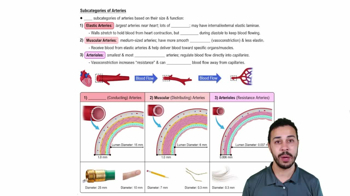
Subcategories of Arteries

Anatomical Location

Anatomical location pertains to the specific position of arteries within the body. This includes their proximity to other structures and their pathways. Knowledge of anatomical location helps in understanding how blood flows through the body and the relationships between different arteries, which is vital for matching them with their descriptions.
추천 영상:
3:55
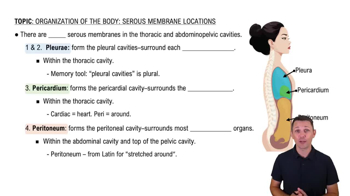
Locations of Serous Membranes

Function of Major Arteries

The function of major arteries involves their roles in supplying blood to critical areas. For instance, the renal artery supplies the kidneys, while the celiac trunk supplies the digestive organs. Recognizing the function of these arteries is key to accurately matching them with their respective descriptions, as each artery serves a distinct physiological purpose.
추천 영상:
가이드 코스
3:23
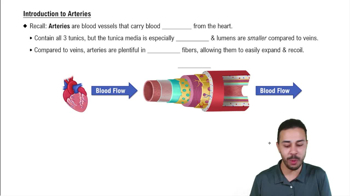
Introduction to Arteries
관련 실천
교과서 질문

Which of the following vessels does not drain into the hepatic portal vein?

a. Splenic vein

b. Inferior mesenteric vein

c. Gastric vein

d. Renal vein

e. Superior mesenteric vein

1091
views
1
rank
교과서 질문

The hydrostatic pressure gradient drives water _____ capillaries, and the colloid osmotic pressure draws water ____ capillaries.

a. out of; out of

b. out of; into

c. into; out of

d. into; into

928
views
교과서 질문

Mark the following statements as true or false. If a statement is false, correct it to make a true statement.

The increase in tissue perfusion in skeletal muscle that occurs during exercise is known as hyperemia.

793
views
교과서 질문

Which of the following is not a common pulse point?

a. Femoral artery

b. Subclavian artery

c. Common carotid artery

d. Brachial artery

1203
views
교과서 질문

Match the following veins with the correct description. 

__Cephalic vein      

__Great saphenous vein      

__Dural sinus      

__Azygos vein      

__Hepatic portal vein      

__Splenic vein      

__Internal jugular vein      

__Brachiocephalic veins       

__Brachial vein      

__Inferior mesenteric vein

a. Drains the posterior abdominal and thoracic walls

b. Two veins merge to form the superior vena cava

c. Receives blood from the spleen and digestive organs

d. Superficial vein in the medial leg

e. Drains the brain and face

f. Drains part of the large intestine

g. Superficial vein in the lateral upper limb

h. Deep vein of the arm

i. Drains the spleen

j. Drain the brain capillaries and cerebrospinal fluid

837
views
교과서 질문

Mark the following statements as true or false. If a statement is false, correct it to make a true statement.

The sympathetic nervous system causes vasodilation in the skin when body temperature decreases.

947
views