Ch. 2 The Chemistry of Life
Amerman- Human Anatomy & Physiology 3e
Amerman3rd EditionHuman Anatomy & PhysiologyISBN: 9780138247201, 9780138247928, 9780138201814당신이 사용하는 게 아니라요?교과서 변경
2장, 문제 1a

Mark the following statements as true or false. If a statement is false, correct it to make a true statement.
The mass number of an atom is the sum of its neutrons and protons.

검증된 단계별 안내
1
Step 1: Understand the concept of mass number. The mass number of an atom is defined as the total number of protons and neutrons in the nucleus of the atom. This is a fundamental concept in chemistry and physics.
Step 2: Analyze the given statement: 'The mass number of an atom is the sum of its neutrons and protons.' Compare this statement to the definition of mass number provided in Step 1.
Step 3: Determine if the statement is true or false. Since the definition of mass number matches the given statement, the statement is true.
Step 4: If the statement were false, you would need to correct it. For example, if the statement incorrectly said 'The mass number of an atom is the sum of its electrons and protons,' you would correct it to 'The mass number of an atom is the sum of its neutrons and protons.'
Step 5: Conclude that the given statement is true and does not require correction.

비슷한 문제에 대한 검증된 영상 답변:

이 영상 해법은 위 문제에 도움이 된다고 튜터들이 추천한 것입니다.
도움이 되었나요?

주요 개념

질문에 올바르게 답하기 위해 반드시 이해해야 하는 핵심 개념들은 다음과 같습니다.

Mass Number

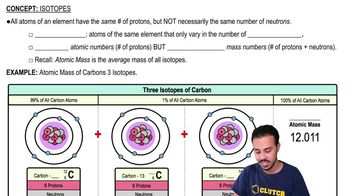
The mass number of an atom is defined as the total number of protons and neutrons in its nucleus. It is a whole number that reflects the atom's overall mass, as protons and neutrons contribute significantly to the atomic mass, while electrons have negligible mass. For example, a carbon atom with 6 protons and 6 neutrons has a mass number of 12.
추천 영상:

Protons and Neutrons

Protons are positively charged particles found in the nucleus of an atom, while neutrons are neutral particles that also reside in the nucleus. The number of protons determines the atomic number and the element's identity, while neutrons contribute to the mass number and can affect the stability of the nucleus. For instance, isotopes of an element differ in the number of neutrons.
추천 영상:
가이드 코스
01:43
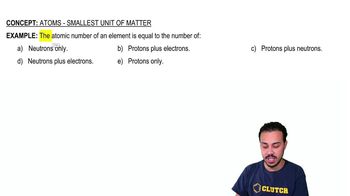
Atoms- Smallest Unit of Matter Example 2

Atomic Structure

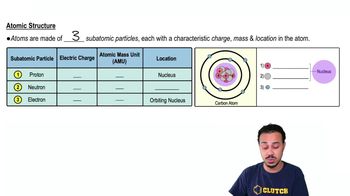
Atomic structure refers to the arrangement of subatomic particles within an atom, including protons, neutrons, and electrons. Understanding atomic structure is crucial for grasping how elements interact, form bonds, and participate in chemical reactions. The nucleus, containing protons and neutrons, is surrounded by a cloud of electrons, which occupy specific energy levels.
추천 영상:
가이드 코스
04:48
Atomic Structure