
Ch. 2 The Chemistry of Life
Amerman- Human Anatomy & Physiology 3e
Amerman3rd EditionHuman Anatomy & PhysiologyISBN: 9780138247201, 9780138247928, 9780138201814당신이 사용하는 게 아니라요?교과서 변경
2장, 문제 12

With respect to their solubility in water, substances with nonpolar covalent bonds are__________, while substances with polar covalent and ionic bonds are__________.

검증된 단계별 안내
1
Understand the concept of solubility: Solubility in water depends on the chemical nature of the substance. Water is a polar solvent, meaning it has regions of partial positive and negative charges due to its molecular structure.
Review the nature of nonpolar covalent bonds: Nonpolar covalent bonds occur when electrons are shared equally between atoms, resulting in no significant charge separation. Substances with nonpolar covalent bonds are hydrophobic (water-fearing) and do not dissolve well in water.
Examine the nature of polar covalent bonds: Polar covalent bonds occur when electrons are shared unequally between atoms, creating partial positive and negative charges. Substances with polar covalent bonds are hydrophilic (water-loving) and tend to dissolve in water.
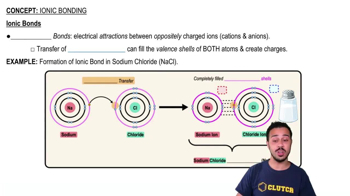
Understand ionic bonds: Ionic bonds involve the transfer of electrons, creating positively charged cations and negatively charged anions. These charged particles interact strongly with water molecules, making ionic compounds generally soluble in water.
Summarize the relationship: Substances with nonpolar covalent bonds are insoluble in water, while substances with polar covalent and ionic bonds are soluble in water due to their ability to interact with the polar nature of water molecules.

비슷한 문제에 대한 검증된 영상 답변:

이 영상 해법은 위 문제에 도움이 된다고 튜터들이 추천한 것입니다.

주요 개념

질문에 올바르게 답하기 위해 반드시 이해해야 하는 핵심 개념들은 다음과 같습니다.

Polarity of Molecules

Polarity refers to the distribution of electrical charge over the atoms in a molecule. Nonpolar covalent bonds occur when electrons are shared equally between atoms, resulting in no significant charge difference. In contrast, polar covalent bonds involve unequal sharing of electrons, leading to partial positive and negative charges, which affects solubility in water.
추천 영상:
가이드 코스
7:17
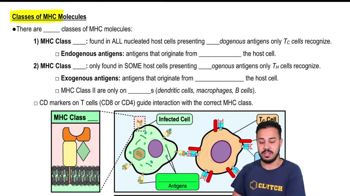
Classes of MHC Molecules

Solubility Principles

Solubility is the ability of a substance to dissolve in a solvent, typically water. The principle 'like dissolves like' indicates that polar substances tend to dissolve well in polar solvents (like water), while nonpolar substances do not. This is due to the interactions between molecules; polar molecules interact through dipole-dipole forces and hydrogen bonding, while nonpolar molecules rely on weaker van der Waals forces.
추천 영상:
3:49
Glomerular Filtration Pressure

Ionic vs. Covalent Bonds

Ionic bonds form between atoms that transfer electrons, resulting in charged ions that attract each other. These compounds are generally soluble in water due to the strong interactions between the ions and water molecules. In contrast, covalent bonds involve the sharing of electrons, and the solubility of covalent compounds in water depends on their polarity, with polar covalent compounds being more soluble than nonpolar ones.
추천 영상: