Ch. 20 The Lymphatic System and Immunity
Amerman- Human Anatomy & Physiology 3e
Amerman3rd EditionHuman Anatomy & PhysiologyISBN: 9780138247201, 9780138247928, 9780138201814당신이 사용하는 게 아니라요?교과서 변경
20장, 문제 11

Match the following antibodies with the correct definition.
____IgD     
____IgM     
____IgG     
____IgA     
____IgE
a. Antibody found in secretions
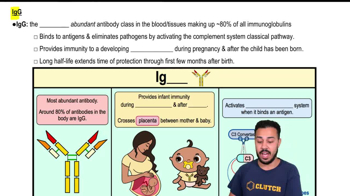
b. Most common antibody; crosses the placenta
c. Antibody involved in allergies and parasitic infections
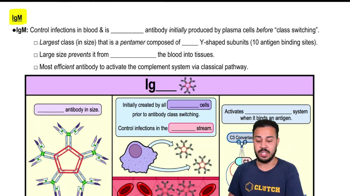
d. Pentamer and potent agglutinating agent
e. Antibody bound to the B cell plasma membrane

검증된 단계별 안내
1
Step 1: Understand the function and location of each antibody type. Antibodies (immunoglobulins) are specialized proteins produced by B cells to help the immune system fight pathogens. Each type has a unique role and location in the body.
Step 2: Match IgD with its definition. IgD is primarily found bound to the plasma membrane of immature B cells and plays a role in initiating B cell activation. Therefore, it corresponds to definition 'e'.
Step 3: Match IgM with its definition. IgM is the first antibody produced during an immune response. It is a pentamer and is highly effective at agglutinating pathogens. This matches definition 'd'.
Step 4: Match IgG with its definition. IgG is the most abundant antibody in the blood and extracellular fluid. It can cross the placenta to provide passive immunity to the fetus. This corresponds to definition 'b'.
Step 5: Match IgA and IgE with their definitions. IgA is found in secretions like saliva, tears, and mucus, matching definition 'a'. IgE is involved in allergic reactions and defense against parasitic infections, matching definition 'c'.

비슷한 문제에 대한 검증된 영상 답변:

이 영상 해법은 위 문제에 도움이 된다고 튜터들이 추천한 것입니다.
도움이 되었나요?

주요 개념

질문에 올바르게 답하기 위해 반드시 이해해야 하는 핵심 개념들은 다음과 같습니다.

Types of Immunoglobulins

Immunoglobulins, or antibodies, are specialized proteins produced by B cells that play a crucial role in the immune response. There are five main classes: IgA, IgD, IgE, IgG, and IgM, each with distinct functions and locations in the body. Understanding these types is essential for matching them to their definitions, as each class has unique characteristics and roles in immune defense.
추천 영상:
가이드 코스
01:06
Types of Phosphorylation

Function of IgG

IgG is the most abundant antibody in the bloodstream and is known for its ability to cross the placenta, providing passive immunity to the fetus. It plays a vital role in the secondary immune response, neutralizing toxins and pathogens, and facilitating opsonization, which enhances phagocytosis. Recognizing its significance helps in identifying its correct definition in the matching exercise.
추천 영상:

Role of IgM

IgM is the first antibody produced in response to an infection and is typically found in a pentameric form, making it an effective agglutinating agent. It is primarily present in the blood and lymphatic fluid and is crucial for the initial stages of the immune response. Understanding its structure and function is key to accurately matching it with its definition.
추천 영상: