Ch. 21 The Respiratory System
Amerman- Human Anatomy & Physiology 3e
Amerman3rd EditionHuman Anatomy & PhysiologyISBN: 9780138247201, 9780138247928, 9780138201814당신이 사용하는 게 아니라요?교과서 변경
21장, 문제 10a

Mark the following statements as true or false. If a statement is false, correct it to make a true statement.
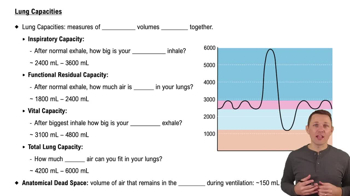
The functional residual capacity is the volume of air normally left in the lungs after a tidal expiration.

검증된 단계별 안내
1
Step 1: Understand the term 'functional residual capacity' (FRC). FRC refers to the volume of air remaining in the lungs after a normal tidal expiration. It is the sum of the expiratory reserve volume (ERV) and the residual volume (RV).
Step 2: Analyze the statement provided. The statement claims that the functional residual capacity is the volume of air normally left in the lungs after a tidal expiration. Compare this definition with the correct definition of FRC.
Step 3: Determine if the statement is true or false. Based on the definition of FRC, the statement is true because it accurately describes the volume of air left in the lungs after a tidal expiration.
Step 4: If the statement were false, you would need to correct it. For example, if the statement incorrectly defined FRC as the total lung capacity or another lung volume, you would rewrite it to reflect the correct definition.
Step 5: Conclude that the statement is true and does not require correction, as it aligns with the proper definition of functional residual capacity.

비슷한 문제에 대한 검증된 영상 답변:

이 영상 해법은 위 문제에 도움이 된다고 튜터들이 추천한 것입니다.
도움이 되었나요?

주요 개념

질문에 올바르게 답하기 위해 반드시 이해해야 하는 핵심 개념들은 다음과 같습니다.

Functional Residual Capacity (FRC)

Functional Residual Capacity (FRC) is the volume of air remaining in the lungs after a normal tidal expiration. It is a crucial measure in respiratory physiology, reflecting the balance between the forces that expand the lungs and those that compress them. FRC is important for understanding lung mechanics and gas exchange efficiency.
추천 영상:
가이드 코스
6:38
Lung Capacities

Tidal Volume (TV)

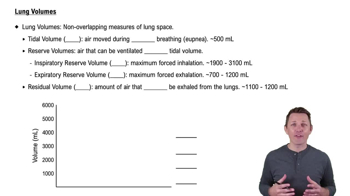
Tidal Volume (TV) is the amount of air inhaled or exhaled during a normal breath. It is a key component in calculating lung volumes and capacities, including FRC. Understanding TV helps in assessing respiratory function and can indicate various pulmonary conditions when measured alongside other lung volumes.
추천 영상:

Lung Volumes and Capacities

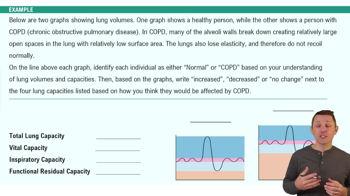
Lung volumes and capacities are measurements that describe the different amounts of air the lungs can hold during various phases of the respiratory cycle. These include tidal volume, inspiratory reserve volume, expiratory reserve volume, and residual volume. Knowledge of these concepts is essential for interpreting pulmonary function tests and diagnosing respiratory disorders.
추천 영상:
가이드 코스
6:18
Lung Volumes and Capacities Example 2
관련 실천
교과서 질문

Mark the following statements as true or false. If a statement is false, correct it to make a true statement.

The tidal volume is the amount of air left in the lungs after maximal expiration.

657
views

교과서 질문

Which of the following statements about pulmonary ventilation is false?

a. Normal expiration requires the use of the expiratory muscles to decrease lung volume.

b. The inspiratory muscles increase lung volume, which decreases intrapulmonary pressure.

c. For inspiration to occur, intrapulmonary pressure must decrease below atmospheric pressure.

d. The intrapleural pressure is less than the intrapulmonary pressure; this prevents the lungs from collapsing during expiration.

955
views
교과서 질문

Mark the following statements as true or false. If a statement is false, correct it to make a true statement.

The vital capacity is the total amount of exchangeable air.

708
views
교과서 질문

Mark the following statements as true or false. If a statement is false, correct it to make a true statement.

The inspiratory capacity is equal to the vital capacity plus the tidal volume.

676
views
교과서 질문

The function of the epiglottis is to:

a. Contract muscularly to cover the laryngopharynx

b. Vibrate to produce sound

c. Trigger a cough reflex

d. Cover the glottis during swallowing

134
views
교과서 질문

Match each term with the correct definition. 

Airway resistance     

Surface tension     

Surfactant     

Pulmonary compliance     

V/Q ratio

a. A detergent-like chemical secreted by bronchial smooth muscle that reduces surface tension

b. The matching of ventilation to perfusion

c. Largely determined by the diameter of the airways

d. Caused by the formation of hydrogen bonds between water molecules

e. Determined by the surface tension of the alveoli, the elastic tissue of the lungs, and the condition of the chest wall

777
views