Ch. 22 The Digestive System
Amerman- Human Anatomy & Physiology 3e
Amerman3rd EditionHuman Anatomy & PhysiologyISBN: 9780138247201, 9780138247928, 9780138201814당신이 사용하는 게 아니라요?교과서 변경
22장, 문제 15

Which of the following best describes the role of bile salts in lipid digestion?
a. Bile salts begin chemical digestion of lipids.
b. Bile salts bind to lipids and physically break them apart into monoglycerides and free fatty acids.
c. Bile salts bind to lipids and physically break them apart into smaller pieces.
d. Bile salts interact with pancreatic lipase and catalyze lipid breakdown.

검증된 단계별 안내
1
Understand the role of bile salts in lipid digestion: Bile salts are produced by the liver and stored in the gallbladder. They are released into the small intestine to aid in the digestion of lipids (fats). Their primary function is to emulsify fats, which means breaking large fat globules into smaller droplets to increase the surface area for enzymatic action.
Clarify the process of lipid digestion: Lipid digestion involves two main steps. First, bile salts emulsify fats into smaller droplets. Second, pancreatic lipase (an enzyme) chemically breaks down these smaller fat droplets into monoglycerides and free fatty acids.
Eliminate incorrect options: Option (a) is incorrect because bile salts do not chemically digest lipids; they only emulsify them. Option (b) is incorrect because bile salts do not directly break lipids into monoglycerides and free fatty acids; this is the role of pancreatic lipase. Option (d) is incorrect because bile salts do not catalyze lipid breakdown; they facilitate the process by increasing the surface area for enzymes.
Focus on the correct description: Option (c) is correct because bile salts bind to lipids and physically break them apart into smaller pieces (emulsification). This process is mechanical, not chemical, and it prepares lipids for enzymatic digestion by pancreatic lipase.
Summarize the key concept: Bile salts play a crucial role in lipid digestion by emulsifying fats, which increases the efficiency of enzymatic breakdown by pancreatic lipase. This process is essential for the absorption of lipids in the small intestine.

비슷한 문제에 대한 검증된 영상 답변:

이 영상 해법은 위 문제에 도움이 된다고 튜터들이 추천한 것입니다.

주요 개념

질문에 올바르게 답하기 위해 반드시 이해해야 하는 핵심 개념들은 다음과 같습니다.

Bile Salts

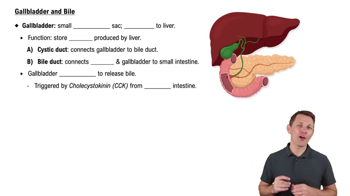
Bile salts are amphipathic molecules derived from cholesterol, produced in the liver and stored in the gallbladder. They play a crucial role in the emulsification of dietary fats, allowing for better interaction with digestive enzymes. Their structure enables them to interact with both water and lipids, facilitating the breakdown of large fat globules into smaller droplets.
추천 영상:
6:54
Gallbladder and Bile

Emulsification

Emulsification is the process by which bile salts disperse fats into smaller droplets, increasing the surface area for digestive enzymes to act upon. This physical breakdown is essential for lipid digestion, as it allows enzymes like pancreatic lipase to access and hydrolyze triglycerides into monoglycerides and free fatty acids, which can then be absorbed by the intestinal lining.

Pancreatic Lipase

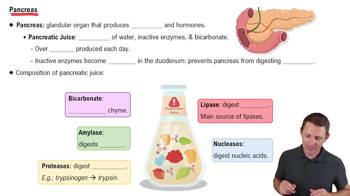
Pancreatic lipase is an enzyme secreted by the pancreas that catalyzes the hydrolysis of triglycerides into monoglycerides and free fatty acids. It requires the presence of bile salts for optimal activity, as the emulsification of fats by bile salts enhances the enzyme's ability to access and break down lipid molecules. This enzymatic action is vital for the digestion and absorption of dietary fats.
추천 영상:
4:46
Pancreas