Ch. 25 Fluid, Electrolyte, and Acid-Base Homeostasis
Amerman- Human Anatomy & Physiology 3e
Amerman3rd EditionHuman Anatomy & PhysiologyISBN: 9780138247201, 9780138247928, 9780138201814당신이 사용하는 게 아니라요?교과서 변경
25장, 문제 5

A cell in a/an ________ fluid will lose water, and a cell in a/an ________ fluid will gain water.

검증된 단계별 안내
1
Step 1: Understand the concept of tonicity, which refers to the ability of a surrounding solution to cause a cell to gain or lose water. Tonicity is determined by the concentration of solutes in the solution relative to the solutes inside the cell.
Step 2: Define the three types of solutions based on tonicity: hypertonic, hypotonic, and isotonic. A hypertonic solution has a higher solute concentration than the cell, a hypotonic solution has a lower solute concentration than the cell, and an isotonic solution has an equal solute concentration to the cell.
Step 3: Analyze the behavior of water movement in a hypertonic solution. Water moves out of the cell into the surrounding solution due to osmosis, causing the cell to lose water and shrink (crenation in animal cells).
Step 4: Analyze the behavior of water movement in a hypotonic solution. Water moves into the cell from the surrounding solution due to osmosis, causing the cell to gain water and potentially swell or burst (lysis in animal cells).
Step 5: Fill in the blanks based on the above analysis: A cell in a hypertonic fluid will lose water, and a cell in a hypotonic fluid will gain water.

비슷한 문제에 대한 검증된 영상 답변:

이 영상 해법은 위 문제에 도움이 된다고 튜터들이 추천한 것입니다.

주요 개념

질문에 올바르게 답하기 위해 반드시 이해해야 하는 핵심 개념들은 다음과 같습니다.

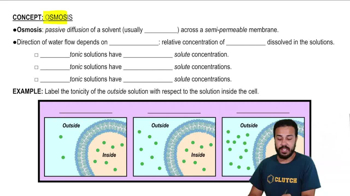
Osmosis

Osmosis is the movement of water across a semipermeable membrane from an area of lower solute concentration to an area of higher solute concentration. This process is crucial for maintaining cell turgor and overall homeostasis. Understanding osmosis helps explain how cells interact with their surrounding fluids, particularly in terms of water loss and gain.
추천 영상:

Hypertonic Solution

A hypertonic solution has a higher concentration of solutes compared to the inside of a cell. When a cell is placed in a hypertonic solution, water moves out of the cell to balance solute concentrations, leading to cell shrinkage or crenation. This concept is essential for understanding why cells lose water in certain environments.
추천 영상:
가이드 코스
02:19
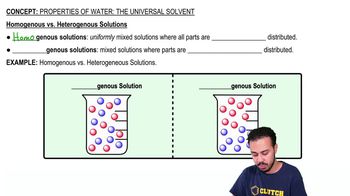
Homogenous vs. Heterogenous Solutions

Hypotonic Solution

A hypotonic solution has a lower concentration of solutes than the inside of a cell. When a cell is immersed in a hypotonic solution, water enters the cell, causing it to swell and potentially burst. This concept is vital for understanding how cells gain water and the effects of different fluid environments on cellular integrity.
추천 영상:
가이드 코스
02:19
Homogenous vs. Heterogenous Solutions
관련 실천
교과서 질문

What do you think has happened to Elise's ECF volume and osmolarity over the past 3 days? Will this lead to a change in the volume of water in the cytosol of her cells? Explain.

472
views

교과서 질문

As a percentage of body weight, the total body water tends to be higher in ________ and lower in ________ .

a. infants; men

b. women; men

c. men; infants

d. infants; women

471
views
교과서 질문

A laboratory printout of arterial blood gases indicates that a patient has an increased Pco₂ , decreased pH, and normal bicarbonate ion concentration. Is this patient in acidosis or alkalosis? Is the pH disturbance respiratory or metabolic in nature? Explain your reasoning. How long do you think the patient has had this pH disturbance? (Hint: Look at the bicarbonate ion concentration. What system controls the concentration of bicarbonate ions, and how quickly does it compensate for pH disturbances?)

361
views
교과서 질문

Mark the following statements as true or false. If a statement is false, correct it to make a true statement.

b. The sensible water loss includes the water lost from the body via the skin and the respiratory system.

417
views
교과서 질문

Mark the following statements as true or false. If a statement is false, correct it to make a true statement.

c. The main hormone that regulates fluid balance is antidiuretic hormone (ADH).

416
views
교과서 질문

Mark the following statements as true or false. If a statement is false, correct it to make a true statement.

a. The thirst mechanism is mediated by osmoreceptors located in the cerebral cortex.

392
views