Ch. 25 Fluid, Electrolyte, and Acid-Base Homeostasis
Amerman- Human Anatomy & Physiology 3e
Amerman3rd EditionHuman Anatomy & PhysiologyISBN: 9780138247201, 9780138247928, 9780138201814당신이 사용하는 게 아니라요?교과서 변경
25장, 문제 L2.1

Your friend argues that all water conducts electricity, regardless of what it contains. You prepare three liquids to test this hypothesis: one with distilled water (with no solutes, only water molecules), one with 5% glucose in distilled water, and one with 5% sodium chloride in water. Which of these solutions, if any, will conduct an electric current? Explain.

검증된 단계별 안내
1
Step 1: Begin by understanding the concept of electrical conductivity in liquids. Electrical conductivity depends on the presence of charged particles (ions) in the solution. Pure water (distilled water) has very few ions and is a poor conductor of electricity.
Step 2: Analyze the first solution, distilled water. Since distilled water contains only water molecules and no dissolved ions, it will not conduct electricity effectively.
Step 3: Examine the second solution, 5% glucose in distilled water. Glucose is a covalent compound and does not dissociate into ions when dissolved in water. Therefore, this solution will also not conduct electricity.
Step 4: Evaluate the third solution, 5% sodium chloride in water. Sodium chloride (NaCl) is an ionic compound that dissociates into sodium (Na⁺) and chloride (Cl⁻) ions when dissolved in water. These ions allow the solution to conduct electricity.
Step 5: Conclude that the solution containing sodium chloride will conduct electricity due to the presence of free ions, while the solutions with distilled water and glucose will not conduct electricity because they lack free ions.

비슷한 문제에 대한 검증된 영상 답변:

이 영상 해법은 위 문제에 도움이 된다고 튜터들이 추천한 것입니다.

주요 개념

질문에 올바르게 답하기 위해 반드시 이해해야 하는 핵심 개념들은 다음과 같습니다.

Electrical Conductivity

Electrical conductivity refers to the ability of a substance to conduct electric current. This property is influenced by the presence of charged particles, such as ions, which can move freely within the solution. Pure distilled water has very few ions and thus has low conductivity, while solutions containing electrolytes, like sodium chloride, have higher conductivity due to the dissociation of the salt into ions.
추천 영상:
3:42
Electrical Conduction System of the Heart Example 2

Electrolytes

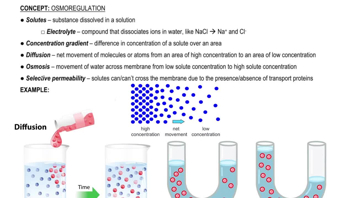
Electrolytes are substances that dissociate into ions when dissolved in water, allowing the solution to conduct electricity. Common examples include salts, acids, and bases. In the context of the question, sodium chloride (NaCl) is a strong electrolyte that fully dissociates into sodium (Na+) and chloride (Cl-) ions, enhancing the solution's ability to conduct electric current, while glucose does not dissociate into ions and therefore does not contribute to conductivity.
추천 영상:
가이드 코스
07:59
Osmosis and Osmolarity

Solute Concentration

Solute concentration refers to the amount of solute present in a given volume of solvent. In this experiment, the concentration of sodium chloride and glucose in the solutions affects their conductivity. A higher concentration of electrolytes typically results in greater conductivity, as more ions are available to carry the electric current. In contrast, distilled water, having no solutes, will not conduct electricity effectively.
추천 영상:
가이드 코스
04:51
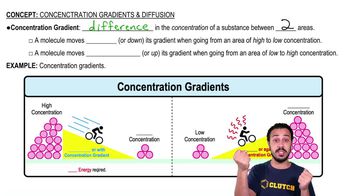
Concentration Gradients and Diffusion