Elise is a freshman college student taking Introduction to Biology. In lab, she is asked her parents' blood types to complete a Punnett square. She knows that she has type A blood and that her mother has type B, but she does not know her father's blood type. Elise's lab partner assures her that she can figure out her father's blood type just by knowing her own and her mother's. Is her lab partner correct? Explain why or why not.
Ch. 27 Development and Heredity
Amerman3rd EditionHuman Anatomy & PhysiologyISBN: 9780138247201, 9780138247928, 9780138201814당신이 사용하는 게 아니라요?교과서 변경
27장, 문제 19
________ are segments of DNA that code for a specific protein, and the human ________ includes over 20,000 of these segments.
검증된 단계별 안내1
Step 1: Understand the context of the question. The problem is asking about segments of DNA that code for specific proteins and the total collection of these segments in humans.
Step 2: Recall that DNA contains specific sequences that serve as instructions for building proteins. These sequences are known as 'genes.'
Step 3: Recognize that the complete set of genes in an organism is referred to as its 'genome.'
Step 4: Note that the human genome contains over 20,000 genes, which are responsible for coding the proteins necessary for various biological functions.
Step 5: Combine the information to understand that the blanks in the problem should be filled with 'genes' and 'genome,' respectively.

비슷한 문제에 대한 검증된 영상 답변:
이 영상 해법은 위 문제에 도움이 된다고 튜터들이 추천한 것입니다.
도움이 되었나요?
주요 개념
질문에 올바르게 답하기 위해 반드시 이해해야 하는 핵심 개념들은 다음과 같습니다.
Genes
Genes are segments of DNA that contain the instructions for synthesizing proteins. Each gene is responsible for producing a specific protein that plays a crucial role in the body's structure and function. In humans, genes are fundamental to heredity and influence traits and biological processes.
추천 영상:
가이드 코스
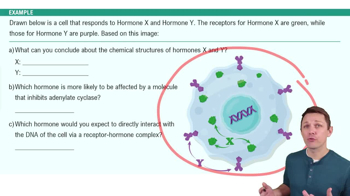
Intracellular Receptors and Direct Gene Action Example 1
Human Genome
The human genome is the complete set of genetic information for humans, consisting of over 20,000 genes. It encompasses all the DNA in an organism, including both coding regions (genes) and non-coding regions. Understanding the human genome is essential for studying genetics, evolution, and various diseases.
추천 영상:
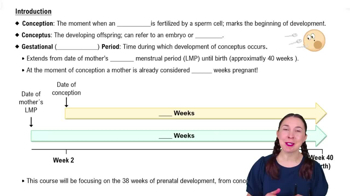
Introduction to Human Development
Proteins
Proteins are large, complex molecules made up of amino acids, and they perform a vast array of functions within living organisms. They are essential for the structure, function, and regulation of the body's tissues and organs. The specific sequence of amino acids in a protein is determined by the corresponding gene, linking genetics to biological function.
추천 영상:
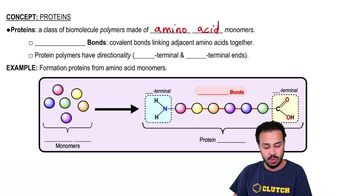
Proteins
관련 실천
교과서 질문
548
views
교과서 질문
Which pattern of inheritance includes examples of codominance?
a. Autosomal dominant and recessive traits
b. Multiple-allele traits
c. Sex-linked traits
d. Polygenic inheritance
555
views
교과서 질문
Certain diseases are transmitted via mitochondrial DNA. Which cell types do you think would be most affected by such diseases, and why?
595
views
교과서 질문
Determine the probability of a couple having a child with a widow's peak if the conditions are as follows: The gene for widow's peak follows strict autosomal dominant-recessive inheritance. Widow's peak (W) is dominant, and no widow's peak (w) is recessive. The genotype of the mother is Ww, and the genotype of the father is ww.
559
views
