
Ch. 3 The Cell
Amerman- Human Anatomy & Physiology 3e
Amerman3rd EditionHuman Anatomy & PhysiologyISBN: 9780138247201, 9780138247928, 9780138201814당신이 사용하는 게 아니라요?교과서 변경
3장, 문제 5b

Mark the following statements about the plasma membrane as true or false. If a statement is false, correct it to make a true statement.
Cholesterol provides the plasma membrane with stability in the face of changing ion concentrations.

검증된 단계별 안내
1
Understand the role of cholesterol in the plasma membrane: Cholesterol is a lipid molecule that is interspersed within the phospholipid bilayer of the plasma membrane. It provides structural stability and fluidity, especially in response to temperature changes, not ion concentrations.
Analyze the statement: The statement claims that cholesterol provides stability in the face of changing ion concentrations. This is incorrect because cholesterol's primary role is to maintain membrane fluidity and stability under varying temperatures, not ion concentration changes.
Correct the false statement: Rewrite the statement to reflect the correct role of cholesterol. The corrected statement should be: 'Cholesterol provides the plasma membrane with stability in the face of changing temperatures.'
Review the corrected statement: Ensure that the revised statement accurately reflects the function of cholesterol in the plasma membrane and aligns with established scientific understanding.
Conclude the evaluation: Mark the original statement as false and provide the corrected version for clarity and accuracy.

비슷한 문제에 대한 검증된 영상 답변:

이 영상 해법은 위 문제에 도움이 된다고 튜터들이 추천한 것입니다.
도움이 되었나요?

주요 개념

질문에 올바르게 답하기 위해 반드시 이해해야 하는 핵심 개념들은 다음과 같습니다.

Plasma Membrane Structure

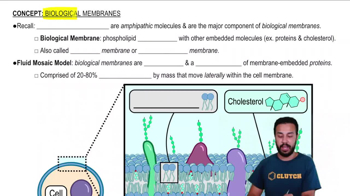
The plasma membrane is a phospholipid bilayer that surrounds and protects the cell, providing a barrier between the internal environment and the external surroundings. It contains various proteins, cholesterol, and carbohydrates that contribute to its fluidity and functionality, allowing selective permeability and communication with other cells.
추천 영상:
가이드 코스
06:49
Biological Membranes

Role of Cholesterol

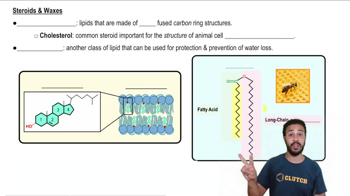
Cholesterol is a lipid molecule embedded within the phospholipid bilayer of the plasma membrane. It plays a crucial role in maintaining membrane fluidity and stability, particularly in varying temperature conditions, by preventing the fatty acid chains of phospholipids from packing too closely together.
추천 영상:
가이드 코스
03:31
Steroids & Waxes

Ion Concentration and Membrane Stability

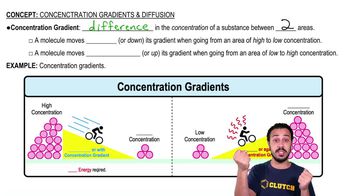
The stability of the plasma membrane in response to changing ion concentrations is essential for cellular function. While cholesterol helps maintain membrane integrity, it does not directly stabilize the membrane against changes in ion concentrations; rather, ion channels and pumps are responsible for regulating ion flow and maintaining homeostasis.
추천 영상:
가이드 코스
04:51
Concentration Gradients and Diffusion
관련 실천
교과서 질문

Mark the following statements about the plasma membrane as true or false. If a statement is false, correct it to make a true statement.

Integral membrane proteins generally span the width of the plasma membrane, whereas peripheral proteins are found on only one side of the membrane.

778
views
교과서 질문

Mark the following statements about the plasma membrane as true or false. If a statement is false, correct it to make a true statement.

Membrane proteins often function as channels or carriers.

666
views
교과서 질문

Mark the following statements about the plasma membrane as true or false. If a statement is false, correct it to make a true statement.

Membrane cholesterol is vital for cell-cell recognition.

601
views
교과서 질문

Mark the following statements about the plasma membrane as true or false. If a statement is false, correct it to make a true statement.

The overall structure of the plasma membrane is a mosaic with the components locked tightly in place.

564
views
교과서 질문

Which of the following best describes the arrangement of the main component of the plasma membrane?

a. A monolayer of phospholipids with the phosphate heads facing the cytosol and the fatty acid tails facing the extracellular fluid

b. A bilayer of phospholipids with the phosphate heads facing the cytosol and extracellular fluid, and the fatty acid tails facing one another

c. A bilayer of phospholipids with the phosphate heads of one layer facing the fatty acid tails of the other

d. A bilayer of phospholipids with a layer of triglycerides sandwiched in the middle

846
views
교과서 질문

Write a single sentence, using no more than 25 words, to summarize each of the following cellular processes:

Primary active transport

516
views