Ch. 3 The Cell
Amerman- Human Anatomy & Physiology 3e
Amerman3rd EditionHuman Anatomy & PhysiologyISBN: 9780138247201, 9780138247928, 9780138201814당신이 사용하는 게 아니라요?교과서 변경
3장, 문제 L2.1d

Write a single sentence, using no more than 25 words, to summarize each of the following cellular processes:
Secondary active transport

검증된 단계별 안내
1
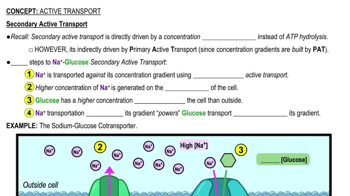
Understand the concept of secondary active transport: it uses the energy from the electrochemical gradient created by primary active transport to move substances across the membrane.
Identify the key components involved: primary active transport establishes the gradient, and secondary active transport utilizes it to move molecules like glucose or ions.
Focus on the mechanism: secondary active transport often involves symporters or antiporters that couple the movement of one substance with another.
Summarize the process in a concise sentence: Secondary active transport uses energy indirectly from a gradient to move molecules against their concentration gradient via carrier proteins.
Ensure the sentence is clear, accurate, and within the word limit, emphasizing the indirect energy use and the role of carrier proteins.

비슷한 문제에 대한 검증된 영상 답변:

이 영상 해법은 위 문제에 도움이 된다고 튜터들이 추천한 것입니다.
도움이 되었나요?

주요 개념

질문에 올바르게 답하기 위해 반드시 이해해야 하는 핵심 개념들은 다음과 같습니다.

Secondary Active Transport

Secondary active transport is a cellular process that moves ions or molecules against their concentration gradient by utilizing the energy from the movement of another substance, typically an ion, down its gradient.
추천 영상:
06:57
Secondary Active Transport

Concentration Gradient

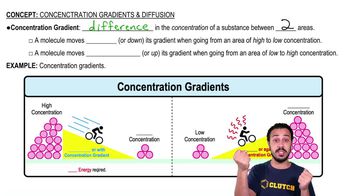
A concentration gradient refers to the difference in the concentration of a substance across a space or membrane, which drives the movement of substances from areas of higher concentration to areas of lower concentration.
추천 영상:
04:51
Concentration Gradients and Diffusion

Ion Coupling

Ion coupling in secondary active transport involves the simultaneous movement of one ion (often sodium or hydrogen) down its gradient, which provides the energy needed to transport another molecule against its gradient.
추천 영상:
01:55
Ions - Sodium and Potassium Example 3