Ch. 4 Histology
Amerman- Human Anatomy & Physiology 3e
Amerman3rd EditionHuman Anatomy & PhysiologyISBN: 9780138247201, 9780138247928, 9780138201814당신이 사용하는 게 아니라요?교과서 변경
4장, 문제 3d

Describe the roles of the following components of the ECM:
Proteoglycans

검증된 단계별 안내
1
Understand that the extracellular matrix (ECM) is a network of proteins and carbohydrates that provides structural and biochemical support to surrounding cells.
Recognize that proteoglycans are a major component of the ECM, consisting of a core protein to which glycosaminoglycan (GAG) chains are covalently attached. These GAG chains are long, unbranched polysaccharides with repeating disaccharide units.
Learn that proteoglycans contribute to the ECM's ability to resist compressive forces by attracting and retaining water due to the negative charges on their GAG chains. This creates a gel-like consistency in the ECM.
Understand that proteoglycans also play a role in cell signaling by binding to growth factors and cytokines, regulating their availability and activity in the cellular environment.
Recognize that proteoglycans help organize the ECM by interacting with other ECM components, such as collagen and elastin, to maintain tissue structure and integrity.

비슷한 문제에 대한 검증된 영상 답변:

이 영상 해법은 위 문제에 도움이 된다고 튜터들이 추천한 것입니다.

주요 개념

질문에 올바르게 답하기 위해 반드시 이해해야 하는 핵심 개념들은 다음과 같습니다.

Extracellular Matrix (ECM)

The extracellular matrix (ECM) is a complex network of proteins and carbohydrates that provides structural and biochemical support to surrounding cells. It plays a crucial role in tissue and organ function, influencing cell behavior, migration, and differentiation. The ECM is composed of various components, including fibrous proteins, glycoproteins, and proteoglycans, each contributing to its overall function and integrity.
추천 영상:
3:31
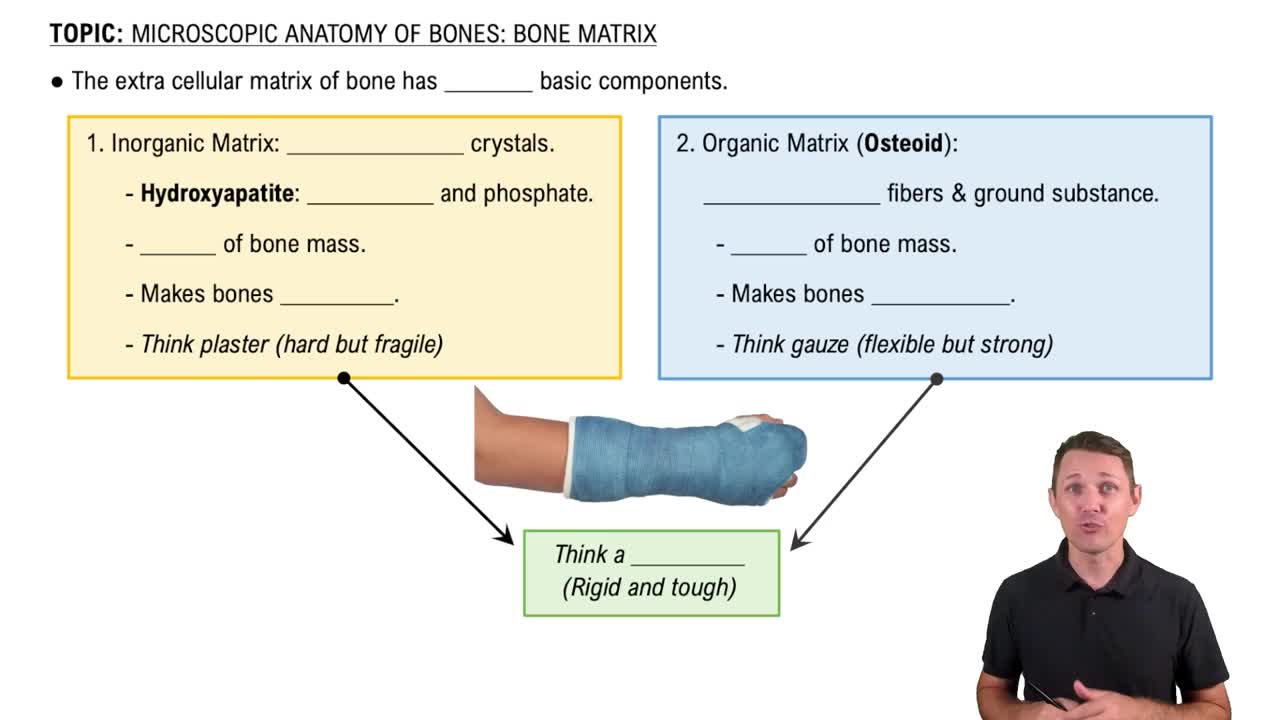
Bone Matrix

Proteoglycans

Proteoglycans are large molecules found in the ECM, consisting of a core protein with one or more glycosaminoglycan (GAG) chains attached. They are essential for maintaining the structural integrity of the ECM, providing hydration, and facilitating cell signaling. Proteoglycans help to regulate the movement of molecules through the ECM and play a significant role in cell adhesion and proliferation.

Cell Signaling

Cell signaling refers to the complex communication processes that govern cellular activities and coordinate responses to external stimuli. In the context of the ECM, proteoglycans can interact with growth factors and other signaling molecules, influencing cellular behavior such as growth, migration, and differentiation. This signaling is vital for tissue homeostasis and repair, highlighting the importance of proteoglycans in cellular communication.
추천 영상: