Ch. 6 Bones and Bone Tissue
Amerman- Human Anatomy & Physiology 3e
Amerman3rd EditionHuman Anatomy & PhysiologyISBN: 9780138247201, 9780138247928, 9780138201814당신이 사용하는 게 아니라요?교과서 변경
6장, 문제 6

The branching pieces of bone in spongy bone are called:


a. Lamellae
b. Lacunae
c. Osteoclasts
d. Trabeculae

검증된 단계별 안내
1
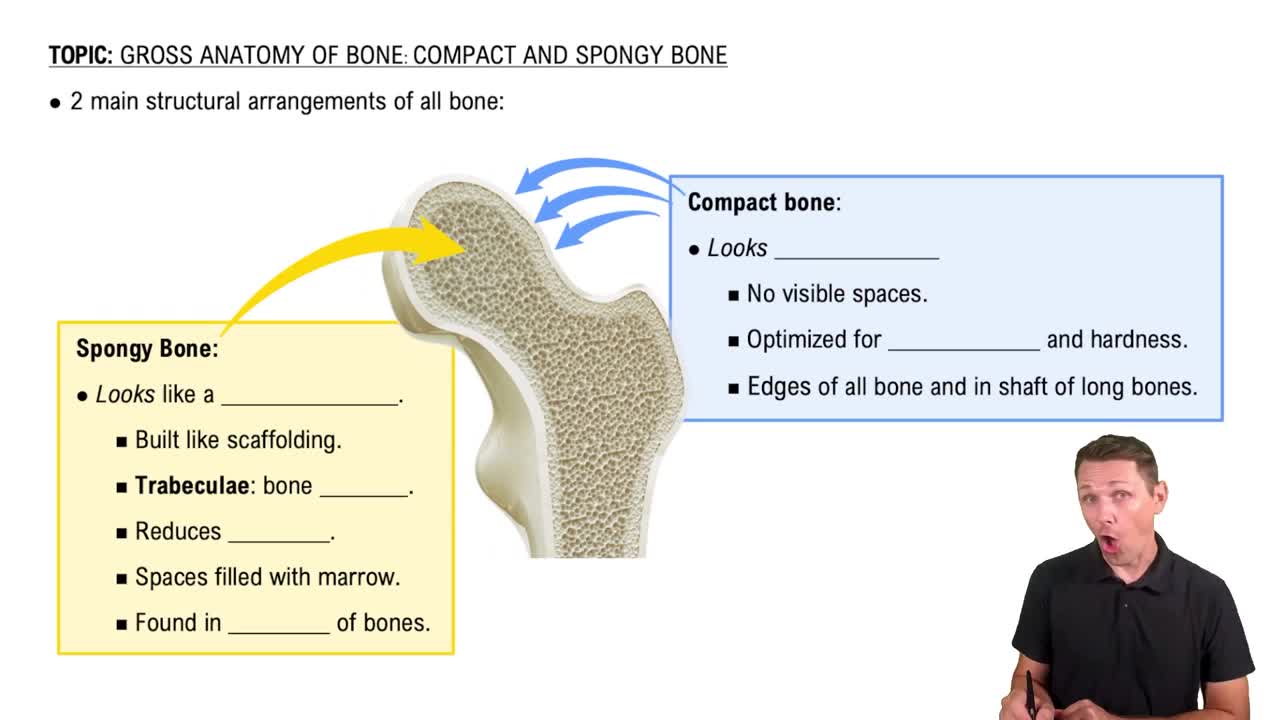
Step 1: Understand the structure of spongy bone. Spongy bone, also known as cancellous bone, is characterized by a porous, lattice-like structure that provides strength while reducing weight. This structure is made up of branching pieces of bone tissue.
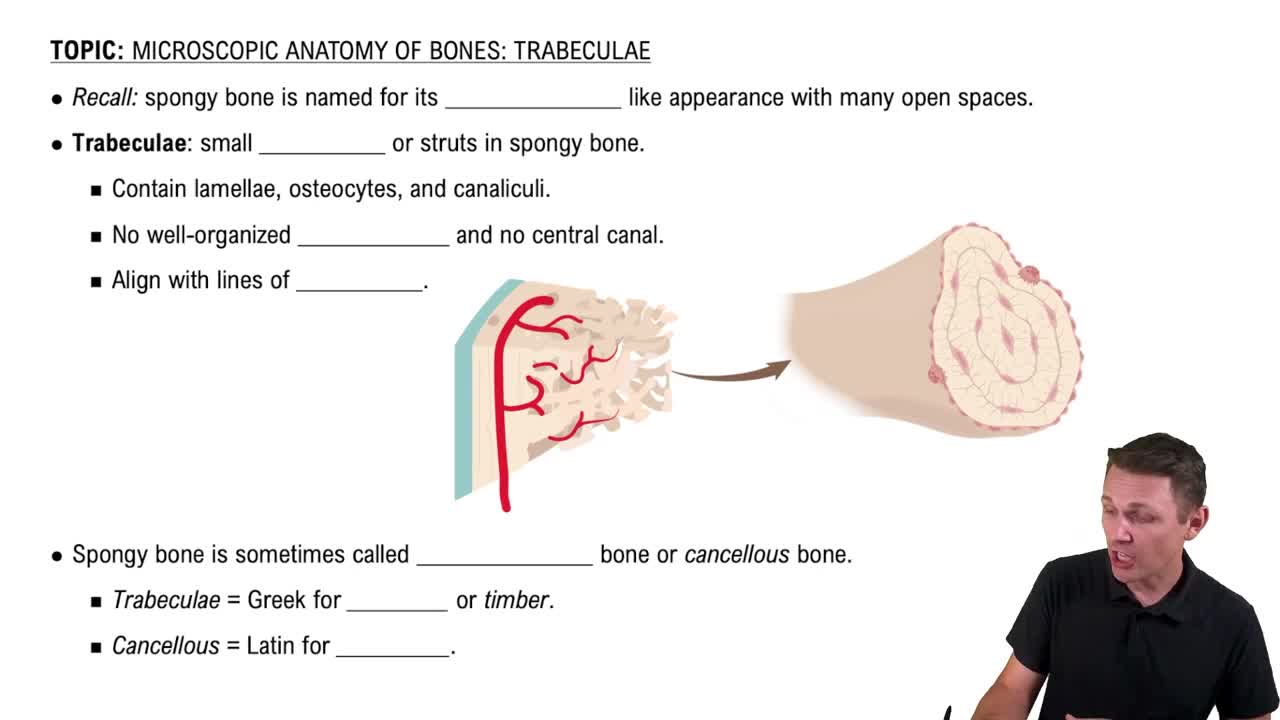
Step 2: Review the term 'trabeculae.' Trabeculae are the small, beam-like structures that form the lattice framework of spongy bone. They are aligned along lines of stress to provide structural support and house bone marrow.
Step 3: Differentiate trabeculae from other terms in the options. For example, 'lamellae' are concentric rings of bone matrix found in compact bone, not spongy bone. 'Lacunae' are small spaces that house osteocytes, and 'osteoclasts' are bone-resorbing cells, not structural components.
Step 4: Match the correct term to the description in the question. The branching pieces of bone in spongy bone are trabeculae, as they form the characteristic lattice structure.
Step 5: Confirm your understanding by visualizing or referencing a diagram of spongy bone to see how trabeculae contribute to its structure and function.

비슷한 문제에 대한 검증된 영상 답변:

이 영상 해법은 위 문제에 도움이 된다고 튜터들이 추천한 것입니다.
도움이 되었나요?

주요 개념

질문에 올바르게 답하기 위해 반드시 이해해야 하는 핵심 개념들은 다음과 같습니다.

Spongy Bone Structure

Spongy bone, also known as cancellous bone, is a type of bone tissue characterized by a porous, lattice-like structure. This architecture provides strength while minimizing weight, allowing for efficient support and flexibility. It is primarily found in the interior of bones and is crucial for the production of blood cells in the bone marrow.
추천 영상:
3:43
Compact and Spongy Bone

Trabeculae

Trabeculae are the small, rod-like or plate-like structures that form the framework of spongy bone. They create a network that supports the bone's overall structure and houses bone marrow. Trabeculae are essential for distributing stress and forces throughout the bone, enhancing its strength and resilience.
추천 영상:
4:06
Trabeculae

Bone Cells

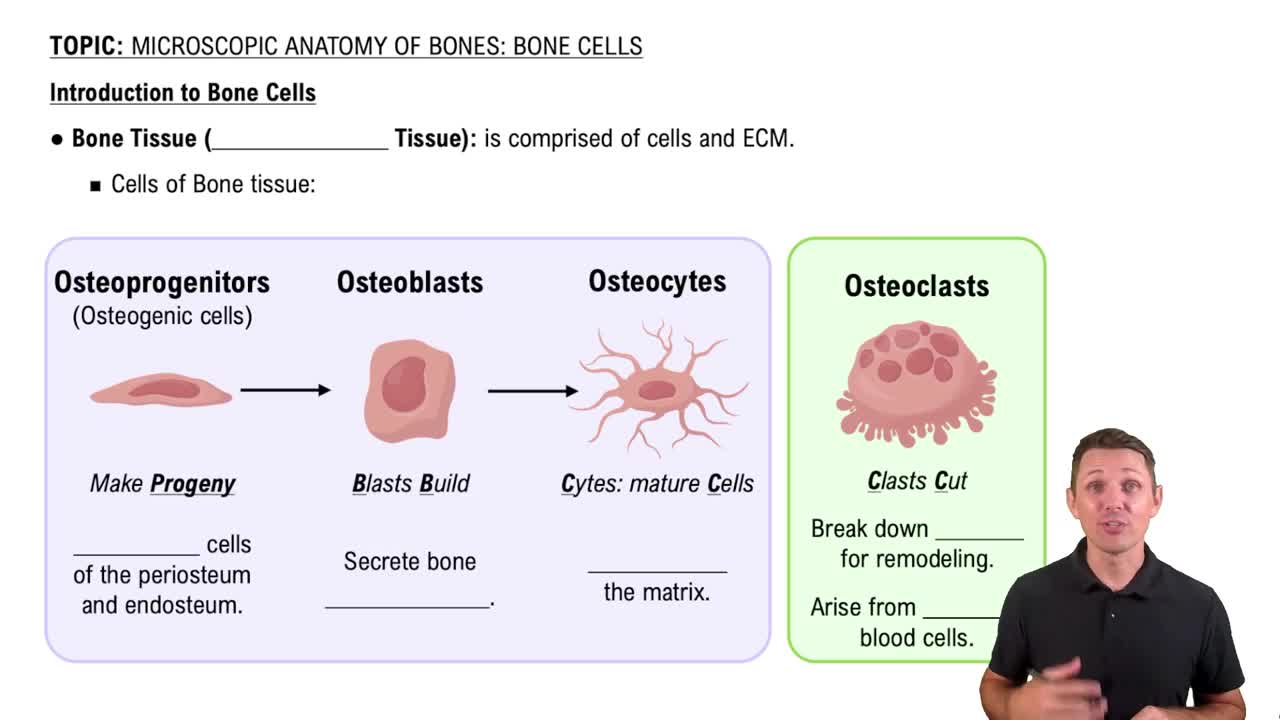
Bone cells, including osteoblasts, osteocytes, and osteoclasts, play vital roles in bone formation, maintenance, and resorption. Osteoblasts are responsible for building new bone, osteocytes maintain bone tissue, and osteoclasts break down bone. Understanding these cells is crucial for comprehending how bones adapt to stress and repair themselves.
추천 영상:
4:19
Introduction to Bone Cells
관련 실천
교과서 질문

Mark the following statements about bone tissue as true or false. If a statement is false, correct it to make a true statement.


e. Osteoblasts are responsible for bone resorption, and osteoclasts are responsible for bone deposition.

63
views

교과서 질문

What is the difference between a primary and secondary ossification center in a long bone?

1487
views
1
rank
교과서 질문

Which bones form via intramembranous ossification?


a. Irregular bones

b. Certain flat bones

c. Long bones

d. Short bones

e. More than one of the above

915
views
교과서 질문

The subunit of compact bone is the _____ . It consists of rings of bone matrix called ______that surround a structure called the______ that contains blood vessels and nerves. Other structures called _______also contain blood vessels and nerves. Osteocytes are housed in_____and communicate via_______.

779
views
교과서 질문

Mark the following statements about bone tissue as true or false. If a statement is false, correct it to make a true statement.


f. Osteocytes are mature and less active osteoblasts that have become surrounded by bone ECM.

706
views
교과서 질문

Of the following statements, identify those that are properties of intramembranous ossification, endochondral ossification, or both.

a. The bone is formed via a hyaline cartilage model.

b. Bone tissue forms from ossification centers.

c. Bone forms from within a mesenchyme membrane.

d. The early spongy bone is formed, after which the early compact bone develops.

e. The original primary bone is replaced with secondary bone.

f. A bone collar forms, followed by the early spongy bone.

791
views