Ch. 7 The Skeletal System
Amerman- Human Anatomy & Physiology 3e
Amerman3rd EditionHuman Anatomy & PhysiologyISBN: 9780138247201, 9780138247928, 9780138201814당신이 사용하는 게 아니라요?교과서 변경
7장, 문제 L2.1

How do the atlas (C1) and the axis (C2) differ from other cervical vertebrae? How does this difference enable them to perform their functions?

검증된 단계별 안내
1
The atlas (C1) is the first cervical vertebra and is unique because it lacks a vertebral body and spinous process. Instead, it consists of an anterior and posterior arch connected by lateral masses. This structure allows it to cradle the occipital condyles of the skull, enabling the nodding motion ('yes' movement).
The axis (C2) is the second cervical vertebra and is distinct due to the presence of the odontoid process (dens), a tooth-like projection that extends upward from its body. The dens acts as a pivot point for the atlas, allowing rotational movement ('no' movement).
Unlike other cervical vertebrae, the atlas and axis are specialized to support and articulate with the skull, facilitating a greater range of motion. Other cervical vertebrae have a more standard structure with a vertebral body, spinous process, and transverse processes designed for stability and protection of the spinal cord.
The articulation between the atlas and axis is called the atlanto-axial joint. This joint, along with the atlanto-occipital joint (between the atlas and the skull), allows for the unique movements of the head, such as rotation, flexion, and extension.
The structural differences of the atlas and axis are essential for their functions. The atlas provides a stable base for the skull, while the axis enables rotational movement. Together, they allow the head to move freely while maintaining support and protection for the spinal cord.

비슷한 문제에 대한 검증된 영상 답변:

이 영상 해법은 위 문제에 도움이 된다고 튜터들이 추천한 것입니다.
도움이 되었나요?

주요 개념

질문에 올바르게 답하기 위해 반드시 이해해야 하는 핵심 개념들은 다음과 같습니다.

Atlas (C1)

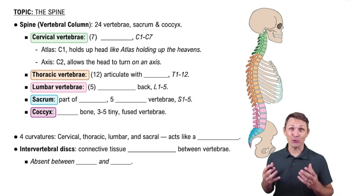
The atlas is the first cervical vertebra, uniquely designed to support the skull and facilitate nodding movements. Unlike other cervical vertebrae, it lacks a vertebral body and spinous process, allowing for a greater range of motion. Its ring-like structure enables it to articulate with the occipital condyles of the skull, providing stability and flexibility in head movements.
추천 영상:
가이드 코스
6:29
Spine (Vertebral Column)

Axis (C2)

The axis is the second cervical vertebra, characterized by the odontoid process (or dens), which protrudes upward and fits into the atlas. This structure allows for rotational movement of the head, distinguishing the axis from other cervical vertebrae. The unique pivot joint formed between the atlas and axis is crucial for actions such as shaking the head 'no'.
추천 영상:
가이드 코스
6:29
Spine (Vertebral Column)

Cervical Vertebrae Structure

Cervical vertebrae are generally characterized by their smaller size and unique features such as transverse foramina, which allow for the passage of vertebral arteries. Unlike the atlas and axis, the other cervical vertebrae have a more typical vertebral body and spinous processes, providing support and protection for the spinal cord while allowing for limited movement. This structural variation is essential for the overall function and mobility of the cervical spine.
추천 영상:
가이드 코스
6:29
Spine (Vertebral Column)