Ch. 8 Articulations
Amerman- Human Anatomy & Physiology 3e
Amerman3rd EditionHuman Anatomy & PhysiologyISBN: 9780138247201, 9780138247928, 9780138201814당신이 사용하는 게 아니라요?교과서 변경
8장, 문제 L2.1a

Explain how the structure of each of the following joint types follows its function.
Fibrous joint

검증된 단계별 안내
1
Understand the definition of a fibrous joint: Fibrous joints are connections between bones where the bones are held together by dense connective tissue, primarily collagen fibers. These joints are immovable or allow very limited movement.
Examine the structure of fibrous joints: The dense connective tissue in fibrous joints is designed to provide strength and stability. This structure ensures that the bones remain tightly bound together, which is essential for their function.
Relate the structure to the function: Fibrous joints are typically found in areas where movement is not required, such as the sutures of the skull. The immobility provided by the dense connective tissue protects vital organs (e.g., the brain) and maintains the integrity of the skeletal framework.
Identify examples of fibrous joints: Common examples include sutures in the skull, syndesmoses (e.g., the connection between the tibia and fibula), and gomphoses (e.g., the joint between teeth and their sockets). Each of these examples demonstrates how the structure supports the function of stability and minimal movement.
Summarize the relationship between structure and function: The structure of fibrous joints, with their dense connective tissue and lack of a joint cavity, is perfectly suited for their function of providing stability and protection in areas where movement is unnecessary or undesirable.

비슷한 문제에 대한 검증된 영상 답변:

이 영상 해법은 위 문제에 도움이 된다고 튜터들이 추천한 것입니다.
도움이 되었나요?

주요 개념

질문에 올바르게 답하기 위해 반드시 이해해야 하는 핵심 개념들은 다음과 같습니다.

Fibrous Joint Structure

Fibrous joints are characterized by dense connective tissue that holds the bones tightly together. This structure provides stability and strength, allowing little to no movement between the bones. Examples include sutures in the skull, where the rigid structure protects the brain and maintains the shape of the head.
추천 영상:
가이드 코스
03:36
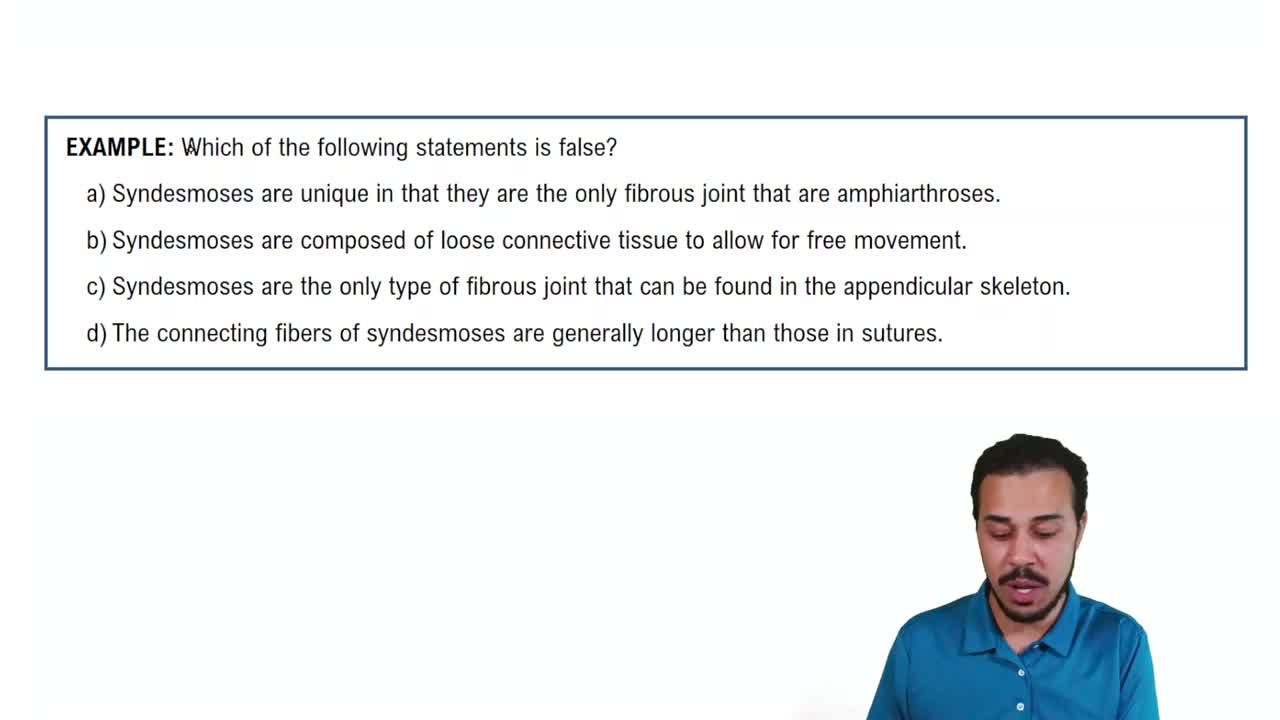
Structural Class: Fibrous Joints Example 3

Function of Fibrous Joints

The primary function of fibrous joints is to provide stability and support to the skeletal system. By limiting movement, these joints protect vital organs and maintain the integrity of the skeletal framework. Their immobility is crucial in areas where strength and protection are more important than flexibility.
추천 영상:
가이드 코스
02:41
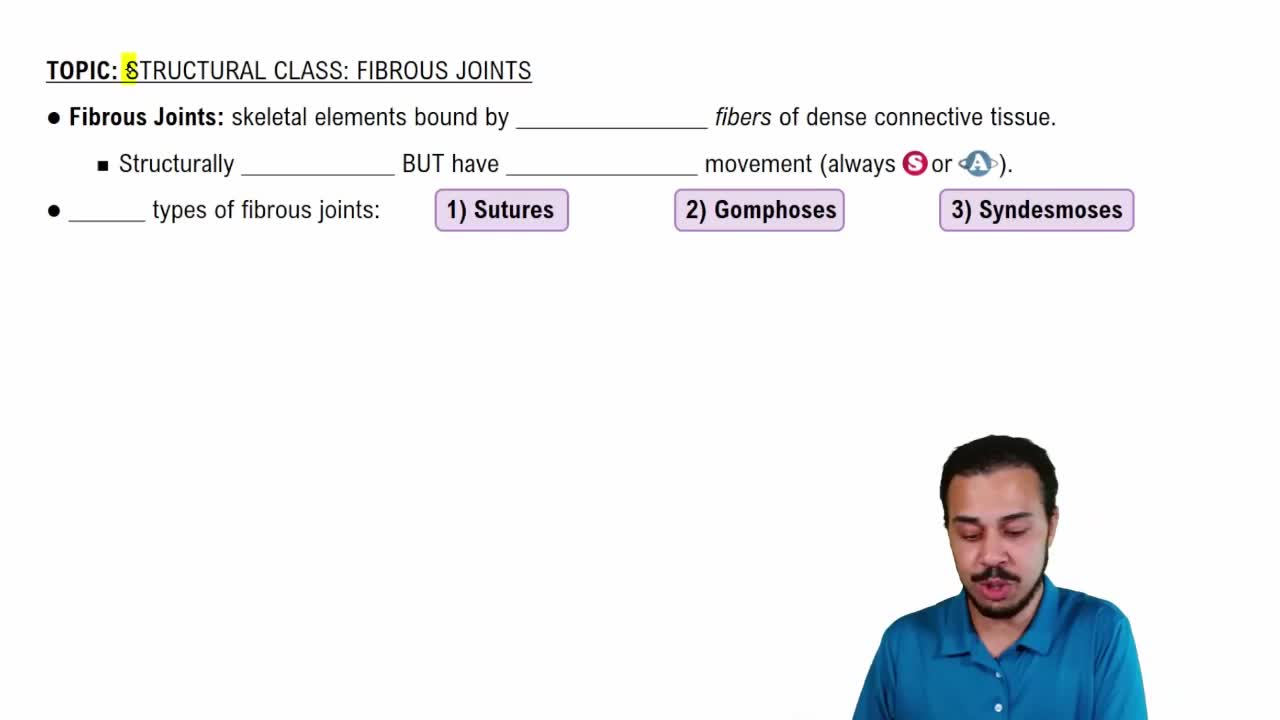
Introduction to Fibrous Joints

Types of Fibrous Joints

There are three main types of fibrous joints: sutures, syndesmoses, and gomphoses. Sutures are found in the skull, syndesmoses allow for slight movement (like the connection between the tibia and fibula), and gomphoses are the peg-and-socket joints found in teeth. Each type is structured to fulfill specific functional roles in the body.
추천 영상:
가이드 코스
02:41
Introduction to Fibrous Joints