
Ch. 8 Articulations
Amerman- Human Anatomy & Physiology 3e
Amerman3rd EditionHuman Anatomy & PhysiologyISBN: 9780138247201, 9780138247928, 9780138201814당신이 사용하는 게 아니라요?교과서 변경
8장, 문제 10

Match the following terms with the correct definition from the right column. 
Plane joint      
Saddle joint     
Ball-and-socket joint     
Condylar joint     
Pivot joint     
Hinge joint
a. Uniaxial joint in which the rounded articular surface of one bone fits into a groove of another bone and is held in place by a ligamentous ring
b. Multiaxial joint in which the spherical articular surface of one bone fits into a cup or socket of another bone
c. Nonaxial joint in which two flat surfaces glide over each other
d. Uniaxial joint in which the convex articular surface of one bone fits into a concave articular depression
e. Biaxial joint in which the oval, convex articulating surface of one bone fits into the shallow depression of another bone
f. Biaxial joint in which each articular surface has both convex and concave regions

검증된 단계별 안내
1
Step 1: Understand the definitions provided in the right column. Each definition describes the type of movement and structural characteristics of a specific joint type.
Step 2: Recall the anatomical features and movement capabilities of each joint type listed in the left column. For example, a plane joint allows gliding movements, while a ball-and-socket joint allows multiaxial movement.
Step 3: Match the term 'Plane joint' with the definition that describes a nonaxial joint where two flat surfaces glide over each other (definition c).
Step 4: Match the term 'Ball-and-socket joint' with the definition that describes a multiaxial joint where the spherical articular surface of one bone fits into a cup or socket of another bone (definition b).
Step 5: Continue matching each joint type (Saddle joint, Condylar joint, Pivot joint, Hinge joint) with the corresponding definition based on their movement capabilities and structural features. For example, a hinge joint is uniaxial and fits definition d.

비슷한 문제에 대한 검증된 영상 답변:

이 영상 해법은 위 문제에 도움이 된다고 튜터들이 추천한 것입니다.
도움이 되었나요?

주요 개념

질문에 올바르게 답하기 위해 반드시 이해해야 하는 핵심 개념들은 다음과 같습니다.

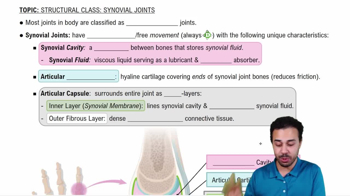
Types of Synovial Joints

Synovial joints are classified into several types based on their movement capabilities and the shapes of their articulating surfaces. These include plane, hinge, pivot, condylar, saddle, and ball-and-socket joints. Each type allows for different ranges of motion, from limited movement in plane joints to the extensive mobility found in ball-and-socket joints.
추천 영상:
8:20
Synovial Joints

Joint Movement and Axes

Understanding the axes of movement is crucial for classifying joints. Joints can be uniaxial (movement in one plane), biaxial (movement in two planes), or multiaxial (movement in multiple planes). This classification helps in identifying how each joint type functions and the specific movements it allows, such as flexion, extension, rotation, and gliding.
추천 영상:
05:39
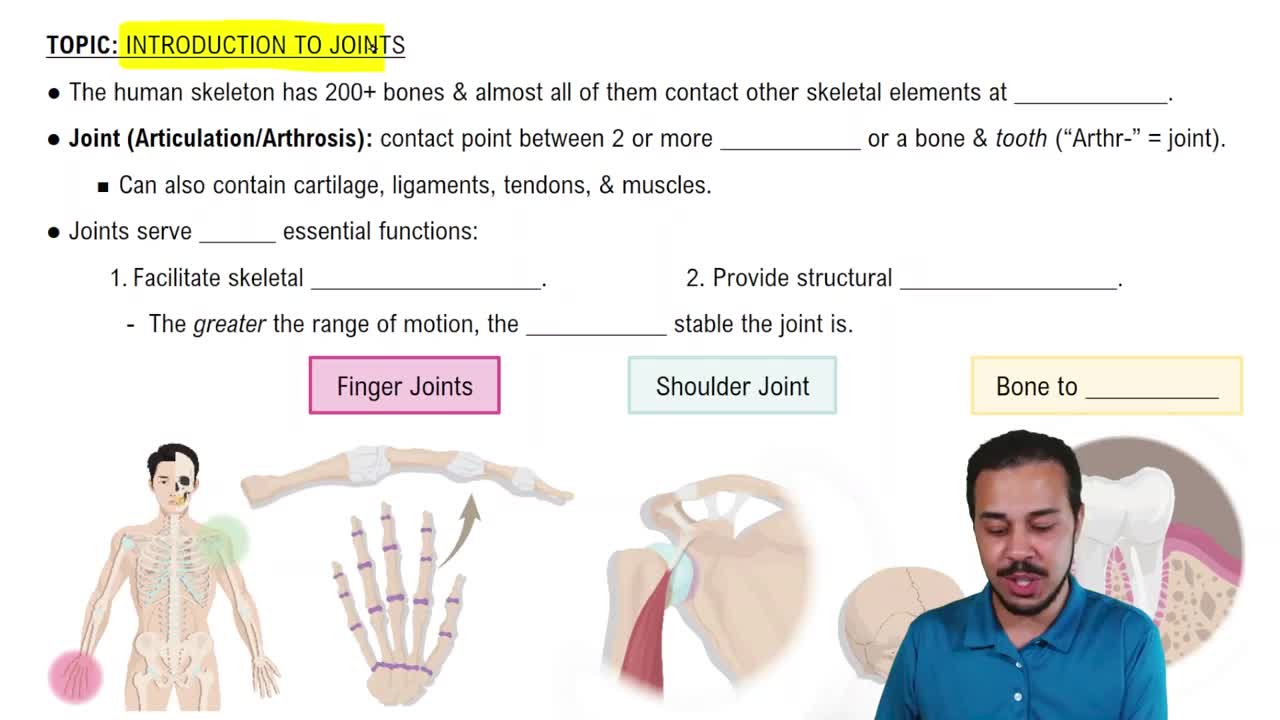
Introduction to Joints

Articular Surfaces and Stability

The shape and configuration of articular surfaces significantly influence joint stability and range of motion. For instance, ball-and-socket joints provide a wide range of motion due to their spherical shape, while hinge joints allow movement primarily in one direction. The fit between the surfaces, along with supporting ligaments and muscles, determines the joint's overall stability and functionality.
추천 영상:
4:05
Cell Surface Receptors