Ch. 10 The Muscular System
Marieb - Human Anatomy & Physiology 11th Edition
Marieb, Hoehn11th EditionHuman Anatomy & PhysiologyISBN: 9780136874034당신이 사용하는 게 아니라요?교과서 변경
10장, 문제 3

Match the muscle names in column B to the facial muscles described in column A.
Column A 
______ (1) squints the eyes 
______ (2) raises the eyebrows 
______ (3) smiling muscle 
______ (4) puckers the lips 
______ (5) pulls the scalp posteriorly
Column B
a. corrugator supercilii
b. depressor anguli oris
c. frontal belly of epicranius
d. occipital belly of epicranius
e. orbicularis oculi
f. orbicularis oris
g. zygomaticus

검증된 단계별 안내
1
Step 1: Identify the muscle responsible for squinting the eyes. The orbicularis oculi muscle encircles the eye and is primarily responsible for closing the eyelids tightly, which is what happens when you squint.
Step 2: Determine which muscle raises the eyebrows. The frontal belly of the epicranius (also called the frontalis) elevates the eyebrows and wrinkles the forehead.
Step 3: Find the muscle known as the 'smiling muscle.' The zygomaticus muscle pulls the corners of the mouth upward and outward, producing a smile.
Step 4: Identify the muscle that puckers the lips. The orbicularis oris muscle encircles the mouth and controls movements like puckering or pursing the lips.
Step 5: Match the muscle that pulls the scalp posteriorly. The occipital belly of the epicranius pulls the scalp backward, complementing the action of the frontal belly.

비슷한 문제에 대한 검증된 영상 답변:

이 영상 해법은 위 문제에 도움이 된다고 튜터들이 추천한 것입니다.
영상 길이:
2m

주요 개념

질문에 올바르게 답하기 위해 반드시 이해해야 하는 핵심 개념들은 다음과 같습니다.

Facial Muscle Functions

Understanding the specific actions of facial muscles is essential for matching their names to their functions. Each muscle controls distinct facial expressions, such as squinting, smiling, or puckering lips, by contracting in unique ways. Recognizing these functions helps in identifying the correct muscle based on the described movement.
추천 영상:
6:30
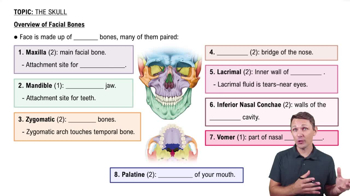
Overview of Facial Bones

Anatomical Location of Facial Muscles

Knowing where each facial muscle is located on the head aids in associating muscle names with their actions. For example, muscles around the eyes control eyelid movements, while those near the mouth influence expressions like smiling or puckering. This spatial awareness is crucial for accurate identification.
추천 영상:
3:55
Locations of Serous Membranes

Epicranius Muscle Structure and Roles

The epicranius muscle has two parts: the frontal belly, which raises the eyebrows, and the occipital belly, which pulls the scalp posteriorly. Understanding this dual structure clarifies how different sections of the same muscle contribute to distinct facial movements, important for matching descriptions to muscle names.
추천 영상:
3:04
Structure of a Skeletal Muscle Example 1