Ch. 12 The Central Nervous System
Marieb - Human Anatomy & Physiology 11th Edition
Marieb, Hoehn11th EditionHuman Anatomy & PhysiologyISBN: 9780136874034당신이 사용하는 게 아니라요?교과서 변경
12장, 문제 15

a. What is the advantage of having a cerebrum that is highly convoluted?
b. What term is used to indicate its grooves? Its outward folds?
c. Which groove divides the cerebrum into two hemispheres?
d. What divides the parietal from the frontal lobe? The parietal from the temporal lobe?

검증된 단계별 안내
1
a. Understand that the cerebrum's convolutions (folds) increase the surface area of the cerebral cortex, allowing for a greater number of neurons to be packed into the limited space of the skull. This enhances the brain's ability to process information and perform complex functions.
b. Identify the terminology for the cerebrum's surface features: the grooves or indentations are called 'sulci' (singular: sulcus), and the outward folds or raised areas are called 'gyri' (singular: gyrus).
c. Recognize the major groove that divides the cerebrum into the left and right hemispheres is the 'longitudinal fissure'. This deep groove separates the two halves of the brain.
d. Know the specific sulci that separate the lobes of the cerebrum: the 'central sulcus' divides the frontal lobe from the parietal lobe, and the 'lateral sulcus' (also called the Sylvian fissure) separates the parietal lobe from the temporal lobe.
Summarize these anatomical features to understand how the brain's structure relates to its function and organization.

비슷한 문제에 대한 검증된 영상 답변:

이 영상 해법은 위 문제에 도움이 된다고 튜터들이 추천한 것입니다.
영상 길이:
2m
도움이 되었나요?

주요 개념

질문에 올바르게 답하기 위해 반드시 이해해야 하는 핵심 개념들은 다음과 같습니다.

Cerebral Convolution and Surface Area

The cerebrum's convoluted surface increases its surface area, allowing for more neurons to be packed into the cortex. This enhances the brain's ability to process information, supporting complex functions like reasoning, memory, and sensory perception.
추천 영상:
4:49
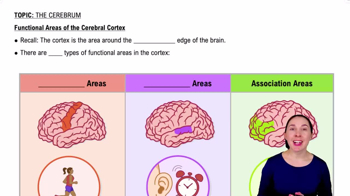
Functional Areas of the Cerebral Cortex

Gyri and Sulci

The grooves on the cerebrum are called sulci (singular: sulcus), and the outward folds are called gyri (singular: gyrus). These structures create the brain's characteristic wrinkled appearance and help organize the cerebral cortex into functional regions.
추천 영상:
0:43
The Cerebrum Example 2

Major Cerebral Fissures and Lobes

The longitudinal fissure divides the cerebrum into left and right hemispheres. The central sulcus separates the frontal lobe from the parietal lobe, while the lateral sulcus (Sylvian fissure) divides the parietal lobe from the temporal lobe, helping to define distinct brain regions.
추천 영상:
가이드 코스
2:31
Major Histocompatibility Complexes
관련 실천
교과서 질문

Explain how the cerebellum is physically connected to the brain stem.

1011
views
교과서 질문

Describe the stages of sleep and outline the order in which we progress through these stages during a typical night's sleep

732
views
교과서 질문

a. Make a rough drawing of the lateral aspect of the left cerebral hemisphere.

b. You may be thinking, 'But I just can't draw!' So, name the hemisphere involved with most people's ability to draw.

c. On your drawing, locate the following areas and provide the major function of each: primary motor cortex, premotor cortex, somatosensory association cortex, primary somatosensory cortex, visual and auditory areas, prefrontal cortex, Wernicke's and Broca's areas.

1234
views
교과서 질문

All of the following descriptions refer to dorsal column–medial lemniscal ascending pathways except one:

a. They include the fasciculus gracilis and fasciculus cuneatus.

b. They include a chain of three neurons.

c. Their connections are diffuse and poorly localized.

d. They are concerned with precise transmission of one or a few related types of sensory input.

749
views
교과서 질문

A number of brain structures are listed below. If an area is primarily gray matter, write a in the answer blank; if mostly white matter, respond with b

________  (1) cerebral cortex 

________   (2) corpus callosum and corona radiata 

________   (3) red nucleus 

________   (4) medial and lateral nuclear groups 

________   (5) medial lemniscus 

________   (6) cranial nerve nuclei 

________   (7) spinothalamic tract 

________   (8) fornix 

________  (9) cingulate and precentral gyri

938
views
교과서 질문

A patient has suffered a cerebral hemorrhage that has caused dysfunction of the precentral gyrus of his right cerebral cortex. As a result:

a. He cannot voluntarily move his left arm or leg.

b. He feels no sensation on the left side of his body.

c. He feels no sensation on his right side.

851
views