Ch. 14 The Autonomic Nervous System
Marieb - Human Anatomy & Physiology 11th Edition
Marieb, Hoehn11th EditionHuman Anatomy & PhysiologyISBN: 9780136874034당신이 사용하는 게 아니라요?교과서 변경
14장, 문제 9

Indicate the results of sympathetic activation of the following structures: sweat glands, eye pupils, adrenal medullae, heart, bronchioles of the lungs, liver, blood vessels of vigorously working skeletal muscles, blood vessels of digestive viscera, salivary glands.

검증된 단계별 안내
1
Understand that sympathetic activation is part of the 'fight or flight' response, which prepares the body for rapid action by altering the function of various organs and tissues.
For sweat glands, recognize that sympathetic activation typically increases sweat production to help cool the body during stress or exertion.
For the eye pupils, note that sympathetic activation causes pupil dilation (mydriasis) to allow more light into the eye, improving vision in low-light or stressful situations.
For the adrenal medullae, understand that sympathetic stimulation triggers the release of catecholamines (epinephrine and norepinephrine) into the bloodstream, amplifying the fight or flight response.
For the heart, bronchioles of the lungs, liver, blood vessels of skeletal muscles, blood vessels of digestive viscera, and salivary glands, analyze how sympathetic activation affects each: it increases heart rate and force of contraction, dilates bronchioles to improve airflow, promotes glycogen breakdown in the liver to increase blood glucose, dilates blood vessels in skeletal muscles to enhance blood flow, constricts blood vessels in digestive organs to reduce blood flow there, and modifies salivary gland secretion to produce a thicker, enzyme-rich saliva.

비슷한 문제에 대한 검증된 영상 답변:

이 영상 해법은 위 문제에 도움이 된다고 튜터들이 추천한 것입니다.
영상 길이:
1m

주요 개념

질문에 올바르게 답하기 위해 반드시 이해해야 하는 핵심 개념들은 다음과 같습니다.

Sympathetic Nervous System Activation

The sympathetic nervous system is part of the autonomic nervous system responsible for the 'fight or flight' response. Activation prepares the body for stressful situations by increasing heart rate, dilating pupils, and redirecting blood flow to essential organs. Understanding its general effects helps explain changes in various organs during sympathetic stimulation.
추천 영상:
1:20
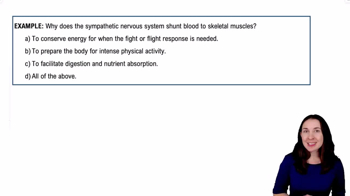
Sympathetic Nervous System Example 1

Organ-Specific Responses to Sympathetic Stimulation

Different organs respond uniquely to sympathetic activation based on receptor types and functions. For example, sweat glands increase secretion, pupils dilate, and bronchioles expand. Recognizing these specific responses is crucial to accurately describe the physiological changes in each listed structure.
추천 영상:
4:04
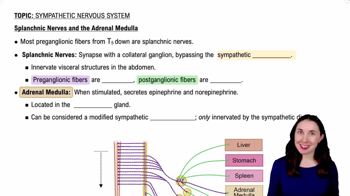
Splanchnic Nerves and the Adrenal Medulla

Adrenergic Receptors and Their Role

Adrenergic receptors (alpha and beta) mediate the effects of norepinephrine and epinephrine released during sympathetic activation. Their distribution in tissues like the heart, blood vessels, and liver determines the nature of the response, such as vasodilation or vasoconstriction, increased heart contractility, or glycogen breakdown.
추천 영상:
2:47
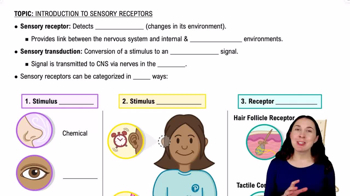
Sensory Receptors