Mary Morgan has just been brought into the emergency room of City General Hospital. She is perspiring profusely and is breathing rapidly and irregularly. Her breath smells like acetone (sweet and fruity), and her blood glucose tests out at 650 mg/100 ml of blood. She is in acidosis. Which hormone drug should be administered, and why?
Ch. 16 The Endocrine System

16장, 문제 21
Name two endocrine glands (or regions) that are important in the stress response, and explain why they are important.
검증된 단계별 안내1
Identify the two main endocrine glands involved in the stress response: the hypothalamus-pituitary-adrenal (HPA) axis and the adrenal medulla.
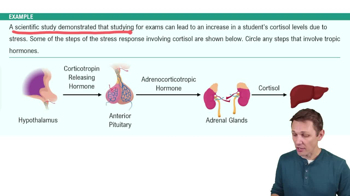
Explain the role of the hypothalamus and pituitary gland: the hypothalamus releases corticotropin-releasing hormone (CRH), which stimulates the pituitary gland to secrete adrenocorticotropic hormone (ACTH).
Describe how ACTH acts on the adrenal cortex (part of the adrenal glands) to release cortisol, a hormone that helps the body manage stress by increasing glucose availability and suppressing non-essential functions.
Explain the role of the adrenal medulla in the stress response: it secretes catecholamines (epinephrine and norepinephrine), which prepare the body for 'fight or flight' by increasing heart rate, blood pressure, and energy supply.
Summarize why these glands are important: they coordinate hormonal responses that enable the body to adapt to and cope with stress through metabolic, cardiovascular, and immune system effects.

비슷한 문제에 대한 검증된 영상 답변:
이 영상 해법은 위 문제에 도움이 된다고 튜터들이 추천한 것입니다.
영상 길이:
2m도움이 되었나요?
주요 개념
질문에 올바르게 답하기 위해 반드시 이해해야 하는 핵심 개념들은 다음과 같습니다.
Hypothalamus-Pituitary-Adrenal (HPA) Axis
The HPA axis is a central stress response system involving the hypothalamus, pituitary gland, and adrenal glands. It regulates the release of cortisol, a hormone critical for managing stress by increasing energy availability and modulating immune responses.
추천 영상:
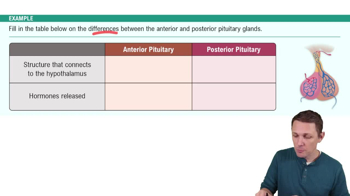
The Hypothalamus and Pituitary Gland Example 3
Adrenal Glands
The adrenal glands produce key stress hormones such as cortisol and adrenaline. Cortisol helps sustain prolonged stress responses, while adrenaline triggers immediate 'fight or flight' reactions, increasing heart rate and energy supply.
추천 영상:
The Hypothalamus and Pituitary Gland Example 1
Pituitary Gland
The pituitary gland acts as a master regulator by releasing adrenocorticotropic hormone (ACTH) in response to hypothalamic signals. ACTH stimulates the adrenal glands to produce cortisol, thus playing a crucial role in coordinating the body's hormonal stress response.
추천 영상:
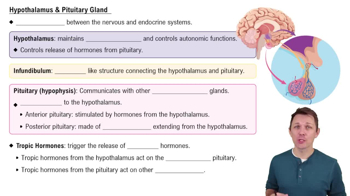
Hypothalamus & Pituitary Gland
관련 실천
교과서 질문
887
views
교과서 질문
The posterior pituitary is not really an endocrine gland. Why not? What is it?
936
views
교과서 질문
Roger Proulx has severe arthritis and has been taking prednisone (a glucocorticoid) for two months. He isn't feeling well, complains of repeated 'colds,' and is extremely 'puffy' (edematous). Explain the reason for these symptoms.
858
views
교과서 질문
Which type of hormone receptor—plasma membrane bound or intracellular—would be expected to provide the most long-lived response to hormone binding and why?
1568
views
교과서 질문
How are the hyperglycemia and lipidemia of insulin deficiency linked?
961
views
교과서 질문
List some problems that elderly people might have as a result of decreasing hormone production.
1234
views
